Startup India at 10: A Decade of Disruption and the Founders Who Shaped the Ecosystem

In January 2016, Prime Minister Narendra Modi launched the Startup India initiative from the ramparts of Vigyan Bhavan in New Delhi, announcing a suite of policy measures aimed at fostering innovation and entrepreneurship across the country. Ten years later, in 2026, the initiative’s anniversary offers a natural moment to assess what has changed—and what hasn’t—in India’s startup ecosystem. The numbers are impressive: from fewer than 500 recognised startups in 2016 to over 140,000 in 2026, from a handful of unicorns to over 115, and from a nascent venture capital market to one that attracts over $10 billion annually. But the story of Startup India is richer and more complicated than these headline figures suggest.
The Inflection Points
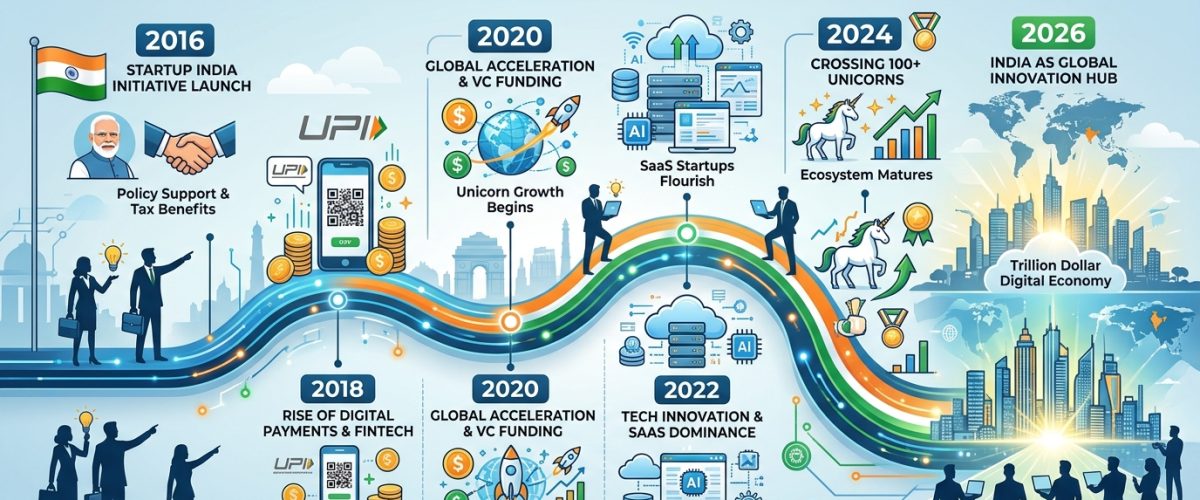
The first decade of Startup India can be understood through a series of inflection points—moments that fundamentally altered the trajectory of the ecosystem.
2016-2017: Policy Foundation. The initial Startup India action plan introduced self-certification for labour and environment compliance, tax exemptions for startups under Section 80-IAC of the Income Tax Act, and the establishment of a ₹10,000 crore Fund of Funds operated through SIDBI. While the immediate impact of these measures was modest, they sent a powerful signal that the Indian government viewed startups as a national priority.
Also read: IPL 2026 Season Preview: Key Transfers, Injuries, and Franchise Strategies
Also read: AI Summit 2026: India Showcases Ambitions but Structural Gaps Exposed
2018-2019: The UPI Revolution. The exponential growth of the Unified Payments Interface (UPI) transformed India’s fintech landscape and created the digital payments infrastructure that countless startups depend on. Monthly UPI transactions grew from 178 million in January 2018 to 1.3 billion by December 2019, providing startups across sectors—from food delivery to e-commerce—with a frictionless payment layer that dramatically reduced transaction costs.
2020-2021: The Pandemic Inflection. COVID-19 accelerated digital adoption across every segment of Indian society, compressing five years of expected digital transformation into 18 months. Edtech, telemedicine, e-commerce, and remote work tools experienced exponential growth, and venture capital poured into Indian startups at unprecedented volumes—$38 billion across 2021 alone, according to PitchBook data.
2022-2024: The Correction. The global interest rate tightening cycle that began in 2022 triggered a severe funding winter in India’s startup ecosystem. Capital dried up, valuations crashed, and thousands of startups laid off employees or shut down entirely. High-profile struggles at Byju’s, OYO, and other celebrated startups shattered the narrative of invincibility that had built up during the boom years.
2025-2026: The Maturation. The current phase is defined by a return to fundamentals—profitability, unit economics, and sustainable growth. The startups that survived the correction are stronger, more disciplined, and more focused on building lasting businesses. The ecosystem has, in a sense, grown up.
The Founders Who Shaped the Decade
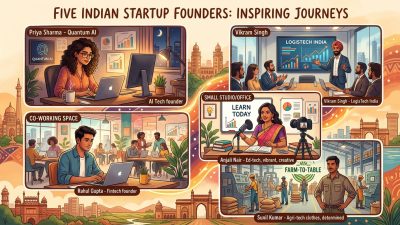
Behind these inflection points are individual founders whose decisions and creations gave the ecosystem its character. Bhavish Aggarwal’s Ola didn’t just build a ride-hailing company—it proved that Indian startups could compete with global giants like Uber on their own turf. Vijay Shekhar Sharma’s Paytm rode the demonetisation wave to become synonymous with digital payments in India, even as its later trajectory illustrated the challenges of transitioning from growth to profitability.
Kunal Shah (CRED) demonstrated that brand and community could be powerful moats in the fintech space. Ritesh Agarwal (OYO) showed that India’s broken hospitality infrastructure could be fixed through technology and standardisation, even as his company’s aggressive expansion led to well-documented growing pains. And newer founders like Aadit Palicha (Zepto), Alakh Pandey (PhysicsWallah), and Srivatsan Venkatesan (Jar, a micro-savings app) are writing the next chapter with a pragmatism shaped by the lessons of the boom and bust.
What Startup India Got Right
Looking back, the Startup India initiative’s most lasting contributions are structural rather than financial. The creation of a formal DPIIT recognition process for startups, the establishment of the Fund of Funds (which has catalysed over ₹80,000 crore in downstream investments), and the simplification of compliance requirements for early-stage companies have collectively lowered the barriers to starting a business in India.
The initiative also normalised entrepreneurship as a career path. In 2016, leaving a stable corporate job to start a company was considered risky and unconventional. In 2026, it is a mainstream aspiration. IITs, IIMs, and other premier institutions report that entrepreneurship is now among the top three career choices for graduating students—a cultural shift that may be Startup India’s most significant legacy.
What Remains Unfinished
Despite the progress, significant gaps remain. The geographic concentration of startups in a handful of cities—Bangalore, Delhi-NCR, and Mumbai account for over 65 per cent of all startup activity—has not meaningfully changed over the decade. Women-founded startups receive less than 5 per cent of total venture funding, a persistent inequity that the ecosystem has failed to address. And the regulatory environment, while improved, still imposes burdens on startups through complex GST compliance, angel tax provisions, and inconsistent enforcement of online gaming and e-commerce regulations.
The deepest challenge, however, is employment creation. While India’s startup ecosystem is celebrated for producing unicorns and attracting capital, its direct employment footprint remains modest relative to the country’s needs. An estimated 1.5 million people work in startups—a meaningful number but a fraction of the 12-15 million new jobs India needs to create annually. For Startup India to fulfil its ultimate promise, the next decade must focus not just on producing billion-dollar companies but on creating millions of quality jobs that can absorb India’s demographic dividend.
The Next Decade
As Startup India enters its second decade, the ecosystem’s foundations are stronger than ever. The capital markets are deep, the talent pool is large, the digital infrastructure is world-class, and the policy environment is broadly supportive. What the next decade requires is depth—more startups in agriculture, manufacturing, and climate technology; more founders from Tier 2 and Tier 3 cities; more companies that create mass employment; and more exits that return capital to the ecosystem and fund the next generation. The first decade built the stage. The second decade must deliver the performance.

- Startup India at 10: A Decade of Disruption and the Founders Who Shaped the Ecosystem - March 24, 2026
- From Side Hustles to Success: Five Indian Founders Who Turned Adversity Into Billion-Dollar Ventures - March 24, 2026
- Healthtech Funding Shifts Toward Integrated Care Models as Investors Eye Sustainable Growth in India - March 24, 2026