India’s Healthtech Revolution: Telemedicine Adoption Surges as Practo and Tata Health Scale Rural Access

India’s healthcare system, long characterised by a stark urban-rural divide, is undergoing a quiet digital revolution in 2026. Telemedicine adoption has surged to new heights, driven by improved internet connectivity, government policy support, and the scaling efforts of leading healthtech platforms like Practo, Tata Health, and Apollo 24/7. According to the Telemedicine Society of India, the country recorded over 180 million telemedicine consultations in 2025, a figure that is projected to reach 250 million in 2026. For millions of Indians in rural and semi-urban areas, where the doctor-to-patient ratio can be as low as 1:25,000, telemedicine is not a convenience—it is a necessity that is finally being met.
Practo’s Rural Expansion
Practo, India’s largest digital health platform with over 35 million monthly active users, has been at the forefront of the telemedicine expansion. Founded in 2008 by Shashank ND and Abhinav Lal, the platform originally served as a doctor discovery and appointment booking tool. Over the past three years, it has evolved into a comprehensive health ecosystem offering teleconsultations, electronic health records, medicine delivery, and diagnostic test booking.
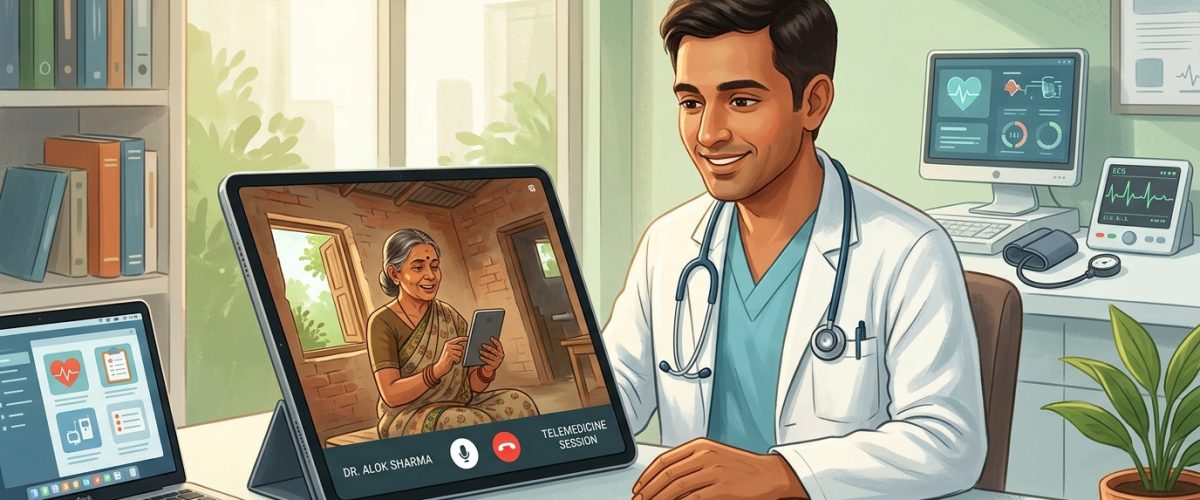
In 2026, Practo has launched a dedicated rural health initiative called “Practo Access,” designed specifically for users in areas with limited healthcare infrastructure. The initiative includes partnerships with over 5,000 Common Service Centres (CSCs)—government-supported digital kiosks in rural villages—where trained operators help patients connect with doctors via video consultation. The service is available in 8 Indian languages and charges consultation fees starting at ₹99, a fraction of the cost of travelling to a city hospital.
Also read: IPL 2026 Season Preview: Key Transfers, Injuries, and Franchise Strategies
Also read: AI Summit 2026: India Showcases Ambitions but Structural Gaps Exposed
Practo CEO Shashank ND described the initiative at the Healthcare Innovation Summit in Delhi: “India has 1.1 million AYUSH practitioners and 1.4 million allopathic doctors for 1.4 billion people. We cannot build enough hospitals to close this gap. Digital health is the only scalable solution, and our job is to make it accessible to the last mile.”
Tata Health: Corporate Muscle Meets Digital Innovation
Tata Health, the digital health arm of the Tata Group, has emerged as a major player in India’s healthtech landscape by leveraging the conglomerate’s vast distribution network and brand trust. Launched in 2020, the platform offers teleconsultations, chronic disease management programmes, mental health counselling, and corporate wellness solutions.
What distinguishes Tata Health from other telemedicine platforms is its integration with the broader Tata ecosystem. Partnerships with Tata Hospitals (which include the venerable Tata Memorial Hospital for cancer care), Tata Motors’ employee health programmes, and Tata Consumer Products’ health-focused brands create a holistic health ecosystem that spans prevention, treatment, and wellness. In 2026, Tata Health has expanded its presence to 450 districts across India and claims over 10 million registered users.
Tata Health’s chronic disease management platform is particularly noteworthy. Given that India is home to over 77 million diabetics and 200 million hypertension patients, the platform’s AI-driven monitoring system—which tracks blood sugar, blood pressure, and medication adherence through connected devices and smartphone apps—addresses a critical and underserved need. Early data suggests that patients on the platform achieve 35 per cent better medication adherence and 20 per cent fewer emergency hospital visits compared to those receiving traditional care.
Government Policy: ABDM as the Backbone
The government’s Ayushman Bharat Digital Mission (ABDM), launched in 2021, is providing the digital infrastructure that underpins the telemedicine expansion. The mission has issued over 620 million Ayushman Bharat Health Account (ABHA) IDs—unique digital health identifiers that enable the creation of longitudinal electronic health records accessible across providers and platforms.
For telemedicine providers, ABDM integration means that a doctor conducting a teleconsultation can access a patient’s previous medical records, lab results, and prescriptions—even if those records were created at a different hospital or clinic. This interoperability dramatically improves the quality of remote consultations and reduces the risk of duplicate testing or drug interactions.
The government has also extended the Telemedicine Practice Guidelines, originally issued as an emergency measure during COVID-19, into a permanent regulatory framework. The guidelines allow registered medical practitioners to conduct consultations via video, audio, and text; prescribe medications remotely; and issue digital prescriptions that are accepted at pharmacies nationwide.
Challenges: Connectivity, Trust, and Quality
Despite the progress, India’s telemedicine expansion faces persistent challenges. Internet connectivity in rural India, while improving, remains inconsistent. According to TRAI data, average mobile broadband speeds in rural areas are 40 per cent lower than in urban areas, and video consultations—which are clinically preferable to audio-only calls—require stable connections that are not always available.
Trust is another barrier. Many patients, particularly older adults in rural areas, are sceptical of receiving medical advice through a screen. The lack of physical examination capability in telemedicine means that certain conditions cannot be reliably diagnosed remotely, and patients who have had unsatisfactory telemedicine experiences may revert to in-person visits even when the digital option is available.
Quality assurance is also a concern. As the number of telemedicine platforms has multiplied, so have reports of unqualified practitioners, superficial consultations, and inappropriate prescribing. Regulatory bodies, including the National Medical Commission (NMC), are working to enforce quality standards, but oversight of the rapidly growing digital health ecosystem remains a work in progress.
The Path Forward
India’s telemedicine revolution is real but unfinished. The technology exists, the regulatory framework is in place, and the demand from underserved populations is overwhelming. What remains is the hard work of execution—improving connectivity, building patient trust, ensuring clinical quality, and integrating telemedicine into the broader healthcare delivery system rather than treating it as a standalone service. If the current trajectory holds, telemedicine could well become the defining healthcare innovation of India’s first half of the 21st century.

- Startup India at 10: A Decade of Disruption and the Founders Who Shaped the Ecosystem - March 24, 2026
- From Side Hustles to Success: Five Indian Founders Who Turned Adversity Into Billion-Dollar Ventures - March 24, 2026
- Healthtech Funding Shifts Toward Integrated Care Models as Investors Eye Sustainable Growth in India - March 24, 2026