Credit Line on UPI Is Reshaping How India Borrows as Banks Race to Scale CLOU in 2026

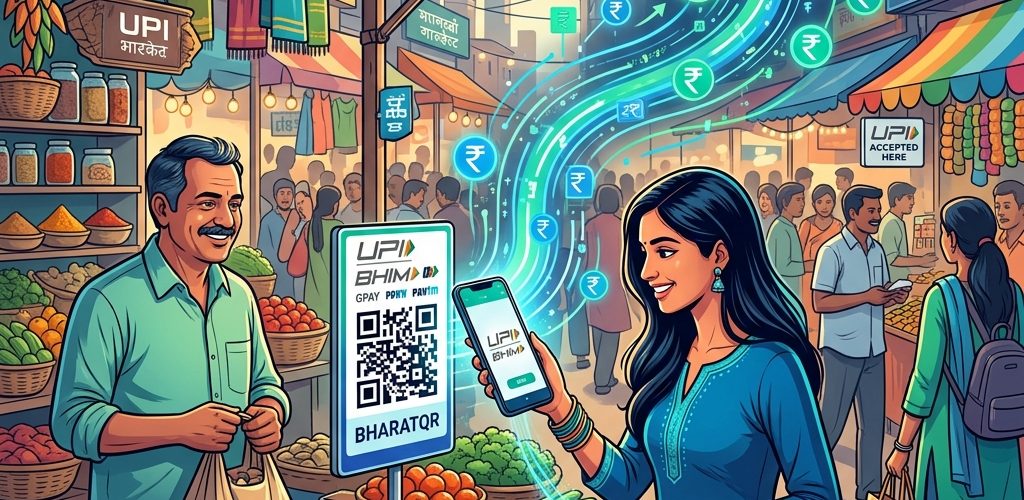
India’s Unified Payments Interface has quietly evolved from a peer-to-peer payment tool into the country’s primary credit delivery rail. The Credit Line on UPI, known as CLOU, is an RBI-approved feature that allows banks to extend pre-sanctioned credit lines directly through the UPI ecosystem that processed 228.5 billion transactions in calendar year 2025 — a 33 per cent increase over 2024.
The feature, first announced by the RBI in April 2023 and expanded to Small Finance Banks through a circular in February 2025, enables customers to make purchases using a bank-issued credit line linked to their UPI app. The experience is identical to a normal UPI scan-and-pay transaction, but the money comes from a pre-approved credit facility rather than a savings account.
How CLOU Works and Why It Matters
Under CLOU, a scheduled commercial bank pre-sanctions a credit line for an individual customer based on the bank’s board-approved policy. The customer can then link this credit line to their UPI application — be it PhonePe, Google Pay or any other UPI-enabled app — with prior consent. When the customer scans a QR code at a kirana shop, pharmacy, auto stand or any other merchant, the transaction draws from the credit line rather than a bank balance.
The terms, including the credit limit, period of credit and rate of interest, are set by the issuing bank. Repayment pathways are flexible, and the entire flow runs within the existing UPI infrastructure that over 350 million Indians already use daily. This means there is no new app to download, no separate onboarding process and no physical card to carry.
The product addresses a fundamental gap in India’s financial ecosystem. Despite 14 billion monthly UPI transactions, India’s credit card penetration remains below 5 per cent of the population. Hundreds of millions of Indians who are comfortable making digital payments have no access to formal credit at the point of sale. CLOU bridges that gap by embedding credit into a payment habit that already exists.
Small Finance Banks Lead the Charge
Small Finance Banks have emerged as the most aggressive early adopters of CLOU. Institutions like Jana Small Finance Bank are scaling the product to reach their core customer segments: new-to-credit users, low-income households and purpose-driven borrowers such as those financing two-wheelers or small business inventory. For these banks, which often lack the infrastructure to issue traditional credit cards, CLOU provides a fast path to credit distribution.
Early data from banks that have deployed CLOU shows encouraging metrics. Non-performing asset rates are running below 2 per cent for standard small-ticket credit usage. The product can go live within 8 to 12 weeks, making it one of the fastest regulated credit products to launch. Customer acquisition costs are approximately one-fifth of traditional credit cards, driven by UPI-based discovery and daily transaction behaviour rather than the episodic usage typical of card products.
Mid-sized banks are following closely. Karur Vysya Bank has already migrated to modern technology platforms specifically to support CLOU operations, recognising that the product’s requirements — dynamic credit limits, configurable interest rules, merchant category code controls, high-velocity authorisations and multiple repayment pathways — are incompatible with legacy banking systems.
The Scale of India’s UPI Ecosystem
The foundation that makes CLOU viable is the sheer scale of UPI adoption. According to the Worldline India Digital Payment Report for 2025, UPI recorded 228.5 billion transactions in the calendar year, with the average transaction size falling from Rs 1,437 in 2024 to Rs 1,314 in 2025 — a clear sign that digital payments have become routine for small everyday purchases, not just high-value transfers.
PhonePe commands the largest share of UPI transactions at approximately 45 to 48 per cent of total volume, followed by Google Pay at 35 to 37 per cent. Paytm holds around 8 to 10 per cent, with its strength concentrated in the merchant payments segment through its extensive QR code network. Over 731 million UPI QR codes have been deployed across the country.
The RBI’s monetary policy decisions, including holding the repo rate at 5.25 per cent, also shape the cost of credit flowing through CLOU. Lower rates could make CLOU products even more attractive for both banks and borrowers.
Challenges: The Zero-MDR Sustainability Question
While CLOU represents a major innovation, the broader UPI ecosystem faces sustainability concerns. The government’s zero Merchant Discount Rate policy on UPI and RuPay debit transactions has driven financial inclusion but has created a revenue vacuum for the companies that build and maintain the payment infrastructure. Each UPI transaction costs approximately Rs 2 to process, a cost borne entirely by banks and fintech firms.
Government incentives for digital payments have declined sharply, from Rs 3,500 crore in FY24 to just Rs 427 crore in the current fiscal year’s budget estimates. PhonePe has warned that the system requires Rs 8,000 to 10,000 crore over the next two years to sustain growth and expand into Tier 4 cities and rural areas. Only about 45 per cent of India’s merchants currently accept UPI payments on a monthly basis, and roughly one-third of India’s pincodes have fewer than 100 active UPI merchants.
The Payments Council of India has advocated a calibrated approach: retaining zero MDR for small merchants and peer-to-peer transfers while introducing a modest regulated MDR of 25 to 30 basis points for large merchants with annual turnover exceeding Rs 10 crore.
India’s Credit Innovation Goes Global
CLOU represents a uniquely Indian innovation: instant, regulated credit embedded inside the country’s most trusted payment rail. The technology stack underpinning UPI has already attracted international interest, with NPCI’s efforts to expand UPI acceptance globally. Countries including the United States, United Kingdom, UAE, Singapore and Australia now support UPI-based payments for Indian travellers.
Industry analysts describe 2026 as the year India’s credit stack becomes a global reference point. The combination of digital public infrastructure, regulatory clarity and massive user adoption creates a template that very few markets can replicate. For the next 300 million Indians who remain outside the formal credit system, CLOU may offer the most accessible entry point yet.

- India Housing Sales Slip 4 Per Cent in Q1 2026 as Global Uncertainty Weighs on Mumbai and Delhi-NCR - April 12, 2026
- Credit Line on UPI Is Reshaping How India Borrows as Banks Race to Scale CLOU in 2026 - April 12, 2026
- How Indian Investors Are Navigating Market Volatility as the Hormuz Crisis Reshapes the 2026 Outlook - April 11, 2026