India 5G Crosses 469,000 Base Stations and 250 Million Subscribers as Airtel and BSNL Accelerate Expansion

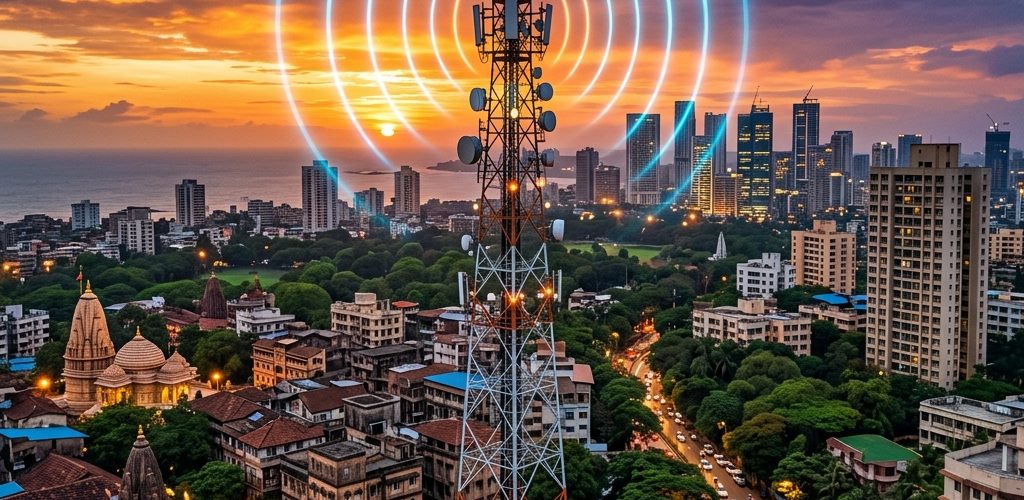
India’s fifth-generation mobile network has expanded to 469,000 base stations with over 250 million active 5G subscribers, according to the latest available data from the Ministry of Communications as of February 2026. The country’s 5G coverage now extends to all states and 99.6 per cent of districts nationwide, achieved in less than two and a half years since commercial launch in October 2022.
The expansion is being driven by intense competition between private operators Reliance Jio and Bharti Airtel, the entry of Vodafone Idea into the 5G market, and the imminent 5G upgrade plans of state-run Bharat Sanchar Nigam Limited. Airtel’s latest deployment push — adding over 7,000 new 5G sites across Uttar Pradesh and Gujarat in April 2026 — has intensified the battle for subscriber growth.
Airtel’s Aggressive Multi-State Push
Bharti Airtel has deployed over 4,300 new 5G sites in Uttar Pradesh East, covering 48 districts and approximately 3.4 crore residents. In Gujarat, the operator has added more than 2,750 5G sites across 36 districts, reaching around 4.1 crore people. The deployments target both urban and rural areas, with Airtel prioritising indoor connectivity, reduced latency and improved download speeds.
Airtel’s strategy has included unlimited 4G and 5G data plans starting at Rs 399, an aggressive pricing move designed to attract subscribers away from competitors. The operator ended 2024 with 120 million 5G subscribers and has been gaining ground through superior network quality metrics, particularly in speed tests and coverage reliability. Airtel operates a non-standalone 5G network, leveraging both 700 MHz spectrum for wide-area coverage and 3500 MHz for high-speed urban connectivity.
The Indian telecom market is witnessing a structural shift as 5G monetisation becomes the primary competitive battleground. Airtel’s focus on network quality over pure subscriber numbers reflects a strategy aimed at capturing higher-value customers willing to pay premium tariffs for reliable connectivity.
Jio Holds the Subscriber Lead
Reliance Jio remains the market leader in 5G subscribers with 170 million users at the end of 2024, representing 35 per cent of its mobile customer base. Jio operates India’s only standalone 5G network, which offers theoretical advantages in latency and network efficiency. However, Airtel’s recent deployment surge suggests the gap is narrowing.
Jio’s True 5G network was the first to launch commercially in India, with founder Mukesh Ambani announcing nationwide coverage plans. The operator has focused on dense urban deployments and enterprise solutions, including fixed wireless access services that compete with traditional broadband providers.
The competition has driven significant consumer benefits. Average 5G data speeds in India have climbed above 200 Mbps in metro areas, and unlimited data plans from both operators have encouraged users to shift video consumption, gaming and cloud services to mobile networks. India’s mobile gaming industry, valued at an estimated $330 billion globally, has been a direct beneficiary of improved network quality.
BSNL Prepares Indigenous 5G Upgrade
State-run BSNL is preparing a major network transformation. The operator currently has approximately 97,000 4G sites operational nationwide, built entirely on indigenous technology developed by Tejas Networks and the Centre for Development of Telematics. Union Telecom Minister Jyotiraditya Scindia has confirmed that all existing BSNL 4G towers will be upgraded to 5G, with the first phase targeting Delhi and Mumbai.
Minister of State for Communications Chandra Sekhar Pemmasani outlined two approaches for BSNL’s 5G rollout: a revenue-sharing model where private players install 5G equipment on BSNL towers, and a direct upgrade of the existing 4G infrastructure. “First, we have to get these additional 23,000 base transceiver stations installed. Most of the quality issues have already been fixed,” Pemmasani said.
The Union Cabinet has approved a third revival package for BSNL worth Rs 89,047 crore, which includes allotment of 4G and 5G spectrum through equity infusion. BSNL has been testing its 5G indigenous technology at three locations in New Delhi: Nehru Place, Chanakyapuri and Minto Road. Commercial 5G services are expected to begin by mid-2026.
Vodafone Idea Enters the 5G Market
Vodafone Idea has launched its 5G service in Mumbai and plans to deploy 10,000 5G sites across 17 service areas in the current fiscal year, with an additional 12,000 planned for fiscal 2026. The carrier’s entry adds a third private 5G option for consumers, though its network footprint remains significantly smaller than Jio and Airtel.
India’s three-way private operator competition, combined with BSNL’s state-backed expansion, has created one of the most dynamic technology markets in the world. The IT industry’s growth to $315 billion in FY26 is partly underpinned by the connectivity infrastructure these operators are building.
What 5G Means for India’s Digital Economy
The rapid 5G rollout has implications beyond consumer mobile. Fixed wireless access services are emerging as broadband alternatives in areas where fibre deployment is uneconomical. Enterprise 5G solutions, including private networks for manufacturing, logistics and healthcare, represent a growing revenue opportunity. The government’s push for “5G-as-a-service” through BSNL’s revenue-sharing model could accelerate enterprise adoption in smaller cities.
For consumers, the immediate benefit is faster, more reliable mobile internet. With 5G-capable smartphones now available below Rs 10,000 from multiple brands and India’s smartphone market continuing to grow, the subscriber base is expected to expand significantly through 2026 and beyond. The race to connect every district and village is transforming India’s digital landscape at a pace that few countries have matched.

- India Faces Early Heatwave Season as IMD Issues Alerts Across Southern and Central States - April 12, 2026
- India 5G Crosses 469,000 Base Stations and 250 Million Subscribers as Airtel and BSNL Accelerate Expansion - April 12, 2026
- India’s Bioeconomy Surges to $165.7 Billion as Government Targets $300 Billion by 2030 - April 11, 2026