India Announces Seven High-Speed Rail Corridors in Budget 2026 as Bullet Train Project Nears First Trial Run

Finance Minister Nirmala Sitharaman announced seven new high-speed rail corridors in the Union Budget 2026-27, marking the most ambitious expansion of India’s railway infrastructure in decades. The announcement comes as the Mumbai-Ahmedabad bullet train project reaches visible construction milestones and prepares for its first partial commissioning in 2027.
Seven New High-Speed Corridors Unveiled
The seven proposed routes connect India’s major economic centres: Mumbai to Pune, Pune to Hyderabad, Hyderabad to Bengaluru, Hyderabad to Chennai, Chennai to Bengaluru, Delhi to Varanasi, and Varanasi to Siliguri. The corridors are designed to function as “growth collectors” linking cities that drive India’s industrial and services economy.
Sitharaman described the initiative as critical for “promoting environmentally sustainable passenger systems.” Detailed project reports for each corridor will be completed by December 2026, with construction expected to begin on the first three routes in 2028.
Mumbai-Ahmedabad Bullet Train Nears First Trial
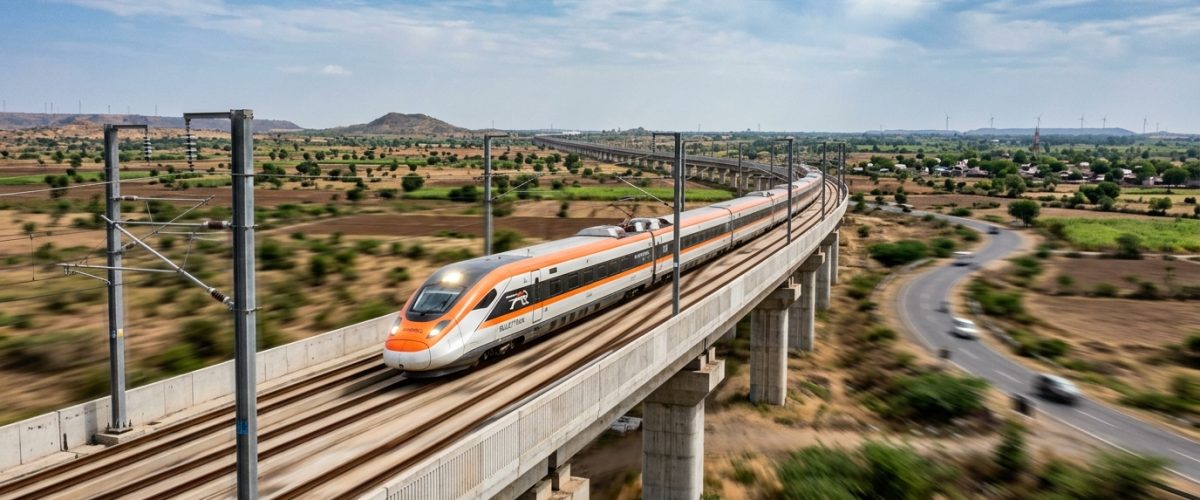
The Mumbai-Ahmedabad high-speed rail corridor has made substantial progress. Elevated viaducts stretch across Gujarat, steel bridges are in place and station structures are rising at multiple locations. The 508-kilometre corridor, India’s first bullet train project, is being built with Japanese Shinkansen technology.
Railway Minister Ashwini Vaishnaw confirmed the phased approach to commissioning. “The first section within this bullet train project will open in 2027 between Surat and Vapi,” he said. The full corridor between Mumbai and Ahmedabad is expected to be operational by December 2029, running at design speeds of 350 kilometres per hour.
What the Corridors Mean for Indian Cities
The southern triangle of Hyderabad-Bengaluru-Chennai is expected to transform intercity mobility in India’s technology and manufacturing belt. Journey times between Bengaluru and Chennai could drop from six hours by road to under two hours by high-speed rail. The Delhi-Varanasi corridor would connect the capital to one of India’s most important cultural and religious centres.
CRISIL Intelligence noted that the corridors are “critical not just for capacity creation, but for enabling technology adoption through advanced signalling, traffic management and safety systems.” The project will require massive investment in land acquisition, civil construction and technology transfer.
Vande Bharat and Broader Rail Expansion
Beyond high-speed rail, the Indian Railways continues to expand its semi-high-speed and conventional network. Vande Bharat Express trains now operate on over 50 routes, with the sleeper variant under development for overnight services. The Amrit Bharat Express programme is upgrading long-distance trains with improved amenities.
The railway budget for 2026-27 allocated Rs 2.65 lakh crore in capital expenditure, the highest ever. This covers track doubling, electrification of the remaining 3,000 route kilometres, and the expansion of the Kavach automatic train protection system across major routes.
Challenges and Execution Risks
India’s bullet train ambitions face significant execution challenges. Land acquisition remains the biggest bottleneck, with the Mumbai-Ahmedabad project delayed by over four years partly due to difficulties in Maharashtra. Environmental clearances, cost overruns and technology adaptation also pose risks for the seven new corridors.
The government’s track record with the existing bullet train project offers both hope and caution. Visible construction progress in 2025-26 has shifted public perception “from scepticism to cautious confidence,” but the ultimate test will be whether India can deliver high-speed rail at global standards within the projected timeline and budget. The broader tourism infrastructure push in the same budget adds context to the government’s vision of connected, modern India.

- India’s Mobile Gaming Industry Enters a New Phase as BGMI Pro Series and 5G Fuel Growth in 2026 - April 12, 2026
- Lakme Fashion Week 2026 Signals India’s Shift Toward Sustainable High-Tech Couture - April 12, 2026
- Spiti Valley Opens, Kashmir Tulips Peak: India’s Trending Domestic Destinations for April 2026 - April 11, 2026