Euler Motors Raises Rs 437 Crore as India’s Commercial EV Startup Ecosystem Accelerates in 2026

Euler Motors, one of India’s leading commercial electric vehicle (EV) manufacturers, has raised Rs 437.5 crore in a Series E funding round to expand its fleet and manufacturing capabilities. The raise, announced on 24 March 2026, comes amid a broader revival in Indian startup funding that has seen multiple deals close in the final week of March alone. From 10-minute food delivery to sustainable textiles, Indian founders are attracting capital across diverse sectors at a pace not seen since the 2021 boom.
Euler Motors Funding 2026: Series E to Power Commercial EV Expansion
Delhi-based Euler Motors plans to deploy the fresh capital across three priorities: expanding its vehicle production capacity, strengthening its charging infrastructure network, and entering new geographic markets. The company manufactures three-wheeled electric cargo vehicles used by last-mile delivery companies, e-commerce firms, and logistics providers.
Founded by Saurav Kumar in 2018, Euler has positioned itself at the intersection of two powerful trends — India’s push toward electric mobility and the explosive growth of e-commerce deliveries. The company claims its vehicles have collectively covered over 500 million kilometres, reducing an estimated 120,000 tonnes of carbon emissions compared with diesel equivalents.
India’s recent unicorn additions demonstrate that investor confidence in Indian startups is recovering after the funding winter of 2023-24. Euler is not yet valued at unicorn levels but is widely regarded as one of the strongest contenders in the commercial EV segment, where competition is intensifying from players such as Mahindra Electric, Piaggio, and OSM.
Swish, Proxgy, and Canvaloop Add to March 2026 Deal Flow
Euler’s raise was not an isolated event. In the same week, Swish, a 10-minute food delivery startup, raised $38 million to expand its rapid commerce model beyond metro cities into tier-two markets. The company operates dark kitchens combined with delivery pods, promising restaurant-quality meals faster than traditional platforms such as Swiggy and Zomato.
Proxgy, a wearable technology startup, secured Rs 2 crore in an investment from cricketer Riyan Parag. The deal highlights a growing trend of Indian athletes putting capital into technology ventures rather than traditional real estate or hospitality businesses. Parag has publicly stated that he wants to “invest in ideas that solve real problems.”
Surat-based Canvaloop raised $1.5 million from Gujarat Venture Finance Limited (GVFL) and Rockstud Capital. The company converts agricultural waste into sustainable textiles, a proposition that gained visibility after its appearance on Shark Tank India. Canvaloop’s technology processes crop stubble, jute, and hemp into fibres suitable for fashion and industrial applications.
The State of India’s Startup Ecosystem in March 2026
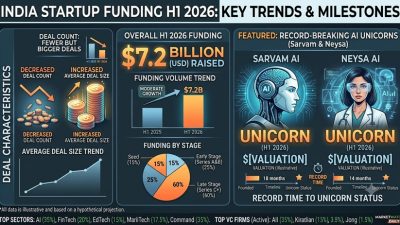
After a challenging 18-month period that saw valuations compress and several high-profile startups pursue profitability over growth, the Indian startup ecosystem appears to have found its footing. According to data from Mint, venture capital investment in Indian startups during January to March 2026 is tracking 40 per cent higher than the same quarter in 2025.
Healthcare, climate technology, and enterprise software are attracting the largest share of early-stage funding. Somerset Indus Capital closed a $288 million Fund III focused exclusively on healthcare growth opportunities in India, signalling that institutional investors see the sector as a multi-decade opportunity.
The corporate earnings landscape also supports the recovery. As India Inc reports improved revenue growth, corporate venture arms are increasing their startup investments. Tata Group, Reliance, and the Aditya Birla Group have all expanded their venture portfolios in the current fiscal year.
Commercial EVs Lead India’s Green Mobility Transition
Euler’s fundraise reflects a structural shift in India’s mobility landscape. The central government’s FAME III subsidy scheme, extended through March 2027, provides direct incentives for commercial EV purchases. State governments in Delhi, Maharashtra, and Karnataka offer additional registration fee waivers and road tax exemptions that make electric three-wheelers price-competitive with diesel alternatives.
The economics are compelling. Euler estimates that its vehicles save fleet operators Rs 1.5 per kilometre compared with internal combustion engine equivalents, a margin that compounds rapidly across fleets running 100 to 150 kilometres daily. Battery swapping technology, which Euler has integrated into its newer models, reduces charging downtime to under three minutes.
Challenges remain. Charging infrastructure outside major cities is sparse, and battery recycling policies are still evolving. The founder stories driving India’s startup culture often highlight perseverance through such infrastructure gaps, and Euler’s founder Saurav Kumar is no exception. His decision to build the company’s own charging network alongside its vehicles has proven prescient as competitors struggle with third-party dependency.
What Investors Are Watching Next
The late-March funding surge suggests that Indian startups are entering the new financial year with momentum. For investors, the key metrics have shifted. Growth at all costs has given way to unit economics, customer retention, and regulatory resilience. Startups that can demonstrate sustainable paths to profitability are commanding premium valuations, while those reliant on heavy discounting continue to face scrutiny.
For Euler Motors specifically, the next milestone will be scaling production beyond its current capacity of 5,000 vehicles per month. The company has hinted at a new manufacturing facility in Tamil Nadu, which would bring it closer to clients in southern India and reduce logistics costs. If successful, the Series E round could be Euler’s last before a potential initial public offering in 2027 or 2028.
The broader message is clear: India’s startup ecosystem is not merely surviving — it is evolving into a more disciplined, diversified, and globally competitive market. The deals closing in March 2026 represent not just capital inflows but a maturation of the entire entrepreneurial landscape.