India Tightens AI Regulation With Mandatory Content Labelling as OpenAI and Google Expand Operations Across the Country

India Tightens AI Regulation With Mandatory Content Labelling as OpenAI and Google Expand Operations
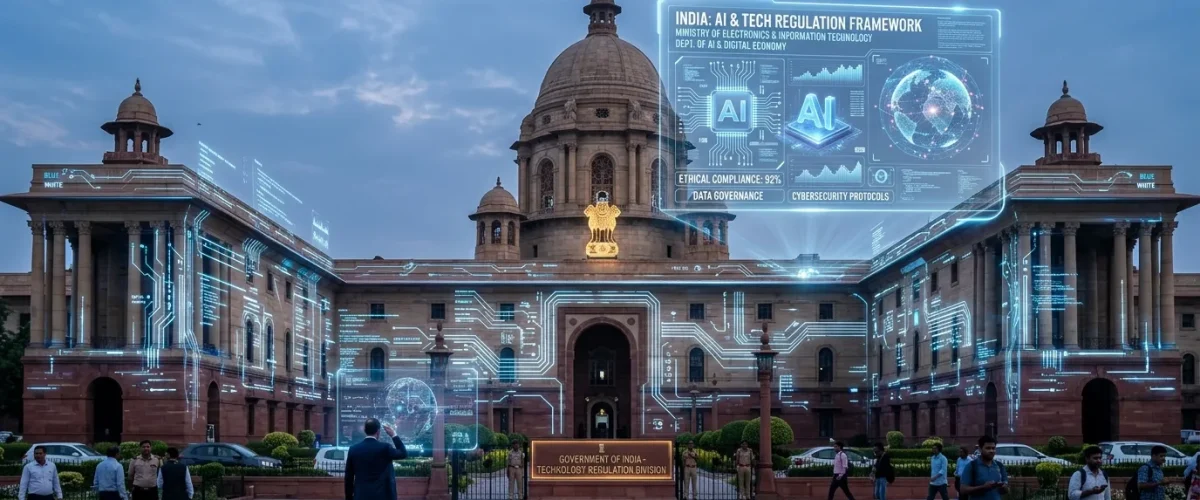
India has taken a decisive step toward regulating artificial intelligence with the enforcement of amended Information Technology rules that require prominent labelling of all AI-generated content across digital platforms. The revised AI and technology regulations, which came into effect on 20 February 2026, mandate that social media companies, search engines, and content platforms proactively identify and tag AI-generated text, images, audio, and video within expedited timelines as short as two to three hours.
The Ministry of Electronics and Information Technology (MeitY) introduced the changes through amendments to the IT (Intermediary Guidelines and Digital Media Ethics Code) Rules, 2021. Global technology firms operating in India now face significant legal risks, including monetary penalties and potential legal proceedings, if they fail to align their compliance systems with the new regulatory framework.
What the New AI Rules Require
The amended rules place the compliance burden squarely on intermediaries and digital platforms. Every piece of AI-generated or AI-modified content must carry a clearly visible label that identifies it as machine-produced. This applies to synthetic text, deepfake videos, AI-generated images, and audio produced using voice cloning or text-to-speech systems. The rules also introduce expedited takedown timelines, requiring platforms to act within two to three hours of receiving a government order related to AI-generated misinformation or harmful content.
Platforms that fail to comply risk losing their safe harbour protections under Section 79 of the Information Technology Act, which shields intermediaries from liability for user-generated content. Legal experts note that this makes India one of the few countries to tie AI labelling requirements directly to platform liability protections, creating a powerful enforcement mechanism.
Industry bodies including NASSCOM and the Internet and Mobile Association of India (IAMAI) have broadly supported the transparency measures while raising concerns about the practical challenges of detecting AI-generated content at scale. The two-to-three-hour takedown window has drawn particular attention, with companies arguing that distinguishing AI-generated content from human-produced material in real time remains technically challenging despite advances in detection tools.
OpenAI Launches India Initiative With Tata Group Partnership
Against this regulatory backdrop, OpenAI made its most significant commitment to India yet by launching the OpenAI for India initiative at the India AI Impact Summit 2026 in Delhi on 18 February. The programme represents a nationwide push to expand access to AI tools and unlock economic and societal benefits across the country, with India now home to more than 100 million weekly ChatGPT users spanning students, teachers, developers, and entrepreneurs.
The initiative begins with a strategic partnership with the Tata Group, one of India’s oldest and most diversified conglomerates, to build sovereign AI capabilities. The collaboration aims to accelerate enterprise adoption of AI across Tata’s vast network of companies spanning steel, automotive, technology services, hospitality, and retail. OpenAI and Tata will also invest in workforce upskilling programmes designed to prepare India’s labour force for an AI-driven economy.
Sam Altman, OpenAI’s chief executive, described India as one of the most exciting AI markets globally, citing the country’s young population, growing developer community, and rapidly expanding digital infrastructure. The partnership with Tata signals a shift in OpenAI’s strategy from consumer-focused growth to deep enterprise integration in key markets.
Google Expands Gemini AI Features to Indian Users
Google announced in March 2026 that it was bringing its full suite of Chrome AI experiences to India, making Gemini-powered features available to hundreds of millions of Indian users. The expansion allows users to interact with an AI assistant directly within the Chrome browser without leaving their current tab, with integration across Gmail, Google Maps, Calendar, and YouTube.
The Gemini integration in Chrome represents a significant upgrade for Indian users, who can now use the AI assistant to compare products across multiple open tabs, summarise lengthy articles, draft emails, and plan activities. Google’s Nano Banana 2 model, optimised for on-device processing, ensures that many of these features work even with limited internet connectivity, a crucial consideration for India’s diverse infrastructure landscape.
Google’s expanded AI presence in India comes alongside its broader investment push in the country. The company has committed substantial resources to its India operations, including data centre expansion and partnerships with Indian startups building on its AI platform. The move intensifies competition with Microsoft, which committed $17.5 billion to India in December 2025, and is now building a flagship data centre in Hyderabad expected to go live in summer 2026.
India’s Sovereign AI Investment Crosses $20 Billion
The combined public and private investment in India’s AI infrastructure has crossed the $20 billion mark in 2026, driven by government funding for sovereign foundation models and massive corporate commitments. The Indian government is directly funding 12 organisations to build indigenous AI foundation models, part of the IndiaAI Mission launched to reduce dependence on foreign AI systems for critical applications.
Sarvam AI, a Bengaluru-based startup building India-specific language models, is closing a $350 million funding round at a $1.5 billion valuation, making it one of the most valuable AI startups in Asia. The company focuses on building models that understand Indian languages, cultural contexts, and regulatory requirements, positioning itself as a key infrastructure provider for enterprises that need AI systems tailored to the Indian market.
Microsoft’s $17.5 billion India commitment, the largest single-country investment by any technology company in India, is materialising rapidly. The company is rebuilding its internal operations around AI, having replaced four senior HR leaders and created a new AI Workforce Readiness team across its global workforce of over 220,000 employees. This internal transformation serves as both a testing ground and a showcase for the AI-powered enterprise solutions Microsoft plans to offer to Indian businesses.
Impact on Indian Startups and the Developer Community
India’s AI regulatory framework and the entry of global giants are creating both opportunities and challenges for the country’s startup ecosystem. On the opportunity side, the sovereign AI push is channelling government funding toward homegrown companies, and the mandatory labelling requirements are spawning a new category of compliance technology startups building AI detection and watermarking tools.
However, smaller startups face challenges in meeting the compliance requirements that come with the new regulations. The cost of implementing robust AI content labelling systems, maintaining real-time detection capabilities, and ensuring compliance with expedited takedown timelines can be prohibitive for early-stage companies operating with limited resources.
The developer community is responding enthusiastically to the expanded availability of AI tools. India already produces more AI-related GitHub contributions than any country except the United States, and the arrival of Gemini in Chrome, ChatGPT’s growing Indian user base, and the availability of agentic AI features in consumer devices like the Samsung Galaxy S26 are accelerating adoption across the technology stack.
What Comes Next for AI in India
The convergence of regulatory action, global investment, and sovereign AI development positions India as one of the most dynamic AI markets heading into the second half of 2026. The government has signalled that additional regulations covering AI in healthcare, financial services, and education are under development, potentially creating sector-specific compliance frameworks that would be among the most detailed globally.
For businesses operating in India, the message is clear: AI adoption is accelerating, but so are the rules governing its use. Companies that invest early in compliance infrastructure while leveraging the expanding ecosystem of AI tools and platforms will be best positioned to benefit from what promises to be a transformative period for technology and financial innovation in the world’s most populous nation.
Industry analysts expect the regulatory framework to evolve further as AI capabilities advance, with particular attention likely on the governance of autonomous AI agents that can take actions on behalf of users. India’s approach of tying AI regulation to existing intermediary liability frameworks, rather than creating entirely new legislation, is being watched closely by policymakers in other emerging markets considering their own AI governance strategies.

- India’s Startup Funding Crosses $7.2 Billion in H1 2026 - July 1, 2026
- After Ireland Shock, India’s T20I Side Faces Bigger Test - July 1, 2026
- Ireland Stun World Champions India 2-0 in Belfast, Sooryavanshi Debate Rages On - June 29, 2026