UPI Crosses 228 Billion Transactions Worth Rs 300 Trillion in 2025: Inside India’s Digital Payments Revolution

India’s digital payments revolution reached a staggering new milestone in 2025, with the Unified Payments Interface (UPI) processing 228.5 billion transactions worth Rs 299.74 trillion over the course of the year. According to Worldline’s annual “India Digital Payments Report — Year 2025 in Review,” published on April 14, 2026, this represents a 33 percent year-on-year growth in transaction volume, cementing UPI’s position as the undisputed default payment method for everyday commerce in the world’s most populous nation.
The numbers are not just impressive — they are transformative. From neighbourhood kirana stores to fuel stations, street food stalls to e-commerce checkouts, UPI has become the backbone of India’s financial transactions. The report paints a picture of a country that has decisively moved away from cash for most daily payments, driven by a combination of infrastructure expansion, policy support, and consumer trust built over nearly a decade of digital payment innovation.
The Numbers Behind UPI’s Record-Breaking 2025
The headline figures tell a compelling story. UPI processed 228.5 billion transactions in 2025 — an increase of roughly 57 billion transactions compared to 2024. The total transaction value of Rs 299.74 trillion (approximately $3.5 trillion) underscores the sheer scale of money flowing through the platform every single day. December 2025 alone saw 21.6 billion transactions worth Rs 28 lakh crore, setting a new monthly record and surpassing the previous peak of 20.47 billion transactions recorded in November 2025.
What makes these numbers particularly significant is the declining average ticket size (ATS). The overall UPI ATS fell 9 percent to Rs 1,314, while the ATS for merchant payments dropped to just Rs 592. This indicates that UPI is no longer reserved for large transfers or bill payments — it is now being used for everyday micro-purchases like chai, auto-rickshaw fares, vegetable shopping, and small retail transactions. India has effectively become a micro-payments economy, with digital transactions replacing the small-value cash purchases that once dominated daily life.
P2P and P2M: The Twin Engines of Growth
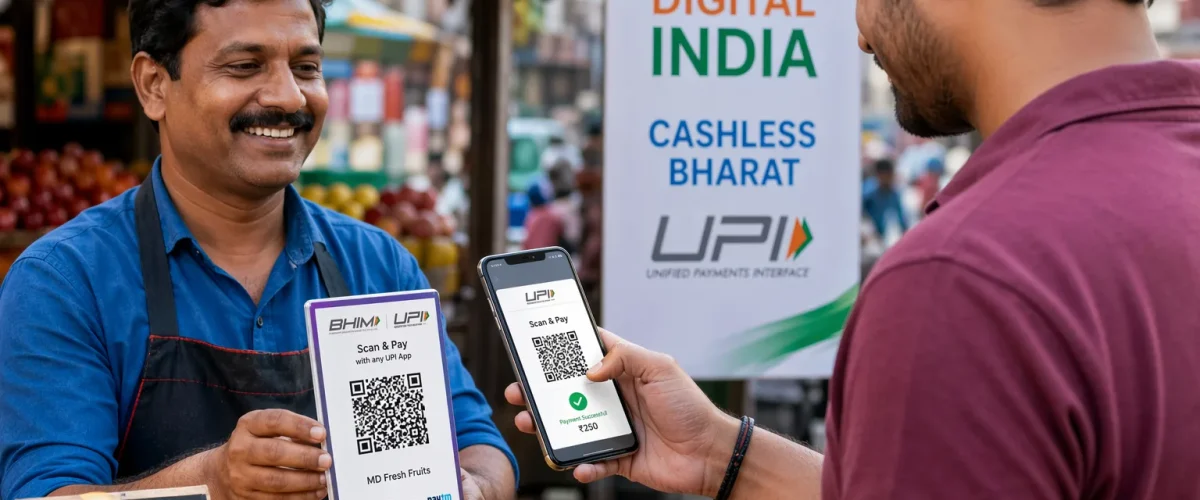
UPI’s growth in 2025 was powered by both person-to-person (P2P) and person-to-merchant (P2M) transactions. P2M payments surged 34 percent to reach 143.82 billion transactions, reflecting UPI’s expanding role as a primary payment tool at merchant counters, online stores, and service providers. The merchant acceptance infrastructure has scaled remarkably — UPI QR codes increased to 731.38 million across the country, up 15 percent year-on-year, while Point-of-Sale (PoS) terminals grew to 11.48 million, also rising 15 percent from the previous year.
The P2P segment continues to be significant, driven by the ease of sending money to family, splitting bills, and making instant transfers between bank accounts. What started as a convenience feature — sending money to a friend by typing their phone number — has become so deeply embedded in Indian culture that phrases like “UPI kar do” (do it via UPI) are now part of everyday vocabulary across languages and demographics.
Meanwhile, recurring digital payments through Bharat BillPay reached 3.05 billion transactions in 2025, up 40 percent year-on-year, with the transaction value surging 93 percent to Rs 14.84 trillion. This growth reflects how utility bills, insurance premiums, loan EMIs, and subscription services are increasingly being managed through automated digital payment channels, driven by initiatives from fintech news and trends leaders and traditional banks alike.
Credit Cards Grow, But UPI Dominates
While UPI dominates everyday payments and small-ticket transactions, the Worldline report notes that credit card usage also continues to grow, particularly in high-value and online commerce. Credit card transactions increased 27 percent to 5.69 billion in 2025, with online credit card payments reaching Rs 14.53 trillion. This reinforces the complementary role of credit cards in e-commerce and premium purchases.
In contrast, debit card volumes declined 23 percent, a clear signal that consumers are migrating small-value debit card transactions to UPI, which offers the convenience of direct bank transfers without the need for a physical card. The shift reflects a broader trend where UPI is cannibalising not just cash but also older digital payment methods, consolidating India’s retail payments into a single, interoperable platform.
The introduction of credit on UPI — a feature that allows users to access credit lines directly through UPI apps — has further blurred the boundaries between payment types. Several banks and fintech companies have enabled this feature, allowing users to make UPI payments backed by pre-approved credit rather than their bank balance. This innovation is expanding UPI’s reach into segments that traditionally relied on credit cards for deferred payments.
UPI Goes Global: From Singapore to France
One of the most significant developments in UPI’s journey has been its international expansion. As of early 2026, UPI is live and operational for digital payments in nine countries: Bhutan, Nepal, Singapore, UAE, Qatar, France, Sri Lanka, Mauritius, and Bahrain. Indian travellers and the diaspora can now use their UPI apps to make payments at merchants in these countries, scanning QR codes just as they would at a shop in Delhi or Mumbai.
The National Payments Corporation of India (NPCI) International, the arm responsible for UPI’s global rollout, has confirmed that negotiations are underway with seven to eight additional countries, primarily in East Asia and the Gulf region. Financial Services Secretary M. Nagaraju has stated that the target for 2026 is to have UPI fully connected in 12 or more countries, with a long-term vision of 20-plus UPI-enabled nations worldwide.
Perhaps the most ambitious international development is the ongoing collaboration between the Reserve Bank of India (RBI) and the European Central Bank (ECB) to link UPI with TIPS, Europe’s instant payments system. If successful, this integration would allow UPI payments to work seamlessly across European Union member states — enabling Indian students in Germany to send money home instantly, tourists in Italy to pay via UPI at cafés, and businesses to settle cross-border transactions in real time. Popular Indian payment apps like PhonePe and Paytm have already added international UPI modes, enabling merchant payments abroad and peer-to-peer transfers in supported corridors. PhonePe has even enabled receiving money from abroad, a first for the UPI ecosystem.
UPI’s Role in Financial Inclusion and Credit Access
Beyond payments, UPI is playing a transformative role in India’s financial inclusion story. The Economic Survey 2025-26 highlighted how UPI’s transaction data is being used to assess creditworthiness, enabling banks and fintech companies to extend formal credit to borrowers who were previously excluded from the financial system. In smaller towns and semi-urban areas, where traditional credit scoring data is scarce, UPI transaction histories are providing lenders with verifiable evidence of economic activity and repayment capacity.
The Survey noted that “Digital Public Infrastructure reshapes credit markets by enabling banks and fintechs to expand lending across the risk spectrum, with fintechs playing a distinctive role in reaching new-to-credit borrowers.” Importantly, the growth in credit linked to digital payments has not come at the cost of higher default rates — richer transaction data has allowed lenders to better identify underserved but creditworthy individuals.
Innovations like UPI Lite, which enables small-value offline transactions without requiring a PIN or internet connectivity, are further extending the platform’s reach to rural areas and users with limited smartphone literacy. These developments align with broader trends across India’s tech ecosystem, where PhysicsWallah’s IPO filing signals India’s tech ambitions and companies like Pocket FM’s rise to profitability through AI innovation demonstrate the country’s appetite for scaling technology-driven solutions.
The Road Ahead: What 2026 Holds for UPI
With the platform already processing over 21 billion transactions per month and expanding globally, UPI’s trajectory for 2026 appears firmly upward. Industry analysts expect the platform to cross 300 billion annual transactions by the end of 2026, driven by continued merchant adoption, credit-on-UPI growth, and international expansion. The integration with Bharat BillPay for recurring payments and the expansion of UPI Lite for offline transactions are expected to unlock new user segments and use cases.
India’s digital payments infrastructure is also attracting attention from other nations seeking to replicate the UPI model. Countries across Africa, Southeast Asia, and Latin America have expressed interest in adopting similar real-time payment systems, positioning India as a global thought leader in financial technology innovation. The Indian economy updates consistently reflect how digital payments are not just a convenience but a fundamental driver of economic growth, formalisation, and tax compliance.
The broader startup ecosystem continues to benefit from UPI’s expansion. The massive funding rounds fueling India’s tech ecosystem are frequently directed at fintech companies building on top of UPI’s rails — from lending platforms to wealth management apps to cross-border payment solutions. As UPI’s infrastructure becomes more robust and feature-rich, the opportunities for innovation multiply.
From a street vendor in Varanasi accepting a Rs 10 payment via QR code to an Indian tourist paying for a croissant in Paris through their phone, UPI has redefined what it means to pay in India — and increasingly, what it means to pay as an Indian anywhere in the world. With 228.5 billion transactions in 2025, the platform has proven that digital payments at scale are not just possible but inevitable. The only question remaining is how far and how fast the revolution will spread.