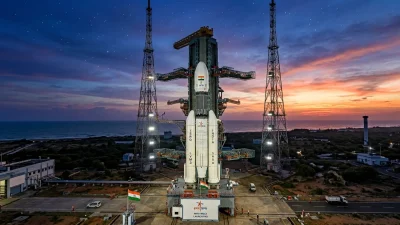
Skyroot Aerospace Vikram-1 Rocket Nears Historic First Launch From Sriharikota


Hyderabad-based Skyroot Aerospace is counting down to the debut launch of its Vikram-1 rocket from the Satish Dhawan Space Centre in Sriharikota, Andhra Pradesh. Targeted for April 2026, this mission represents a landmark moment for India’s private space industry — if successful, Vikram-1 will be the first orbital-class rocket developed entirely by an Indian private company to reach Low Earth Orbit.
The rocket, named after Vikram Sarabhai, the father of India’s space programme, is designed to carry approximately 350 kilograms of payload to Low Earth Orbit (LEO). The debut flight will carry several cubesats, with specific payload identities to be confirmed closer to launch. Telangana Chief Minister A. Revanth Reddy is expected to attend the flagging ceremony, underscoring the state government’s investment in aerospace development.
From Vikram-S to Vikram-1: The Journey
Skyroot Aerospace made history in November 2022 when it launched Vikram-S, a suborbital sounding rocket, from Sriharikota. That mission, named “Prarambh” (meaning “the beginning”), made Skyroot the first Indian private company to launch a rocket into space. The six-kilogram vehicle reached an altitude of 89.5 kilometres and demonstrated the viability of Skyroot’s solid propulsion technology.
Vikram-1 represents a quantum leap in capability. Standing significantly taller and heavier than Vikram-S, the orbital-class vehicle features a three-stage solid propulsion system with a liquid-fuelled terminal stage for precise orbital insertion. The development programme has taken over three years of testing, including multiple static fire tests and structural qualification campaigns. Skyroot’s progress is part of the broader story of India’s booming $13 billion space economy and the 200-plus startups fuelling the country’s new space race.
What Makes Vikram-1 Different
Unlike ISRO’s workhorses — the PSLV and GSLV — which are designed for medium to heavy payloads, Vikram-1 targets the dedicated small satellite launch market. With the global demand for small satellite launches growing at over 20 per cent annually, Skyroot is positioning itself to serve customers who need quick, dedicated access to orbit without sharing a ride on a larger vehicle.
The rocket’s manufacturing incorporates advanced carbon composite structures, which reduce weight while maintaining structural integrity. Skyroot claims that its production process is designed for rapid turnaround, with the goal of eventually conducting multiple launches per month from a single production line.
“Subject to launch port availability and from a manufacturing readiness standpoint, we are aiming at four to six launches this financial year,” Skyroot CEO Pawan Kumar Chandana told VIA Satellite magazine in March 2026. “Depending on the observations of the first flight, we may have to adjust that. But currently, we do plan to follow up quickly.”
India’s Private Space Ecosystem Matures
Skyroot is not operating in isolation. India’s private space sector has exploded since the government opened the industry to private participation in 2020 through the Indian National Space Promotion and Authorisation Centre (IN-SPACe). Over 200 space-related startups now operate in the country, spanning launch vehicles, satellite manufacturing, ground systems, and space technology innovation.
Agnikul Cosmos, another Hyderabad-area startup, is developing the Agnibaan rocket with the world’s first single-piece 3D-printed engine. Pixxel operates a constellation of hyperspectral imaging satellites. Dhruva Space provides satellite platforms and antenna systems. Together, these companies form an ecosystem that is transforming India from a space power defined solely by ISRO into one with a vibrant commercial sector.
ISRO itself has embraced the shift. The space agency now shares its launch infrastructure with private companies, offers technology transfers, and provides testing facilities. This collaboration model — sometimes described as “ISRO as the enabler” — draws parallels to how NASA’s partnerships with SpaceX and Blue Origin transformed the American launch market. Meanwhile, ISRO’s own Gaganyaan human spaceflight programme continues to advance toward its 2027 target.
Challenges Ahead
Debut launches are inherently risky. The history of orbital rocketry is littered with first-flight failures, from early American and Soviet programmes to more recent stumbles by companies like Virgin Orbit and Astra. Skyroot’s engineering team has conducted extensive ground testing, but the transition from ground tests to actual flight always introduces unknowns, including aerodynamic loads, stage separation dynamics, and thermal environments that cannot be perfectly replicated on the ground.
If the debut succeeds, Skyroot will join an exclusive club of private companies worldwide that have achieved orbital flight — a list that currently includes SpaceX, Rocket Lab, and a handful of Chinese firms. For India, it would represent a validation of the policy reforms that opened the sector and a signal to global investors that the country can produce world-class launch services.
What Comes Next for Skyroot
Beyond Vikram-1, Skyroot is already developing Vikram-2, a larger rocket capable of carrying over one tonne to LEO. The company has raised over $100 million in funding from investors including GIC (Singapore’s sovereign wealth fund), alongside contributions from the growing global interest in sustainable space operations. With plans for Vikram-2 development running in parallel, Skyroot aims to offer a full range of launch services covering payloads from 50 kilograms to over 1,000 kilograms.
As ISRO completes critical Gaganyaan milestones, the parallel progress of companies like Skyroot ensures that India’s space ambitions are not dependent on a single organisation. The Vikram-1 debut, whether it succeeds on the first attempt or requires iteration, marks a defining chapter in India’s journey from a government-only space programme to a full-spectrum space power.