BJP’s First-Ever West Bengal Chief Minister to Be Sworn In on May 9: Suvendu Adhikari, Dilip Ghosh and Sukanta Majumdar Lead the Race

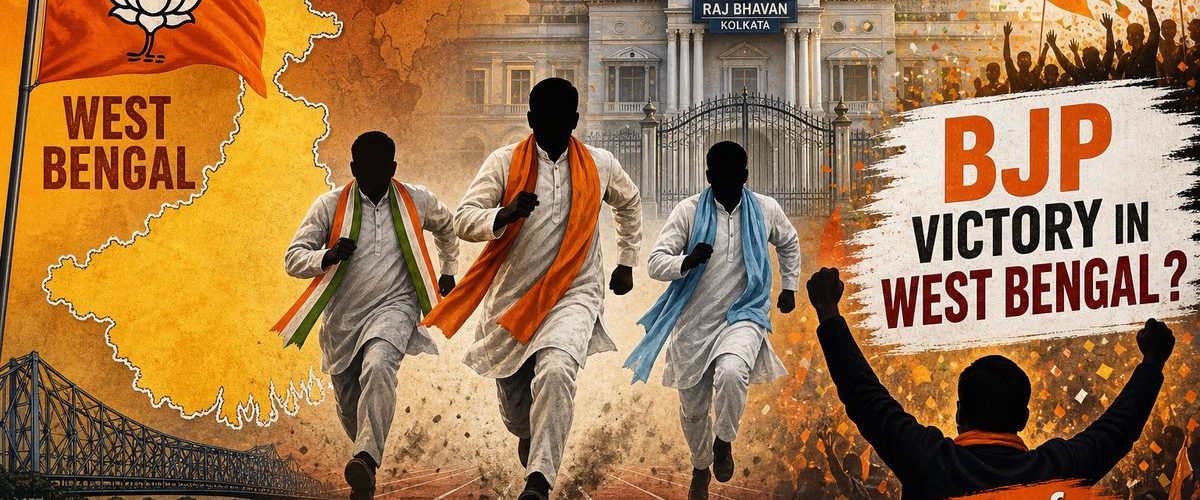
The Bharatiya Janata Party is set to script another chapter of history when its first-ever Chief Minister of West Bengal takes the oath of office on Friday, May 9, 2026 — a date that coincides with Rabindra Jayanti, the birth anniversary of Nobel laureate Rabindranath Tagore, a symbol deeply woven into Bengal’s cultural identity. The choice of date is widely seen as a deliberate move to connect the BJP’s historic electoral achievement with Bengal’s rich cultural heritage.
The Three Frontrunners
With the BJP having secured a commanding 206 seats in the 294-member Assembly, all eyes are now on who will lead the state. Unlike in many states where the BJP announces its CM candidate before elections, the party followed its usual practice of not declaring a face in Bengal — leaving the decision to the central leadership. Three names have emerged as the most prominent contenders:
Suvendu Adhikari: The Giant Killer
Suvendu Adhikari, 55, is widely considered the frontrunner. The former TMC leader, who defected to the BJP in late 2020, has established himself as the party’s most recognisable face in Bengal. His political credentials are formidable: he defeated Mamata Banerjee in Nandigram in 2021 and followed it up with a decisive victory in Bhabanipur in 2026, defeating Mamata by over 15,000 votes.
Adhikari’s strengths include his deep grassroots network in Bengal’s Midnapore belt, his combative political style that resonates with the BJP’s support base, and his role as the Leader of the Opposition in the outgoing Assembly. His supporters argue that no one has done more to bring the BJP to power in Bengal.
However, Adhikari’s candidacy is not without complications. He is an accused in the Narada sting operation case, a corruption scandal that has been a contentious issue in Bengal politics. While the case has not resulted in a conviction, and the Supreme Court has granted him bail, the BJP’s central leadership may weigh the political and legal risks of appointing a CM who faces ongoing judicial scrutiny.
Dilip Ghosh: The RSS Loyalist
Dilip Ghosh, 62, represents the BJP’s organisational backbone in Bengal. A former RSS pracharak (volunteer) who joined the BJP in 2014, Ghosh served as the party’s state president from 2015 to 2022 and played a critical role in building the BJP’s organisational infrastructure in Bengal from virtually nothing to a mass party.
Ghosh’s credentials include his reputation for discipline, his ideological alignment with the RSS — which has a strong influence on the BJP’s internal decision-making — and his image as a selfless party worker who has never held a government position. His appointment as CM would send a powerful message about the BJP’s commitment to organisational values over personal ambition.
On the flip side, Ghosh is known for his controversial statements and has occasionally been at odds with other BJP leaders in the state. His blunt speaking style, while popular with party cadres, has sometimes attracted criticism from moderates within the party.
Sukanta Majumdar: The Understated Choice
Sukanta Majumdar, 48, is the quietest but potentially most strategic choice. A two-time Lok Sabha MP from Balurghat in North Bengal, Majumdar currently serves as a Union Minister of State for Education and North-Eastern Region Development. He is also the current president of the BJP’s Bengal unit.
Majumdar’s profile is that of an educated, moderate leader — a physics professor by training who entered politics relatively late. He does not carry the baggage of any legal controversies and is seen as close to the central leadership. If the BJP is looking for a “safe” and “balanced” choice, Majumdar fits the bill perfectly.
Decision-Making Process
The final decision on the CM pick rests with the BJP’s Parliamentary Board, the party’s highest decision-making body, which includes PM Modi, Home Minister Amit Shah, BJP President JP Nadda, and other senior leaders. Shah has been appointed as the central observer for the CM selection process — a role that gives him significant influence over the outcome.
The selection process typically involves a round of consultations with newly elected MLAs, who are asked to submit their preference for the CM to the observer. While this process gives MLAs a formal voice, the central leadership’s recommendation carries decisive weight. In the BJP’s organisational culture, the MLA consultations serve as a democratic endorsement of a decision that is largely made at the top.
Sources indicate that Shah is expected to arrive in Kolkata on Wednesday or Thursday to conduct the consultations. The BJP’s Bengal MLAs are expected to gather at the state party office for a formal legislature party meeting, at which the CM designate will be announced. This is expected to happen by Thursday evening, leaving time for the new CM to prepare for the Friday swearing-in ceremony.
Other Names in the Mix
While Adhikari, Ghosh, and Majumdar are the top three contenders, several other names are circulating in political circles. Agnimitra Paul, the firebrand BJP leader who won from Asansol South, is considered a dark horse — particularly given the BJP’s recent emphasis on women leadership in states like Uttar Pradesh and Madhya Pradesh. Rupa Ganguly, the actor-turned-politician, has also been mentioned, though her chances are considered slimmer.
Samik Bhattacharya, the BJP’s state spokesperson and a Rajya Sabha MP, is another name being discussed — he is credited with building the party’s media and communication strategy in Bengal. However, he does not hold an Assembly seat, which would require a workaround if he were to be appointed CM.
Significance of the May 9 Swearing-In
The choice of May 9 — Rabindra Jayanti — for the swearing-in ceremony is laden with symbolism. Rabindranath Tagore is Bengal’s most revered cultural figure, and the BJP’s decision to link the inauguration of its first government in the state with Tagore’s legacy is a clear attempt to establish cultural legitimacy in a state where the party has long been viewed as an outsider force.
The swearing-in ceremony is expected to be held at the Raj Bhavan (Governor’s House) in Kolkata, with a guest list that includes PM Modi, senior Union ministers, and BJP chief ministers from other states. The event is being planned as a grand political statement — the culmination of a journey that began with the BJP winning just three seats in Bengal in the 2011 Assembly elections.
As the historic victory in the 2026 elections demonstrated, the BJP has fundamentally redrawn Bengal’s political map. Now, the question is not whether the BJP will govern Bengal, but who will be the face of that governance — and what kind of Bengal the new CM will build. The answer is expected within 48 hours.
As political observers note, the choice of CM will reveal much about the BJP’s long-term strategy for eastern India and its vision for governance in a state that has been shaped by decades of Left and TMC rule. Whatever the outcome, May 9, 2026, will be a date etched in Bengal’s political history and in the cultural consciousness of its people.