Madhya Pradesh High Court Declares Bhojshala in Dhar as Saraswati Temple in Landmark Verdict and Orders End to Shared Hindu-Muslim Worship Arrangement

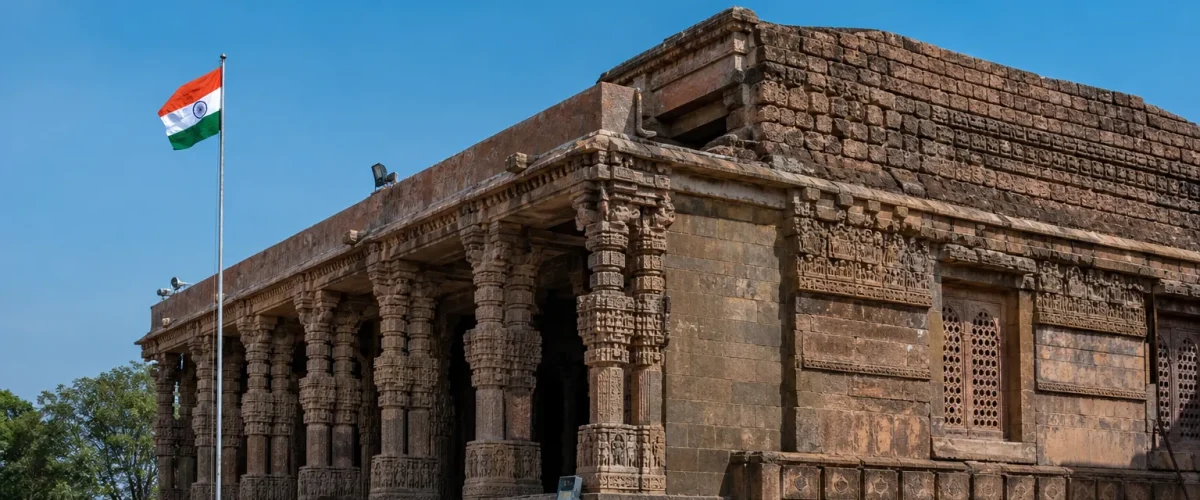
The Madhya Pradesh High Court on Thursday, 15 May 2026, delivered a landmark verdict in the decades-old Bhojshala dispute, declaring that the 11th-century structure in Dhar district is fundamentally a temple of Goddess Vagdevi (Saraswati) and ordering an end to the shared worship arrangement that had governed the site since 2003. The court directed the Archaeological Survey of India (ASI) to take over complete supervision of the monument’s preservation and suggested that a separate piece of land be identified for the construction of a mosque for Muslim worshippers.
The ruling by a division bench of Justices Sujoy Paul and Prakash Chandra Gupta came after an extensive hearing spanning over 18 months, during which both Hindu and Muslim groups presented historical, archaeological and epigraphic evidence to support their claims. The bench noted that “the overwhelming weight of historical and archaeological evidence establishes that the structure was originally built as a Sanskrit learning centre and temple of Goddess Saraswati by Raja Bhoj, the Paramara dynasty ruler, in the 11th century CE.”
History of the Bhojshala Dispute
The Bhojshala, located in the heart of Dhar town in Madhya Pradesh, has been at the centre of a religious dispute for over a century. Historical records indicate that the structure was built during the reign of Raja Bhoj (1010–1055 CE) as a centre for Sanskrit learning and worship of Goddess Saraswati. The site contains inscriptions in Sanskrit and Prakrit, architectural motifs associated with Hindu temple traditions, and fragments of a famous literary work, the Prabandha Chintamani.
During the medieval period, the structure underwent modifications under Muslim rulers, and a Kamal Maula mosque was established at or near the site. By the colonial era, the British authorities classified the site as a protected monument under the ASI, acknowledging its mixed religious usage. After Independence, the dispute intensified, with Hindu groups demanding the right to conduct daily worship and Muslim groups asserting their right to offer Friday prayers.
In 2003, following communal tensions, the ASI implemented a time-sharing arrangement: Hindus were allowed to worship on Tuesdays (Basant Panchami being the annual highlight), while Muslims could offer Namaz on Fridays. This arrangement, while intended as a compromise, satisfied neither side and led to recurring tensions, particularly during festivals.
Key Findings of the Court
The High Court’s verdict rested on several key findings. First, the bench accepted the ASI’s archaeological survey report, which identified the site’s original architectural plan as consistent with a Nagara-style Hindu temple, with later additions and modifications made during the Sultanate period. Second, the court relied on epigraphic evidence — including Sanskrit inscriptions on the walls and pillars — which “unambiguously establish the site’s origin as a centre of Vedic learning dedicated to Goddess Saraswati.”
Third, the bench drew on ten legal principles from the 2019 Ayodhya verdict by the Supreme Court, including the principle that the religious character of a site should be determined by its original purpose and historical evidence, rather than the later imposition of a different religious identity. “The parallels with the Ayodhya verdict are unmistakable,” observed legal expert Fali Nariman. “The court has applied the same evidentiary framework to reach its conclusion.”
The court, however, was careful to distinguish the Bhojshala case from Ayodhya. “This is not a title dispute,” the bench noted. “The land is owned by the ASI and the Government of India. The question before us is the religious character of the monument, and on that question, the historical evidence speaks clearly.”
Reactions: Celebration and Caution
The verdict was met with jubilation by Hindu groups, who have campaigned for decades for unrestricted access to the site. The Vishwa Hindu Parishad (VHP) and the Bharatiya Janata Party (BJP) welcomed the ruling, with Madhya Pradesh Chief Minister Mohan Yadav calling it “a historic day for Sanatan Dharma and the people of Dhar.” Celebrations broke out in Dhar, Bhopal and other cities, with devotees distributing sweets and lighting lamps at temples.
Muslim groups, meanwhile, expressed disappointment. The All India Muslim Personal Law Board (AIMPLB) said it was “studying the verdict carefully” and would consider filing an appeal before the Supreme Court. “We respect the judiciary, but we believe the shared arrangement respected the sentiments of both communities,” said AIMPLB spokesperson Maulana Khalid Saifullah Rahmani.
Security in Dhar and surrounding areas was tightened in anticipation of the verdict, with additional police and paramilitary forces deployed. The district administration imposed Section 144 (prohibition on assembly of more than four persons) around the Bhojshala complex and nearby areas as a precautionary measure. The verdict comes at a time when religious identity questions are reverberating across Indian politics, from West Bengal’s new government decisions to Tamil Nadu’s policy shifts.
Legal and Political Implications
The Bhojshala verdict is the latest in a series of court rulings that have addressed the religious character of disputed sites in India. Following the 2019 Ayodhya verdict, cases related to the Gyanvapi mosque in Varanasi, the Shahi Idgah in Mathura, and now Bhojshala in Dhar have followed a broadly similar trajectory — with courts increasingly relying on archaeological evidence and historical documentation to determine the original religious character of contested structures.
Legal experts note that the Bhojshala verdict could set a precedent for the remaining cases, particularly those currently pending before various High Courts. “The judiciary is developing a consistent jurisprudence on these matters,” said Supreme Court advocate Pinky Anand. “The emphasis on archaeological evidence and the original character of the site is becoming the dominant legal framework.”
Politically, the verdict is expected to energise the BJP’s base ahead of potential state elections and the 2029 general election cycle. The opposition Congress party urged “calm and restraint” while noting that “all parties should respect the court’s verdict and work to maintain communal harmony.” Congress leaders across states were cautious in their responses, reflecting the party’s delicate balancing act on religious identity issues.
The ASI has been given 90 days to submit a detailed preservation plan for the site, which will now be managed exclusively as a temple of Goddess Saraswati. The court directed that Muslim worshippers should be provided an alternative site for prayers, with the state government tasked with identifying and developing suitable land within six months. The verdict adds to the growing body of landmark cultural rulings that continue to reshape India’s religious and legal landscape.

- Indian Army Gets New Chief as General Dwivedi Hands Over Command Amid Push for Indigenous Defence Tech - July 1, 2026
- Ayodhya Ram Temple Donation Scandal Deepens as Trustees Resign and SIT Arrests Eight - June 29, 2026
- Bengal Seven Weeks On: Modi’s Historic Win and the Questions That Won’t Go Away - June 28, 2026