Eurovision 2026 Winner Bulgaria Dara Makes History With Bangaranga as Country Claims First Ever Victory in Vienna With 516 Points

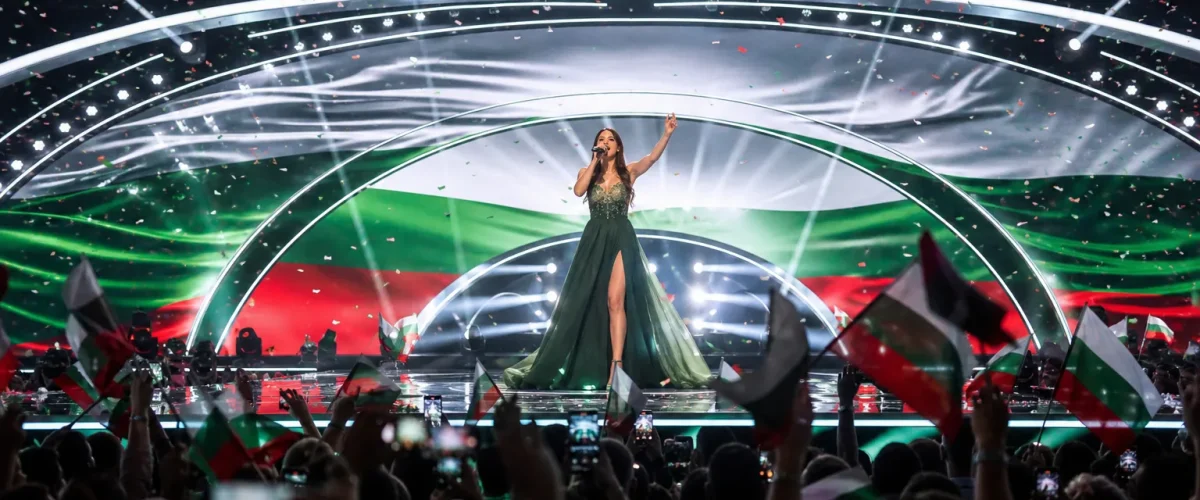
Bulgarian singer Dara has made history by winning the Eurovision Song Contest 2026 in Vienna, Austria, with her electrifying performance of “Bangaranga,” scoring a commanding 516 points and sweeping both the jury and public votes. The victory marks Bulgaria’s first-ever win in the competition’s 70-year history and ends a remarkable journey for the 27-year-old artist, whose real name is Darina Yotova, from national selection hopeful to European champion.
A Dominant Victory: 516 Points Across Both Votes
Dara’s triumph was as comprehensive as it was historic. Bangaranga, a high-energy fusion of Balkan folk melodies, electronic beats, and powerful vocal delivery, resonated with both the professional jury panels and the millions of viewers who voted from across Europe and beyond. The song’s total of 516 points placed it well ahead of the second-place finisher, with Dara winning the jury vote and topping the public televote — a rare double victory that underscores the broad appeal of her performance.
The song was written by an international team of songwriters: Anne Judith Wik from Norway, Romanian-born Cristian Tarcea, Dara herself, and the legendary Greek-Canadian composer Dimitris Kontopoulos, who has been behind some of Eurovision’s most successful entries over the past two decades. The production blended traditional Bulgarian instrumentation with modern electronic sounds, creating what music critics have described as “the most distinctive Eurovision winner in years.”
“I cannot believe this is real. Bulgaria, we did it! This is for everyone who believed in me, everyone who believed in our music, and everyone who believes that small countries can dream big,” Dara said in her emotional victory speech, fighting back tears as the Vienna arena erupted in applause.
Bulgaria’s Long Road to Eurovision Glory
Bulgaria’s Eurovision journey has been a rollercoaster since the country’s debut in the contest in 2005. Despite producing several critically acclaimed entries, including Kristian Kostov’s “Beautiful Mess” which finished second in 2017, Bulgaria had never managed to claim the top prize. The country even withdrew from the competition for several years due to financial constraints at the national broadcaster, Bulgarian National Television (BNT).
The path to Vienna began in January 2026, when BNT organised a multi-stage national selection process called “Natsionalnata selektsiya.” In the first show on 24 January, eight artists competed for the right to represent Bulgaria. Dara was selected as the winning artist by a combined jury and public vote in the second show on 31 January. The final song selection took place on 28 February, where Dara performed three candidate songs. Bangaranga, competing against two other options, was chosen through the same 50/50 jury-public vote mechanism.
The 2026 Eurovision in Context
The 2026 contest in Vienna was held against a backdrop of significant controversy. Five countries withdrew from the competition in protest over the participation of Israel, with over 1,100 artists signing an open letter demanding the country’s exclusion. The boycott, the largest in the contest’s 70-year history, cast a shadow over the proceedings and led to heightened security measures at the Wiener Stadthalle, where the shows were held.
Despite the political tensions, the musical quality of the 2026 contest was widely praised by critics. The competition featured 37 participating countries, with entries spanning genres from traditional folk to hard rock to experimental electronic music. Dara’s victory was seen by many as a return to the contest’s musical roots, with a performance that prioritised vocal talent and cultural authenticity over gimmicks and spectacle.
Who Is Dara?
Darina Yotova, known by her stage name Dara, was born in 1999 in Pleven, a city in northern Bulgaria. She began singing at the age of five and trained at the Bulgarian National Music Academy, where she studied both classical and contemporary vocal techniques. Her musical style draws heavily on Bulgarian folk traditions, which she blends with pop, electronic, and world music influences.
Before Eurovision, Dara had already built a successful career in the Balkans, with several hit singles and a devoted fanbase in Bulgaria, Romania, and Greece. She represented Bulgaria at the Junior Eurovision Song Contest in 2016 as a teenager, finishing in a respectable 12th place with the song “Smile.” That early experience on the Eurovision stage, she has said in interviews, planted the seed for her eventual senior contest entry.
Since winning in Vienna, Dara has been inundated with offers from international record labels and concert promoters. Her management has confirmed that a world tour is being planned for late 2026 and early 2027, with dates expected in major cities across Europe, Asia, and the Americas.
Impact on Bulgarian Culture and Tourism
The Eurovision victory has sparked a wave of national pride in Bulgaria and is expected to provide a significant boost to the country’s tourism and cultural profile. Bulgarian government officials have announced plans to leverage the win in their international tourism marketing campaigns, highlighting the country’s rich musical heritage and cultural attractions.
“This is the best advertisement Bulgaria could possibly receive. Millions of people across the world watched Dara perform and fell in love with Bulgarian music. We expect this to translate into a measurable increase in tourist interest,” said Bulgaria’s Minister of Tourism in a statement.
Comparisons have been drawn to the impact that previous Eurovision victories have had on host and winning countries. Portugal’s 2017 win with Salvador Sobral’s “Amar Pelos Dois” was credited with a double-digit increase in tourism to the country over the following year, and Finland’s 2006 victory by Lordi put the country on the map as a cultural destination beyond its Nordic neighbours.
Reactions From the Music World
The victory has been celebrated across the global music community. British pop star Dua Lipa, who has Bulgarian heritage on her father’s side, posted a congratulatory message on Instagram, calling Dara “an incredible talent” and saying the win was “a proud moment for all of us with Balkan roots.” Greek singer Eleni Foureira, who finished second at Eurovision 2018, called Bangaranga “a masterpiece that deserved every single point.”
In India, where Eurovision has a growing niche following, social media reactions were overwhelmingly positive, with Indian music fans praising the blend of folk and electronic elements that echoes the fusion experiments popular in Bollywood and independent Indian music.
As Bulgaria celebrates its first Eurovision triumph, the country now faces the delightful challenge of hosting the 2027 contest. BNT has confirmed that preparations for a Bulgarian-hosted Eurovision are already underway, with Sofia, Plovdiv, and Varna being considered as potential host cities. For a country that once debated whether it could afford to participate in the contest at all, hosting it represents the ultimate validation of its musical and cultural ambitions on the European stage.

- India’s Startup Funding Crosses $7.2 Billion in H1 2026 - July 1, 2026
- After Ireland Shock, India’s T20I Side Faces Bigger Test - July 1, 2026
- Ireland Stun World Champions India 2-0 in Belfast, Sooryavanshi Debate Rages On - June 29, 2026