Indian Rupee Crashes to Record Low of 96.35 Against US Dollar Amid West Asia Crisis

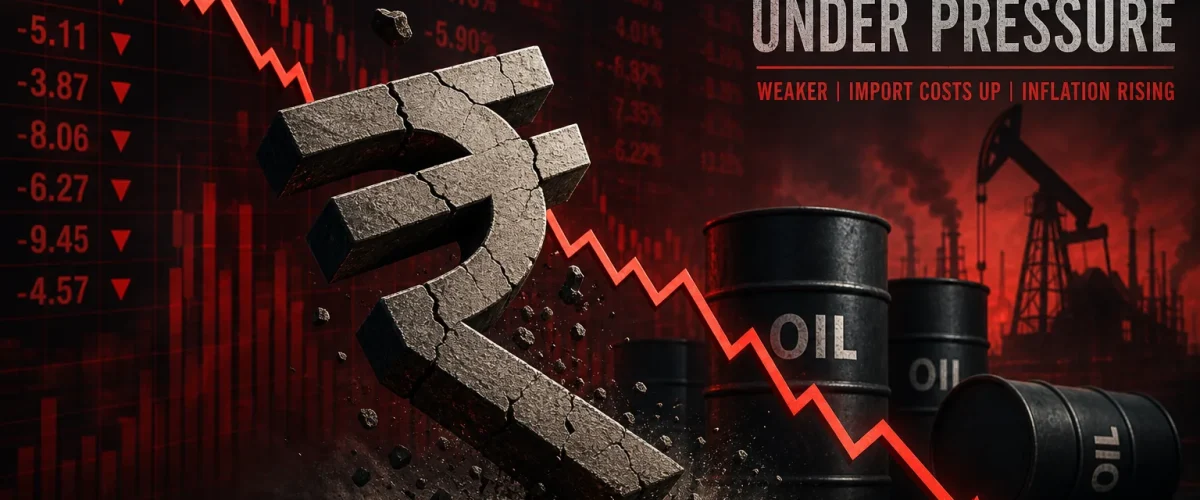
Rupee Breaches 96 Mark as Multiple Pressures Converge
The Indian rupee weakened sharply and closed at a record low of 96.35 against the US dollar on 18 May 2026, marking a steep decline that has alarmed economists, traders, and policymakers alike. The currency, which opened the session at 96.19, fell further to touch 96.39 during intraday trading before settling at 96.35, a decline of 54 paise from its previous close.
This latest fall follows a week of relentless selling pressure that saw the rupee breach the psychologically important 96-mark for the first time on 15 May, when it touched an intraday low of 96.14. The currency’s rapid deterioration reflects a convergence of adverse factors, including soaring crude oil prices, escalating geopolitical tensions in West Asia, persistent foreign institutional investor (FII) outflows, and a strengthening US dollar.
West Asia Crisis Drives Oil Prices Above 109 Dollars
The primary catalyst for the rupee’s decline is the escalating conflict in West Asia involving the United States, Israel, and Iran. The crisis has raised serious concerns about disruptions to oil shipments through the Strait of Hormuz, one of the world’s most critical energy chokepoints through which approximately 20 per cent of global oil supply passes daily.
Brent crude, the global oil benchmark, was trading at USD 109.97 per barrel on 18 May, up 0.65 per cent in futures trade. Oil prices have surged more than 30 per cent since the crisis intensified in early April, driven by fears that a wider conflict could disrupt supply routes and reduce production from major Middle Eastern exporters.
India is particularly vulnerable to oil price spikes because it imports approximately 88 per cent of its crude oil requirements. More than 50 per cent of India’s oil imports transit the Strait of Hormuz, making the country one of the most exposed major economies to any disruption in the waterway.
India’s Oil Vulnerability: 45 Days of Reserves
According to energy analytics firm Kpler, India holds approximately 100 million barrels of commercial crude oil stocks, including volumes in storage tanks, underground strategic reserves at Mangalore, Padur, and Visakhapatnam, and on ships currently en route to Indian ports. This combined stockpile could cover roughly 40 to 45 days of the country’s requirements if flows through the Strait of Hormuz were completely disrupted.
While this buffer provides short-term insulation, analysts warn that a prolonged disruption would create severe medium-term pressures through higher import costs, increased freight charges, and the need to reroute supplies over longer distances. Indian refiners would be forced to seek alternative sources at premium prices, further widening the trade deficit and putting additional downward pressure on the rupee.
The government has taken some steps to mitigate the impact. India has continued purchasing Russian crude oil despite the expiry of a US waiver, securing a discounted alternative to Middle Eastern supply. Fuel retailers have also implemented a recent price hike that has narrowed their under-recoveries, though further increases may be needed if oil prices remain elevated.
Foreign Capital Outflows Add to Currency Pressure
The rupee’s weakness is compounded by sustained foreign capital outflows from Indian equity and debt markets. Foreign institutional investors have been net sellers for several consecutive weeks, pulling billions of dollars out of Indian assets amid global risk aversion and higher yields available in US Treasury bonds.
The US 10-year Treasury yield has risen sharply, making dollar-denominated assets more attractive relative to emerging market investments. This has strengthened the dollar against most major currencies, with the dollar index trading near 99.14, adding to the pressure on the rupee.
Domestic factors have also played a role. India’s trade deficit has widened significantly, driven by higher oil import bills and sluggish export growth. While merchandise exports showed some improvement earlier in 2026, the combination of a strong dollar and weak global demand has limited India’s ability to earn foreign exchange through trade.
RBI’s Response and Market Interventions
The Reserve Bank of India (RBI) has been actively intervening in the foreign exchange market to slow the rupee’s decline, selling dollars from its reserves to provide liquidity and reduce volatility. India’s forex reserves, which jumped USD 6.295 billion to USD 696.988 billion during the week ended 8 May, remain substantial but have declined from their peak levels.
However, there are limits to how much the RBI can do. Sustained intervention depletes foreign reserves, which are needed as a buffer against external shocks. The central bank must balance its desire to support the rupee against the risk of exhausting reserves that may be needed even more urgently if the West Asia situation deteriorates further.
In a separate decision, the RBI chose not to impose additional capital buffers on banks, suggesting that the central bank is prioritising credit flow and economic growth even as it manages currency stability. This reflects the delicate balancing act facing Indian monetary authorities, who must simultaneously address inflation concerns, support growth, and manage external vulnerabilities.
Impact on Indian Consumers and Businesses
A weaker rupee has direct consequences for Indian consumers and businesses. Imported goods become more expensive, contributing to inflation. Students studying abroad face higher costs for tuition and living expenses. Companies that rely on imported raw materials see their input costs rise, squeezing profit margins.
The technology sector, which earns a significant portion of its revenue in dollars, does benefit from a weaker rupee, as dollar earnings translate into more rupees. However, this benefit is partially offset by higher operational costs for companies with significant dollar-denominated liabilities.
For the average consumer, the most immediate impact is likely to be felt at the fuel pump. If crude oil prices remain above USD 100 per barrel and the rupee stays weak, further fuel price increases are almost inevitable, which would have a cascading effect on transportation costs, food prices, and overall inflation.
Outlook: What Traders and Analysts Expect
Currency analysts expect the rupee to remain under pressure in the near term. Anuj Choudhary, Research Analyst at Mirae Asset Sharekhan, projected that the USD-INR pair would trade in a range of 96 to 96.60, with a negative bias. Any escalation of the West Asia crisis or further rise in oil prices could push the currency beyond 97, a level that would represent uncharted territory.
The key variables to watch include developments in the Strait of Hormuz, the trajectory of US Treasury yields, the pace of FII outflows, and any additional intervention measures from the RBI. Commerce Minister Piyush Goyal’s recent call for Indian industry to reduce dependence on capital goods imports reflects a longer-term strategy to reduce the country’s vulnerability to currency fluctuations, but this structural shift will take years to materialise.
Explore more: Business & Economy | Economy

- Fentanyl Vaccine Breakthrough: Scripps Research Develops Shot That Blocks Deadly Overdoses Before They Reach the Brain - June 13, 2026
- Nipah Virus Returns to Kerala — First Case of 2026 Confirmed, State Declares High Alert - June 12, 2026
- Jill Biden Reveals She Wanted to Keep PM Modi’s 7.5-Carat Diamond Gift but Returned It After State Department Valued It at $20,000 - June 8, 2026