Trump Calls Off Planned Military Strike on Iran After Saudi Arabia Qatar and UAE Leaders Request Pause as Serious Negotiations Begin

US President Donald Trump announced on Monday that he has called off a planned military attack on the Islamic Republic of Iran that was scheduled for Tuesday, saying he agreed to pause the strike at the urgent request of three key Gulf allies — Saudi Arabia, Qatar and the United Arab Emirates — who believe they are close to brokering a deal that would include a commitment from Tehran not to pursue nuclear weapons.
What Did Trump Say About the Decision?
In a post on Truth Social on Monday evening, Trump said he had been asked by the Emir of Qatar, Tamim bin Hamad Al Thani, the Crown Prince of Saudi Arabia, Mohammed bin Salman Al Saud, and the President of the UAE, Mohamed bin Zayed Al Nahyan, to hold off on the planned military assault. Trump said he had spoken by phone with all three leaders before making his decision.
“I have been asked by the Emir of Qatar, the Crown Prince of Saudi Arabia, and the President of the United Arab Emirates to hold off on our planned Military attack of the Islamic Republic of Iran, which was scheduled for tomorrow (Tuesday),” Trump wrote. He added that “serious negotiations are now taking place” and that, in the opinion of these Gulf leaders, “a Deal will be made, which will be very acceptable to the United States of America, as well as all countries in the West Asia and beyond.”
Crucially, Trump emphasised that any deal must include a commitment that Iran will not pursue nuclear weapons. “This Deal will include, importantly, NO NUCLEAR WEAPONS FOR IRAN!” he declared. However, he also issued a warning, saying he had instructed Secretary of War Pete Hegseth, Chairman of the Joint Chiefs of Staff General Daniel Caine, and the US military to “be prepared to go forward with a full, large scale assault of Iran, on a moment’s notice, in the event that an acceptable Deal is not reached.”
Background: The US-Iran Military Confrontation
The announcement comes after weeks of escalating military tension between the United States and Iran that has rattled global energy markets and sent crude oil prices surging above $100 per barrel. The US had previously rejected Iran’s ceasefire response as “totally unacceptable” when Tehran demanded that all sanctions be lifted and the Strait of Hormuz be reopened as preconditions for any agreement.
The conflict has had severe consequences for global energy supply, with disruptions near the Strait of Hormuz — through which approximately 20 per cent of the world’s oil passes — creating persistent supply fears. The crisis has directly impacted India and other oil-importing nations, with fuel prices being hiked multiple times in India as a result.
Market Reaction: Oil Prices Drop, Stocks Rally
Global markets reacted swiftly to Trump’s announcement. Crude oil prices fell over 2 per cent in early Asian trading, with Brent crude dropping below $101 per barrel after the news broke. US West Texas Intermediate (WTI) also declined sharply, falling to around $97 per barrel.
Stock markets across Asia opened higher on Tuesday morning, with India’s benchmark indices expected to see a strong opening after days of selling pressure driven by the geopolitical crisis. The Sensex, which had crashed over 3,000 points in the preceding days, was expected to recover a significant portion of those losses if the diplomatic momentum continued.
Currency markets also responded positively, with the Indian rupee expected to strengthen against the US dollar after hitting multi-month lows in recent sessions due to the oil price surge and foreign portfolio investor (FPI) outflows.
India’s Strategic Position in the Crisis
India, which imports approximately 85 per cent of its crude oil requirement, has been one of the nations most affected by the US-Iran confrontation. The crisis triggered the first fuel price hike in four years, pushed CNG prices to record highs, and contributed to a weakening rupee and elevated inflation concerns.
Prime Minister Narendra Modi, who is currently on a multi-nation tour of Europe, has been engaging with world leaders on the energy security front. India has maintained a balanced diplomatic position, calling for dialogue and de-escalation while also ensuring that its own energy supply chains are not disrupted.
The US also announced on Monday that it would extend sanctions relief on Russian oil purchases that are already at sea by 30 days, providing temporary relief to India and other countries that have been purchasing discounted Russian crude. India’s Petroleum Ministry stated that the country would continue purchasing Russian oil regardless of the waiver, as existing contracts and supply arrangements were unaffected by the sanctions regime.
Pakistan’s Role and Regional Dynamics
Notably absent from Trump’s list of mediators was Pakistan, which has been playing a behind-the-scenes role as a mediator in the US-Iran conflict. Trump’s Truth Social post made no reference to Pakistan’s efforts, instead crediting only the Gulf Arab states for the diplomatic breakthrough. This omission is significant, as Pakistan has deployed military assets, including a jet squadron in Saudi Arabia, as part of its efforts to position itself as a key player in the regional security architecture.
Iran, for its part, has responded cautiously to the development. Iranian state media reported that Supreme Leader Ayatollah Ali Khamenei has authorised negotiations but warned that Iran would not accept any deal that compromised its sovereignty or right to peaceful nuclear energy. Iranian Foreign Minister Javad Zarif said Tehran was willing to discuss all issues “in good faith” but warned that the US military threat was not conducive to productive negotiations.
What Happens Next?
The next 48 to 72 hours will be critical in determining whether the diplomatic window opened by the Gulf states’ intervention leads to a substantive agreement or collapses back into military escalation. Trump’s explicit warning that he has instructed the military to be ready for a “full, large scale assault” on a moment’s notice means that the threat of conflict remains very real.
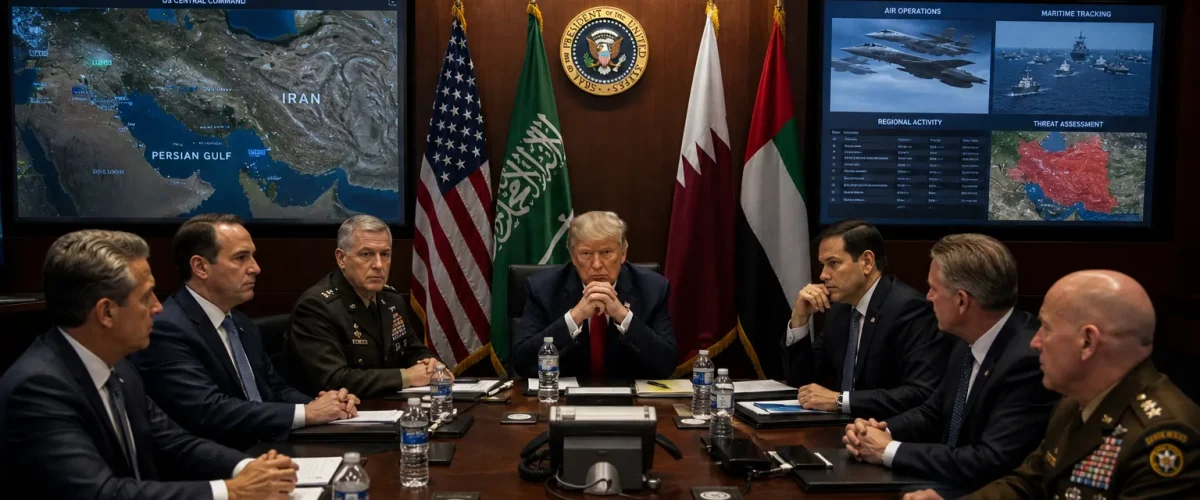
Before the announcement, Trump was expected to convene his top national security team in the White House Situation Room on Tuesday to discuss military options, according to two US officials who spoke to Axios. Whether that meeting now shifts to a focus on diplomatic options or continues to plan military contingencies will depend on the pace and substance of the ongoing negotiations.
For India and other energy-importing nations, the temporary de-escalation offers a breathing space but not a resolution. As long as the fundamental issues — Iran’s nuclear ambitions, US sanctions, and the security of the Strait of Hormuz shipping routes — remain unresolved, the risk of a sudden escalation and its economic consequences will continue to hang over global markets and national economies.

- Indian Army Gets New Chief as General Dwivedi Hands Over Command Amid Push for Indigenous Defence Tech - July 1, 2026
- Ayodhya Ram Temple Donation Scandal Deepens as Trustees Resign and SIT Arrests Eight - June 29, 2026
- Bengal Seven Weeks On: Modi’s Historic Win and the Questions That Won’t Go Away - June 28, 2026