Google I/O 2026: Gemini AI Gets Major Upgrade with Real-Time Reasoning and Deep Research Capabilities

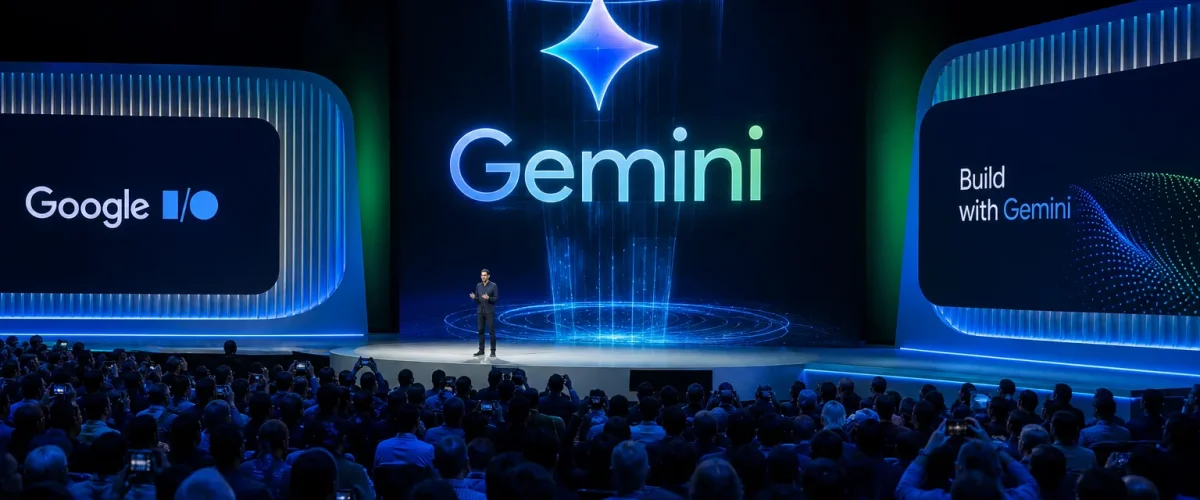
Google I/O 2026: Gemini Becomes the Brain Behind Everything Google
Google’s annual developer conference, I/O 2026, held on 19 May at the Shoreline Amphitheatre in Mountain View, California, was dominated by one theme: the transformation of Gemini AI from a standalone chatbot into the intelligence layer powering every Google product. CEO Sundar Pichai opened the keynote by declaring that Gemini is now processing over 2 billion queries per day across Google’s ecosystem, a figure that underscores how deeply AI has been embedded into the company’s core services.
The announcements spanned search, productivity, mobile, wearables, and developer tools, but the central narrative was clear. Google is betting its future on AI that can reason in real time, conduct deep research, and take action on behalf of users, moving beyond simple question-and-answer interactions toward a model of AI as a persistent, proactive assistant.
Real-Time Reasoning: Gemini Thinks Before It Answers
The most technically significant announcement was the introduction of real-time reasoning in Gemini. Unlike previous AI systems that generate responses word by word in a single pass, the upgraded Gemini can pause, consider multiple approaches, evaluate evidence, and revise its thinking before delivering an answer. This chain-of-thought process happens in seconds but produces dramatically more accurate and nuanced responses.
In a live demonstration, a Google engineer asked Gemini to analyse a complex legal contract and identify potential risks. The AI visibly worked through the document section by section, flagging ambiguous clauses, comparing them against standard legal templates, and producing a structured risk assessment. The entire process took approximately 15 seconds, a task that would take a human lawyer significantly longer.
Real-time reasoning also improves Gemini’s performance on mathematical problems, scientific questions, and coding challenges, areas where getting the right answer requires systematic thinking rather than pattern matching. Google reported that reasoning-enabled Gemini scores 15 to 20 per cent higher on advanced mathematics benchmarks compared to the non-reasoning version.
Deep Research Mode: Multi-Step Investigations on Demand
Google also unveiled a Deep Research mode within Gemini that can conduct multi-step investigations on complex topics. When a user asks a question that requires synthesising information from multiple sources, Deep Research mode breaks the query into sub-questions, searches across the web and Google’s knowledge graph, evaluates source credibility, and assembles a comprehensive report with citations.
The feature is designed for professionals and students who need thorough, well-sourced answers rather than quick summaries. In a demonstration, a researcher asked Gemini to investigate the environmental impact of lithium mining in South America. The AI produced a detailed report covering extraction processes, water usage, local community effects, regulatory frameworks across different countries, and recent academic studies, all within about 30 seconds.
Deep Research mode represents Google’s response to a growing concern about AI-generated content: the tendency of chatbots to produce confident but shallow answers. By conducting genuine research and citing sources, Gemini aims to provide the depth and reliability that users need for serious work.
AI-Powered Google Search: The Next Generation
Google Search is receiving its most significant overhaul in years, with Gemini AI now deeply integrated into the search experience. The new AI-powered search goes beyond the AI Overviews that were introduced in 2024, offering more interactive, conversational search experiences that adapt to the user’s intent in real time.
Users can now ask follow-up questions, refine their searches through conversation, and receive answers that combine web results, knowledge graph data, and AI-generated analysis. The search interface can present information in different formats, such as tables, timelines, or comparison charts, based on what best suits the query.
Google’s head of search explained at I/O that users are now submitting longer, more detailed queries that reveal deeper context and intent. This shift is fundamentally changing how search engines must operate, moving from matching keywords to understanding and fulfilling complex information needs.
Gemini Across Google’s Ecosystem
Beyond search, Gemini AI is being woven into virtually every Google product. In Google Workspace, Gemini can now draft documents, create presentations, analyse spreadsheets, and schedule meetings based on natural language instructions. The integration is particularly powerful in Gmail, where Gemini can summarise email threads, draft contextually appropriate replies, and even flag messages that require urgent attention.
Google Maps is getting AI-powered navigation that goes beyond turn-by-turn directions. Gemini can now understand requests like “find a quiet restaurant near my hotel that serves vegetarian food and is open late,” processing multiple constraints simultaneously to deliver personalised recommendations.
On Android, Gemini is becoming the default AI assistant, gradually replacing Google Assistant for complex tasks while maintaining backward compatibility for simple voice commands. The transition reflects Google’s broader strategy of making Gemini the single AI brain across all its platforms and devices.
Developer Tools and APIs
For developers, I/O 2026 brought several important announcements. The Gemini API now supports function calling, allowing developers to build applications where the AI can interact with external services and databases. There are new SDKs for Android, iOS, and web development that make it easier to integrate Gemini into third-party applications.
Google also introduced Gemini Code Assist 2.0, an upgraded coding assistant that competes directly with GitHub Copilot and other AI coding tools. The new version offers improved code generation, better understanding of project context, and the ability to run and test code within the development environment.
Perhaps most significantly, Google announced that Gemini models can now run on-device for certain tasks, using the processing power of modern smartphones and laptops rather than relying entirely on cloud servers. This on-device capability reduces latency, improves privacy, and enables AI features to work offline.
What Google I/O 2026 Means for India
India is a critical market for Google, with hundreds of millions of users across Search, YouTube, Android, and Google Pay. Several I/O announcements had India-specific relevance, including improved Hindi and regional language support in Gemini, enhanced Google Pay AI features for the Indian market, and the audio glasses announcement that could eventually launch in India. Google’s investment in AI infrastructure in India, including data centres and research labs, suggests that many of the features announced at I/O 2026 will reach Indian users relatively quickly, making this one of the most consequential Google events for the Indian technology ecosystem in recent years.