Cocaine Worth Rs 1,150 Crore Seized Off Gujarat’s Mundra Coast — India’s Biggest-Ever Maritime Drug Bust Nabs International Smuggling Ring

Massive Cocaine Haul Intercepted in Coordinated Operation Off Kutch Coast
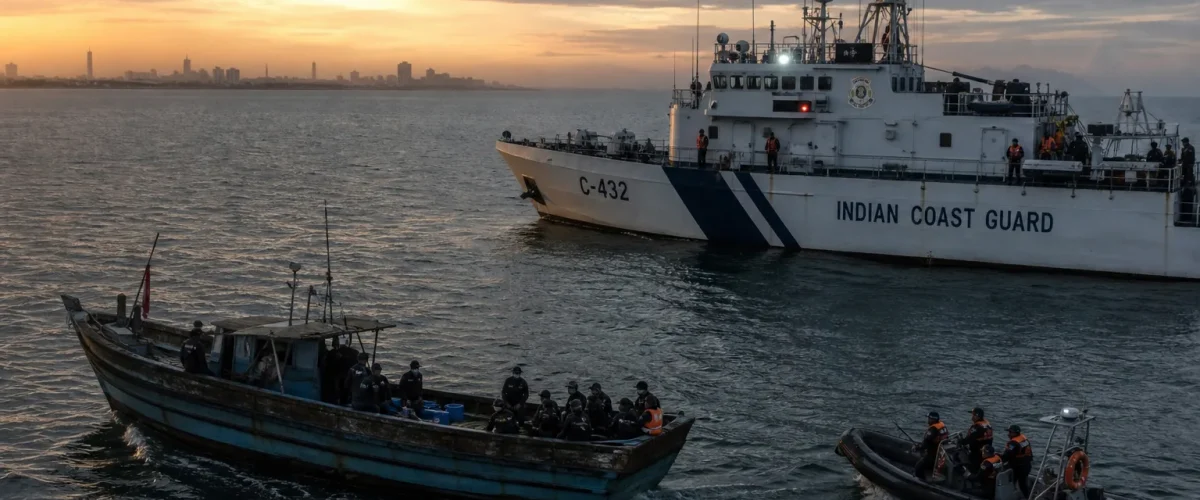
In what is being described as India’s biggest-ever maritime drug seizure, security agencies on Tuesday intercepted a consignment of high-purity cocaine worth approximately Rs 1,150 crore off the coast of Mundra in Gujarat’s Kutch district. The operation, conducted jointly by the Indian Coast Guard, the Narcotics Control Bureau and the Directorate of Revenue Intelligence, resulted in the seizure of approximately 230 kilograms of cocaine from a fishing vessel that was being used to transport the contraband from international waters to the Indian mainland.
Six individuals were arrested in connection with the seizure, including two foreign nationals believed to be part of an international drug trafficking network with links to South American cocaine cartels. Authorities said the operation was the culmination of months of intelligence gathering and surveillance that involved coordination between Indian agencies and their counterparts in multiple countries.
How the Operation Unfolded
According to officials briefed on the operation, the intelligence trail began when the Narcotics Control Bureau intercepted communications suggesting that a large consignment of cocaine was being routed to India through a complex maritime network. The drugs were believed to have originated in South America and were transhipped through multiple waypoints in the Indian Ocean before being loaded onto a locally registered fishing vessel off the coast of Gujarat.
The Indian Coast Guard deployed its offshore patrol vessel and a Dornier maritime surveillance aircraft to track the suspect vessel as it approached Indian territorial waters. The interception took place approximately 40 nautical miles off the Mundra coast in the early hours of Tuesday morning. Coast Guard personnel boarded the vessel and discovered the cocaine concealed in specially constructed hidden compartments below the deck, packaged in waterproof bundles weighing approximately one kilogram each.
The Directorate of Revenue Intelligence, which had been coordinating the intelligence effort, said the cocaine was of exceptionally high purity, estimated at over 90 per cent, which significantly increases its street value. At current international prices and Indian market rates, the seized cocaine has an estimated value of approximately Rs 1,150 crore, making it the single largest cocaine seizure in Indian maritime history.
Mundra’s Emergence as a Drug Trafficking Hotspot
The seizure off Mundra is the latest in a series of major drug interceptions along Gujarat’s coast, raising serious concerns about the state’s emergence as a preferred entry point for international drug trafficking networks. Mundra port, India’s largest private port operated by the Adani Group, has been the site of several significant drug seizures in recent years, including a nearly 3,000-kilogram heroin consignment seized from cargo containers in 2021.
Security analysts say the geographic location of Gujarat’s coast, with its extensive and often poorly monitored coastline stretching over 1,600 kilometres, makes it vulnerable to maritime smuggling operations. The proximity to international shipping lanes and the relatively short distance from key transhipment points in the western Indian Ocean have made the region attractive to drug cartels seeking to penetrate the lucrative Indian market.
Authorities have responded by deploying additional Coast Guard assets along the Gujarat coast and establishing a dedicated joint task force for counter-narcotics maritime operations. The latest seizure is being cited as evidence that enhanced surveillance and inter-agency coordination are yielding results, though officials acknowledge that the scale of the trafficking networks means many consignments likely evade detection.
International Dimensions of the Smuggling Network
The investigation has revealed that the smuggling network operated across multiple continents, with the cocaine originating in Colombia before being transported through Brazil to West Africa and then across the Indian Ocean. The route mirrors patterns identified by the United Nations Office on Drugs and Crime, which has warned that Indian Ocean maritime routes are increasingly being exploited by South American cartels seeking to expand their market reach into South and Southeast Asia.
The two foreign nationals arrested in connection with the seizure are believed to be mid-level operatives in the network who were responsible for coordinating the final leg of the shipment from international waters to the Indian coast. Indian authorities have requested mutual legal assistance from several countries as part of the ongoing investigation, which aims to identify and dismantle the broader network behind the consignment.
The NCB has indicated that the investigation is still in its early stages and that further arrests are anticipated as the agency traces the financial flows associated with the smuggling operation. Officials said that the sophistication of the concealment techniques and the multi-country logistics involved suggest the involvement of a well-funded and professionally organised criminal enterprise.
Growing Cocaine Demand in India
The size of the Mundra seizure has also focused attention on the growing demand for cocaine in India’s urban centres. While heroin and cannabis have traditionally been the dominant illicit drugs in the Indian market, law enforcement data shows a sharp increase in cocaine seizures over the past five years, reflecting changing consumption patterns among affluent urban populations. The NCB’s annual report for 2025 noted a 340 per cent increase in cocaine seizures compared to 2020 levels.
Drug policy experts say the rising cocaine demand in India is driven by multiple factors, including increased connectivity with global markets, rising disposable incomes in urban areas, and the influence of social media and popular culture that has normalised recreational drug use among certain demographics. The challenge for enforcement agencies is that cocaine trafficking networks are typically more sophisticated and better funded than those dealing in traditional drugs, making detection and disruption significantly more difficult.
The Mundra seizure comes at a time when India is also grappling with broader societal trends that intersect with issues of law enforcement, governance, and public health. Home Minister Amit Shah congratulated the agencies involved in the operation and reiterated the government’s zero-tolerance approach to drug trafficking, pledging additional resources for maritime counter-narcotics operations along India’s coastline.
Explore more: Social Trends | Culture
Related Articles

- Indian Army Gets New Chief as General Dwivedi Hands Over Command Amid Push for Indigenous Defence Tech - July 1, 2026
- Ayodhya Ram Temple Donation Scandal Deepens as Trustees Resign and SIT Arrests Eight - June 29, 2026
- Bengal Seven Weeks On: Modi’s Historic Win and the Questions That Won’t Go Away - June 28, 2026