India Fertility Rate Drops to 1.9 Below Replacement Level for First Time — Only Six States Remain Above 2.1 as Demographic Shift Accelerates

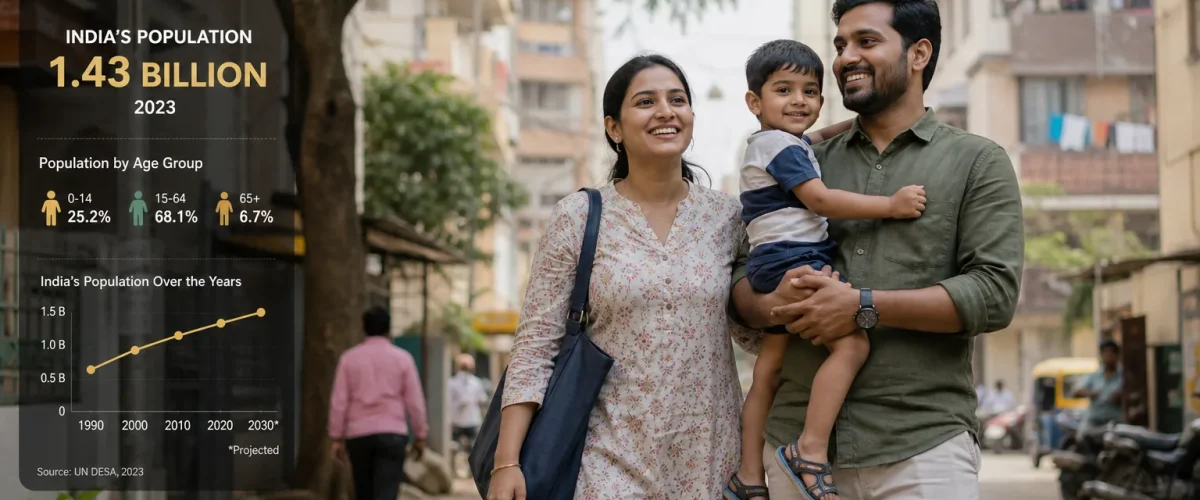
India’s Total Fertility Rate has dropped to 1.9 children per woman, falling below the replacement level of 2.1 for the first time in the country’s history. The data, published in the Sample Registration System Statistical Report 2024 by the Office of the Registrar General, confirms that India is now firmly in the demographic transition that economists and demographers have been tracking for decades.
The implications are enormous. A country that spent the better part of the 20th century worrying about population explosion is now facing the early signs of a very different challenge — population ageing, a shrinking workforce and the economic consequences of having fewer young people entering the labour market.
Delhi recorded the lowest TFR in the country at 1.2, followed by Tamil Nadu at 1.4. Only six states — Bihar (2.9), Uttar Pradesh (2.4), Madhya Pradesh (2.3), Rajasthan (2.2), Chhattisgarh (2.2) and Jharkhand (2.1) — remain at or above the replacement threshold. Every other state and union territory is now below 2.1.
The Numbers Behind the Decline
The TFR has been falling steadily since the 1970s. It stood at 5.2 in 1971, dropped to 3.6 by 1991, and has now reached 1.9 in 2024. What is striking is the pace of the most recent decline — from 2.1 to 1.9 in just a few years — and the fact that urban areas (1.5) are now well below replacement while rural areas (2.1) are exactly at the threshold.
Bihar’s decline has been the slowest in the country. Its TFR dropped just 9.4 per cent over the past decade, from 3.2 in 2012-14 to 2.9 in 2022-24. Chhattisgarh (11.5 per cent) and Assam (13 per cent) also recorded relatively small declines. By contrast, Delhi and Tamil Nadu, which already had low fertility rates, saw steep additional drops of 29.4 and 23.5 per cent respectively.
These regional disparities matter because they directly affect political representation. India’s parliamentary constituencies are frozen at 1971 population levels for delimitation purposes, but a fresh delimitation exercise — potentially linked to the upcoming Census 2027 — could shift seats from southern states with low fertility to northern states with higher populations, creating significant political tension.
What a Sub-Replacement Fertility Rate Actually Means
A TFR below 2.1 does not mean India’s population will start shrinking immediately. Population momentum — the effect of a large base of young people who have yet to complete their reproductive years — will keep India’s population growing for another two to three decades. India is projected to peak at approximately 1.7 billion around 2060 before beginning a gradual decline.
The more immediate concern is the dependency ratio. As fertility drops and life expectancy rises, the proportion of elderly dependents relative to working-age adults increases. Countries like Japan, South Korea and much of Western Europe have already experienced the economic consequences of this shift — strained pension systems, rising healthcare costs and chronic labour shortages in key sectors.
India is not there yet, but the window of the demographic dividend — the period when a large working-age population drives economic growth — is finite. A Carnegie Endowment analysis published in April 2026 warned that “the question is no longer whether India will age before it grows wealthy but, rather, whether the country’s institutions can successfully manage its demographic potential.”
Why the Fertility Rate Fell So Fast
Three factors have driven the decline. First, female education levels have risen sharply. Women with secondary education consistently have fewer children than those without. India’s female literacy rate has climbed from 54 per cent in 2001 to over 72 per cent in 2024, and states with the highest female education — Kerala, Tamil Nadu, Goa — also have the lowest fertility.
Second, access to contraception has expanded. The government’s family planning programmes, once focused almost exclusively on sterilisation, have diversified to include reversible contraceptive methods, IUD insertions and oral contraceptive pills. The National Family Health Survey shows that contraceptive prevalence has increased significantly among women aged 15-49.
Third, economic aspirations have changed. Urbanisation, rising housing costs and the desire to invest in children’s education and health have created strong incentives for smaller families. This is a pattern seen globally — as household incomes rise and access to information improves, fertility rates fall.
Policy Implications for India
The sub-replacement TFR raises several policy questions that India has not yet fully addressed. Should India begin investing in elder care infrastructure now, before the demographic wave arrives? Should immigration policy be liberalised to maintain the labour supply? Should pronatalist incentives — common in countries like Hungary, Japan and Singapore — be considered for states where fertility has dropped below 1.5?
The digital census infrastructure being developed for 2027 will provide the granular data needed to answer these questions. But the policy response will need to begin before those numbers arrive.
For the social trends shaping modern India, the fertility data tells a story of a country that is modernising rapidly — in some respects faster than its institutions can adapt. The six states above replacement will eventually converge with the national trend. When they do, India will face the full force of a demographic challenge that no country with 1.4 billion people has ever had to manage.
Healthcare companies, particularly those in the healthtech sector, are already positioning for a market where geriatric care, chronic disease management and preventive health services will see demand growth that outpaces traditional maternal and child health segments.