Delhi Malviya Nagar Hotel Fire Kills 21 Including 17 Foreign Nationals — Owner Arrested as Safety Violations Emerge

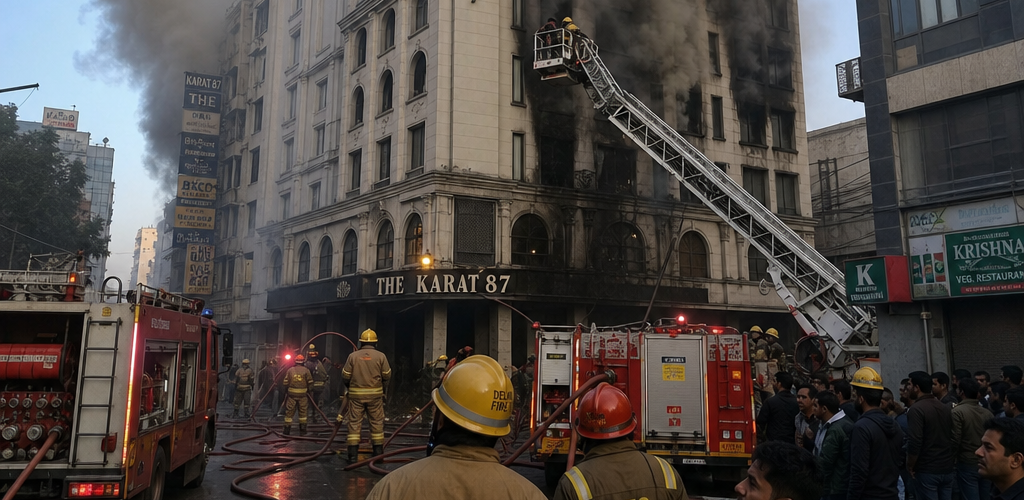
A massive fire tore through the Flourish Stay Bed and Breakfast hotel in south Delhi’s Malviya Nagar early on Wednesday morning, killing at least 21 people — including 17 foreign nationals — and injuring over a dozen others. The blaze, which broke out around 8:50 a.m. in the ground-floor restaurant, spread rapidly through the multi-storey structure before fire services could reach the narrow lanes surrounding the building.
What Happened at Flourish Stay
According to Delhi Fire Services, the fire originated in the basement restaurant of the Flourish Stay hotel and quickly engulfed the adjacent Micasa Inn through a shared stairwell. Thick smoke filled the corridors within minutes, trapping dozens of guests on upper floors. Forty-seven people were inside the building at the time.
Rescue teams from the National Disaster Response Force (NDRF) and Delhi Police extracted survivors using ladders from windows, but the narrow access lanes delayed fire tenders from reaching the spot for critical minutes. The hotel sits in a densely packed residential area off a main road, with approach lanes barely wide enough for a single vehicle.
Eighteen bodies were brought to the All India Institute of Medical Sciences (AIIMS) Trauma Centre, while 15 injured survivors received treatment in intensive care. Among the dead were nationals from Bangladesh, Libya, Cameroon, and several Central Asian countries — most of whom were in Delhi for medical treatment at the nearby Max Hospital in Saket.
Safety Violations That Made the Fire Deadly
An initial investigation by fire officials has uncovered a staggering list of safety and regulatory violations that turned a manageable fire into a fatal catastrophe. The Flourish Stay was licensed to operate as a six-room bed and breakfast under Delhi’s tourism department regulations. In practice, it had expanded into a 25-room hotel — more than four times its permitted capacity.
The premises lacked a fire No Objection Certificate (NOC), smoke detectors, automated fire alarms, and sprinkler systems. Hotel owner Lovkesh Bajaj reportedly told police that buildings under 15 metres in height do not require a fire NOC under Rule 27 of the Delhi Fire Service Rules, 2010 — a claim investigators are now scrutinizing.
Perhaps the most damning revelation concerns the hotel’s locking system. The main entrance was fitted with an electronically operated gate that required a control button to open. After 11 p.m. each night, an additional iron grille gate outside was padlocked shut. When the fire knocked out the building’s electricity supply, both systems became inoperable — effectively sealing the exit.
“The moment the electricity went out, the main gate became completely jammed,” Mohit, a local resident who witnessed the rescue, told reporters. “The hotel staff used a control button to operate the gate, but because of the fire and power failure, it stopped functioning and people got trapped inside.”
Individual room doors also used electronic key-card locks that failed without power, leaving guests unable to open their own rooms. Rescuers had to break through the iron grille gate with cutting equipment before they could even enter the building.
Who Were the Victims
The human cost reveals a troubling pattern. Of the 21 dead, 17 were foreign nationals — predominantly medical tourists who had travelled to Delhi for treatment at hospitals in the Saket area. The hotel’s proximity to Max Hospital and its relatively low room rates (Rs 2,500 to Rs 3,000 per night) made it a popular choice for patients and their families from Africa and Central Asia.
Minister of State for External Affairs Kirti Vardhan Singh visited the injured at various hospitals. The Ministry of External Affairs has reached out to the embassies of Bangladesh, Libya, and Cameroon to coordinate with the families of the deceased and arrange repatriation of remains where requested.
Government Response and Arrests
Prime Minister Narendra Modi expressed grief over the incident and announced ex-gratia payments of Rs 2 lakh from the Prime Minister’s National Relief Fund (PMNRF) for the families of each deceased victim and Rs 50,000 for those injured. Delhi Chief Minister Rekha Gupta ordered a magisterial inquiry and directed the Municipal Corporation of Delhi (MCD) to conduct fire safety audits of all budget hotels and guest houses across the city.
Delhi Police arrested hotel owner Lovkesh Bajaj within hours of the fire under sections relating to culpable homicide not amounting to murder and public endangerment. A First Information Report (FIR) has been registered at the Malviya Nagar police station, and investigators are examining whether the restaurant’s gas cylinders contributed to the fire’s rapid spread.
A Pattern of Fire Tragedies in Delhi
The Malviya Nagar fire is the latest in a grim series of building fires in the national capital that have exposed chronic gaps in fire safety enforcement. In May 2026, a building collapse near Saket Metro killed four people, while multiple factory fires in East Delhi’s industrial areas have claimed lives over the past year.
Fire safety experts point out that Delhi has roughly 80,000 commercial establishments operating without valid fire NOCs. The city’s fire services department has only about 70 fire stations serving a population of over 20 million — a ratio that falls far short of National Fire Protection Association standards.
“The problem is not a lack of rules — it is a complete absence of enforcement,” said Rakesh Kumar, a fire safety consultant who has audited buildings in the Malviya Nagar area. “Every hotel fire in Delhi follows the same script: overcrowding, no safety equipment, locked exits, and narrow lanes. Until there are criminal consequences for building owners who flout norms, nothing will change.”
What Needs to Change
The Delhi government has promised a crackdown, but structural challenges remain. Budget hotels in residential areas often operate under bed-and-breakfast licenses that have lighter regulatory requirements than full hotel licenses. Building owners exploit this loophole by registering as B&Bs while operating commercial-scale accommodations.
Fire safety advocates are calling for mandatory electronic fire suppression systems in all commercial lodgings regardless of height, a ban on sole-entry buildings used for hospitality, and regular unannounced fire safety inspections with authority to immediately shut down non-compliant establishments.
For the families of the 21 victims — many of whom had come to India seeking medical care and instead found a dangerous and unregulated accommodation — the policy debate offers no comfort. The investigation continues, and the death toll may still rise as several critically injured survivors remain in intensive care.
The Delhi High Court has taken suo motu cognizance of the fire and is expected to hear the matter later this week, with the possibility of issuing directions on fire safety compliance across the city’s hospitality sector.