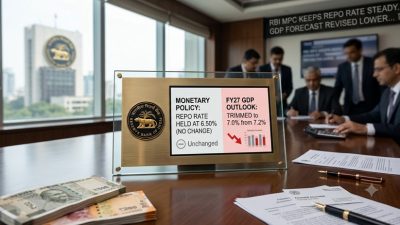
RBI Holds Repo Rate Unchanged at 5.25 Percent as MPC Unanimously Votes for Neutral Stance in June 2026 Meeting

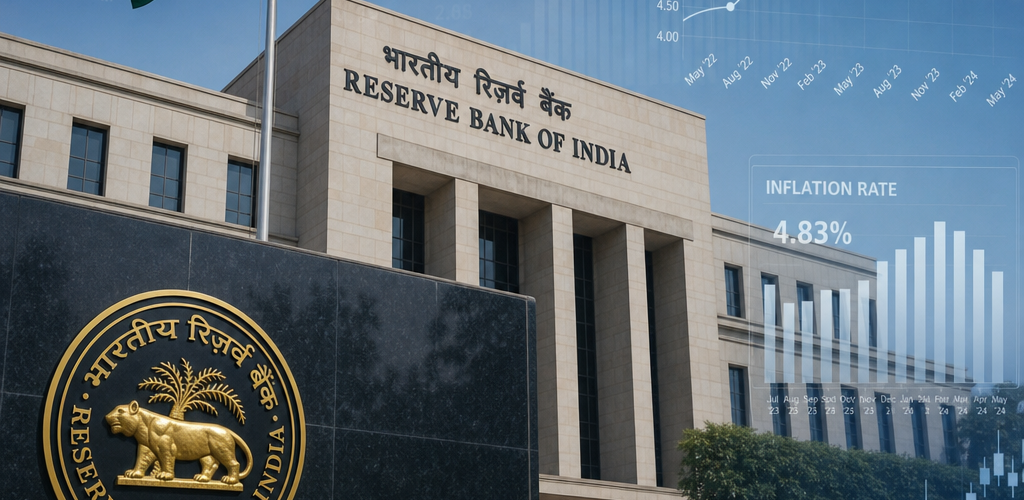
The Reserve Bank of India kept the policy repo rate unchanged at 5.25% on Friday after the conclusion of its three-day Monetary Policy Committee meeting in June 2026. The decision was unanimous, with all six MPC members voting to maintain both the rate and the neutral monetary policy stance — a signal that the central bank sees no immediate need to adjust policy in either direction.
RBI Governor Sanjay Malhotra, who chaired the meeting, noted that domestic economic activity remains resilient despite a challenging global environment, supported by strong demand, healthy bank balance sheets, sustained credit growth, and continued infrastructure spending.
The Rate Cut Pause: Context and Reasoning
The decision to hold rates marks a pause after the RBI’s cumulative 125 basis points of rate cuts since February, which brought the repo rate down from 6.5% to 5.25% in one of the most aggressive easing cycles in recent memory. The cuts were designed to stimulate growth amid a global slowdown, but the MPC’s decision to pause suggests the committee believes the economy has absorbed the stimulus and further cuts carry inflation risks.
Consumer Price Index (CPI) inflation currently sits below the RBI’s 4% target, but the central bank cautioned that inflation could move closer to the upper tolerance band of 6% in the coming months. The monsoon forecast, food price pressures from a potential El Niño, and elevated global energy costs from the ongoing Gulf tensions all feature as upside risks to inflation.
“The MPC decided to remain watchful and assess the evolving inflation-growth dynamics before considering any further adjustment,” Governor Malhotra said during the post-meeting press conference. “The neutral stance gives us flexibility to act in either direction as the situation demands.”
GDP Growth Outlook: Cautious Optimism
The RBI retained its GDP growth projection at 6.9% for FY27, positioning India as one of the fastest-growing major economies. However, the growth outlook comes with significant caveats. Geopolitical tensions in the Middle East, uncertainty around global trade policies, and the potential impact of El Niño on agricultural output all cloud the picture.
Also read: the RBI MPC meeting that began on June 3
Chief Economic Advisor V. Anantha Nageswaran separately noted this week that India could return to over 7% growth in FY28 if global conditions improve and domestic reforms continue. The government’s capital expenditure push, combined with the private investment cycle showing early signs of revival, forms the basis for this optimism.
However, the recent data showing India’s economy slipping to the sixth-largest globally — displaced by a weakening rupee rather than any fundamental deterioration — underscores the challenges of maintaining growth momentum when currency headwinds erode nominal GDP in dollar terms.
Dollar Inflows and the FII Play
Running parallel to the MPC decision, the government announced a significant sweetener for foreign investors by exempting Foreign Institutional Investors (FIIs) from capital gains tax on government securities through an Income Tax Amendment Ordinance effective 01 April 2026. RBI Deputy Governor Poonam Gupta indicated that gross FDI could cross $100 billion in FY27, buoyed by these measures.
The RBI also announced swap support measures that are expected to reduce hedge costs for foreign currency deposits, potentially lifting FCNR(B) rates by up to 200 basis points. Market participants estimate these combined initiatives could attract $30-40 billion in fresh inflows over the next 12 months.
“The RBI is clearly trying to strengthen the rupee’s position while keeping monetary conditions supportive of growth,” said Rajeev Kapoor, chief economist at a leading Mumbai-based brokerage. “The G-Sec tax exemption and the swap window together form a coordinated strategy to attract dollar flows without cutting rates further.”
What This Means for Borrowers and Markets
For retail borrowers, the rate pause means EMIs on floating-rate home loans, car loans, and personal loans will remain stable at current levels. Banks have already transmitted most of the previous rate cuts, with the weighted average lending rate on fresh loans declining by approximately 95 basis points since the easing cycle began.
Also read: RBI’s recent denial of selling $12 billion in gold reserves
For equity markets, the pause was largely expected and priced in. The Nifty 50 showed muted reaction, with traders focused more on the government’s G-Sec tax exemption as a potential trigger for bond market inflows that could indirectly support equity sentiment.
The next MPC meeting is scheduled for August, and most economists expect the RBI to maintain its pause through at least September unless inflation undershoots meaningfully or global growth takes a sharper turn downward. For now, the message from Mint Road is clear: the heavy lifting on rate cuts is done, and the central bank is content to watch and wait.
The Bigger Picture: India’s Monetary Transition
The June MPC meeting marks a subtle but important transition in India’s monetary policy approach. After the aggressive 125 basis point easing cycle that began in February, the RBI has effectively signalled that the era of rate cuts is over — at least for now. The focus has shifted from stimulating growth through lower borrowing costs to maintaining financial stability while managing external risks.
Governor Malhotra’s emphasis on the neutral stance was carefully calibrated. By maintaining neutrality rather than shifting to an accommodative or hawkish stance, the RBI preserves optionality. If global conditions deteriorate sharply — a deeper Gulf conflict, for instance, that sends oil prices above $120 per barrel — the MPC retains the ability to cut rates further. Conversely, if food prices spike due to El Niño or core inflation re-accelerates, the neutral stance allows for a pivot toward tightening.
“The RBI is threading a needle between supporting growth and managing inflation expectations,” said Dr. Madan Sabnavis, chief economist at Bank of Baroda. “The pause was expected, but the unanimity of the decision and the commitment to neutrality suggest this isn’t just a one-meeting pause. This is a holding pattern that could last through the year.”
For the Indian economy, the MPC’s decision reflects a moment of transition. The heavy monetary stimulus has been deployed. The fiscal infrastructure spending continues. Now comes the harder part — translating those inputs into sustained, broad-based growth while keeping inflation within the target band. The RBI’s willingness to pause and watch, rather than chase growth with further cuts, suggests the central bank believes the economy is strong enough to stand on its own feet.

- India’s Startup Funding Crosses $7.2 Billion in H1 2026 - July 1, 2026
- After Ireland Shock, India’s T20I Side Faces Bigger Test - July 1, 2026
- Ireland Stun World Champions India 2-0 in Belfast, Sooryavanshi Debate Rages On - June 29, 2026