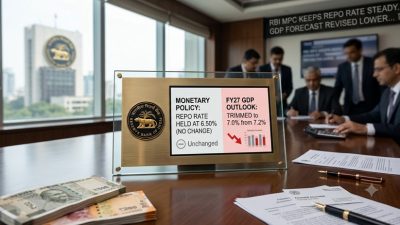
RBI MPC Meeting Begins on June 3 — Repo Rate Hold at 5.25 Percent Expected as Governor Malhotra to Announce Decision on June 5

The Reserve Bank of India’s Monetary Policy Committee began its second bimonthly review of the 2026-27 fiscal year on June 3, with Governor Sanjay Malhotra set to announce the committee’s final resolution on Friday, June 5. Most economists and market participants expect the six-member MPC to hold the repo rate steady at 5.25 percent while maintaining its “neutral” monetary policy stance, as the central bank balances weakening global growth prospects against domestic inflation that has remained broadly within its target range.
Why a Rate Hold Is Expected
The consensus among economists is that the MPC will opt for a status quo on rates after having kept the repo rate unchanged at 5.25 percent during its April 2026 review. The decision to hold in April was unanimous, with all six committee members voting to maintain the current rate and continue with the neutral stance. Several factors support a similar outcome this time.
Consumer price inflation, the RBI’s primary mandate under its inflation-targeting framework, has been hovering near the 4 percent midpoint of the 2-6 percent target band. While food prices remain a concern — particularly for vegetables, pulses, and edible oils — core inflation (excluding food and fuel) has moderated to comfortable levels. The central bank’s inflation projections for the full fiscal year remain anchored around 4.2-4.5 percent, suggesting no urgency to tighten monetary policy.
At the same time, the case for further rate cuts has weakened in recent months. After cutting rates by a cumulative 75 basis points between late 2025 and early 2026, the RBI has signalled that the current level of the repo rate is appropriate given the balance of risks between growth and inflation. The neutral stance gives the MPC flexibility to move in either direction based on incoming data, without committing to a specific trajectory.
Global Headwinds Complicating the Outlook
The MPC’s deliberations are taking place against a backdrop of significant global uncertainty. The US Federal Reserve has maintained its benchmark rate in a range that remains elevated by historical standards, limiting the space for emerging market central banks to cut rates aggressively without risking capital outflows and currency depreciation. The Indian rupee has been under intermittent pressure, and a premature rate cut by the RBI could widen the interest rate differential with the US and trigger capital outflows.
The escalation in global energy prices, driven by geopolitical tensions in the Middle East and production adjustments by OPEC+ nations, poses an upside risk to India’s inflation trajectory. India imports over 85 percent of its crude oil requirements, making it particularly vulnerable to oil price shocks. A sustained increase in crude prices could feed through to transportation costs, manufacturing inputs, and eventually consumer prices, potentially pushing inflation above the RBI’s comfort zone.
The US government’s latest proposal to impose additional tariffs on 60 countries including India over forced labour concerns has added another layer of uncertainty to the global trade outlook. If implemented, these tariffs could affect India’s export growth and, paradoxically, put downward pressure on domestic demand growth — a scenario that would call for a more accommodative monetary policy.
Domestic Growth Dynamics
India’s GDP growth has been resilient but uneven. The economy grew at an estimated 6.5 percent in 2025-26, but growth has been increasingly driven by government capital expenditure and services sector expansion, while private consumption and manufacturing have shown mixed signals. The RBI’s own growth projection for 2026-27 stands at around 6.7 percent, which would represent a moderate improvement.
Credit growth in the banking system has been robust, supported by strong demand for retail loans (home loans, auto loans, personal loans) and a gradual recovery in corporate borrowing for capital expenditure. However, some segments of the financial system — particularly the microfinance sector and certain non-banking financial companies — have shown signs of stress, prompting the RBI to tighten prudential norms in these areas.
What to Watch on June 5
Beyond the rate decision itself, market participants will closely scrutinise the RBI’s updated growth and inflation projections, the Governor’s assessment of global and domestic risks, and any signals about the future direction of monetary policy. The committee’s voting pattern will also be important — a divided vote with some members calling for rate cuts would suggest the MPC is moving closer to an easing cycle, while a unanimous hold would indicate comfort with the current stance.
The RBI is also expected to announce measures related to liquidity management, digital payments infrastructure, and potentially new guidelines for the financial technology sector. The central bank has been progressively expanding its regulatory perimeter to cover emerging risks in areas such as digital lending, cryptocurrency-adjacent activities, and AI-driven financial services.
Bond markets have largely priced in a rate hold, with the yield on the benchmark 10-year government bond trading in a narrow range. Equity markets are expected to react more to the commentary and forward guidance than to the rate decision itself, given that the outcome is widely anticipated. Any surprise — whether in the form of an unexpected rate cut or a change in stance — could trigger significant market moves.