Commercial LPG Prices Hiked by Up to Rs 53.50 Per Cylinder from June 1 — Restaurants and Businesses Hit Hard

Commercial LPG Gets Costlier Across India from June 1
Commercial LPG cylinder prices have been increased by Rs 42 to Rs 53.50 per cylinder across major Indian cities, effective from 1 June 2026, according to oil marketing companies. The price revision applies to 19-kg commercial cylinders used by hotels, restaurants, canteens, and businesses — not to domestic cooking gas cylinders, which remain unchanged.
In Delhi, the price of a 19-kg commercial LPG cylinder has risen by Rs 42, taking the retail price to Rs 3,113.50. Kolkata sees the steepest increase at Rs 53.50, pushing the price to Rs 3,255.50. In Mumbai and Chennai, prices have risen by Rs 44 and Rs 49 respectively, according to news agency ANI.
City-Wise Breakdown of New Commercial LPG Prices
The revised prices paint a picture of varying impacts across the country. Delhi’s new price of Rs 3,113.50 represents a 1.4 percent increase from the previous month. Mumbai’s commercial cylinder now costs Rs 3,031, while Chennai’s price stands at Rs 3,389.50 — the highest among metro cities due to higher state-level taxes and transportation costs.
Kolkata’s Rs 53.50 increase — the sharpest in absolute terms — takes the price to Rs 3,255.50. Industry observers note that the differential pricing across cities reflects variations in local taxes, freight charges, and dealer commissions rather than differences in base product cost.
The 5-kg Free Trade LPG cylinder, commonly used by small eateries and street food vendors, has also seen a price increase, though the exact quantum varies by city. This smaller format is particularly important for the street food economy, where margins are already razor-thin.
Why Commercial LPG Prices Are Rising
The price hike comes amid several converging pressures on global energy markets. The ongoing Strait of Hormuz crisis has disrupted oil and gas supply chains, adding a significant risk premium to energy commodities. Saudi Aramco’s official selling prices for June have also been revised upward, reflecting tighter global supply conditions.
Commercial LPG prices in India are revised monthly based on the trailing average of international benchmark Saudi CP (Contract Price) for propane and butane. The Saudi CP for propane rose to $615 per metric tonne in May, up from $590 in April, while butane prices climbed to $620 from $595. These increases directly feed into the domestic commercial LPG pricing formula.
Additionally, the weakening of the Indian rupee against the US dollar — currently hovering around 87.65 — has added to the import bill. India imports roughly 60 percent of its LPG requirement, making the domestic market highly sensitive to both global price movements and currency fluctuations.
Impact on Restaurants and Food Businesses
The restaurant and hospitality industry, still recovering from pandemic-era disruptions and recent food inflation, has expressed concern over the latest increase. The National Restaurant Association of India (NRAI) estimates that LPG costs account for 3–5 percent of total operating expenses for a typical restaurant, but the cumulative effect of repeated hikes over the past year has pushed that figure higher for smaller establishments.
“Every Rs 50 increase on a commercial cylinder might seem small, but a mid-sized restaurant uses 15–20 cylinders per month. That’s an additional Rs 750–1,000 monthly, and these costs compound over the year,” said Anurag Katriar, a prominent restaurateur and former NRAI president. “At some point, this has to be passed on to consumers through higher menu prices.”
Street food vendors and small dhabas, which operate on even thinner margins, are disproportionately affected. Many of these businesses lack the pricing power to raise menu prices without losing customers. Industry groups have called on the government to consider subsidising commercial LPG for small food businesses, similar to the Ujjwala scheme for household consumers.
Domestic Cylinders Untouched — For Now
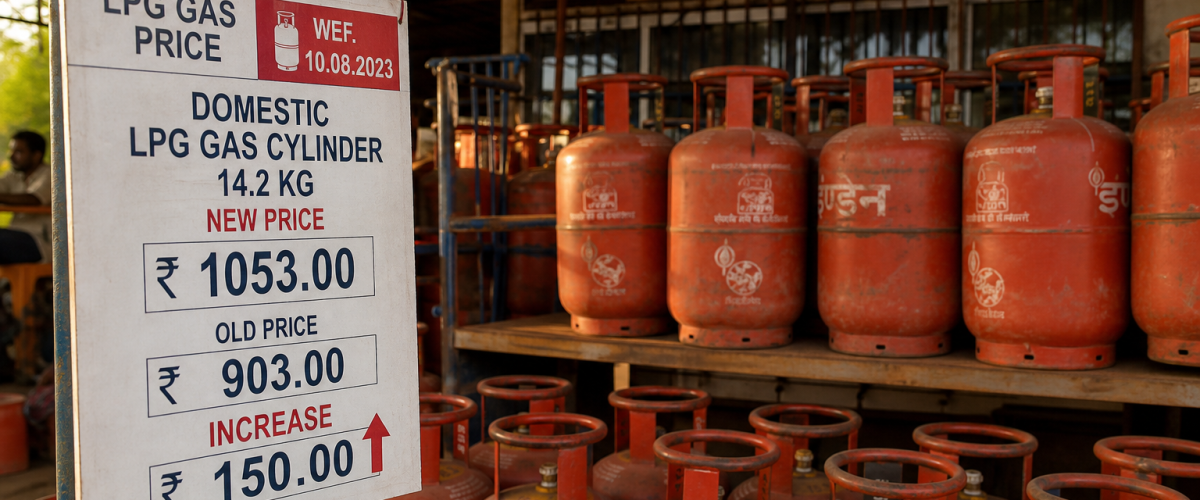
In a relief for household consumers, the price of 14.2-kg domestic LPG cylinders remains unchanged. The government has kept domestic cylinder prices stable since early 2024 through a combination of subsidies and absorption of costs by oil marketing companies.
However, analysts warn that the divergence between commercial and domestic prices cannot be sustained indefinitely. “The spread between commercial and subsidised domestic LPG is now one of the widest it has ever been,” noted K. Ravichandran, senior vice president at ICRA. “Either domestic prices will need to adjust upward, or oil marketing companies will start reporting losses on their LPG segment.”
The political sensitivity of domestic LPG prices — especially with several state elections on the horizon — makes any increase unlikely in the near term. The Pradhan Mantri Ujjwala Yojana, which provides subsidised connections to below-poverty-line households, remains a flagship government programme that no ruling party wants to dilute.
Historical Context and Cumulative Impact
Commercial LPG prices have risen significantly over the past 18 months. In January 2025, a 19-kg commercial cylinder in Delhi cost approximately Rs 2,700. The current price of Rs 3,113.50 represents a cumulative increase of over Rs 400, or roughly 15 percent, in that period.
The sharpest increases came during the first quarter of 2026, coinciding with the Hormuz crisis and the broader disruption to Middle Eastern energy flows. While the temporary ceasefire in April-May provided some respite, the latest geopolitical developments suggest that energy prices may remain elevated for the foreseeable future.
What Consumers and Businesses Can Do
Energy consultants recommend that commercial LPG users explore energy efficiency measures to offset rising costs. Investing in energy-efficient burners, which can reduce LPG consumption by 15–20 percent, is one practical step. Larger establishments might also consider transitioning partially to piped natural gas (PNG) where available, as PNG prices tend to be more stable and are currently cheaper than LPG on a per-unit energy basis.
For the broader Indian economy, the commercial LPG hike is one more data point in the inflation puzzle that the Reserve Bank of India is closely monitoring. With food inflation already elevated and energy costs creeping up, the trajectory of prices in the coming months will be critical for both monetary policy decisions and household budgets.