What Salaried and Business Taxpayers Need to Know for AY 2026-27

Filing dates for ITR-1 through ITR-4 are no longer uniform — here’s the revised calendar following Budget 2026 changes.
Tax season has arrived with a twist this year. For decades, India’s salaried class circled one date on the calendar — 31 July — as the income tax return deadline. That single-date system has now been replaced with a tiered structure that depends on which ITR form a taxpayer is required to use, following changes introduced in Budget 2026.
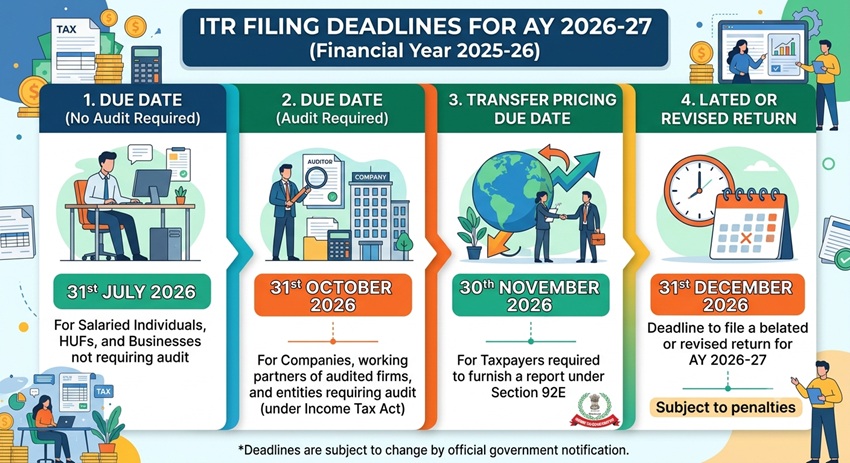
According to the Income Tax Department’s e-filing portal, taxpayers filing ITR-1 (Sahaj) or ITR-2 — covering salary income, capital gains, interest income, and those owning one or two house properties — must still file by 31 July 2026 for Assessment Year 2026-27. The bigger change applies to small business owners and professionals. Those filing ITR-3 or ITR-4 for non-audit business or professional income now get an extra month, with their deadline pushed to 31 August 2026.
For businesses whose accounts require a statutory audit, the timeline extends further, to 31 October 2026. Companies and entities with transfer pricing reporting obligations involving international or specified domestic transactions get until 30 November 2026.
Officials at the tax department’s offline utility desk confirmed that ITR-1, ITR-2, ITR-3 and ITR-4 forms have all been activated for online and offline filing for AY 2026-27, meaning taxpayers in every category can begin preparing their returns now rather than waiting for last-minute portal congestion in July.
Why the change matters
Tax consultants point out that the revised structure offers real relief to freelancers, consultants, doctors, lawyers and small business owners who previously had to scramble against the same end-of-July rush as salaried employees. The additional weeks are intended to give this group more breathing room for bookkeeping, reconciling income against TDS records, and avoiding the kind of last-minute errors that lead to defective return notices.
There’s a second, equally important change buried in the fine print. Until now, the window to file a belated or revised return closed on 31 December of the assessment year. Under the new framework, taxpayers can revise their returns until 31 March 2027 — the actual end of the assessment year — giving far more time to fix mismatches flagged in the Annual Information Statement (AIS) or claim deductions missed in the original filing.
Those who miss the original deadline altogether can still file a belated return up to 31 December 2026, though this attracts a late fee of up to Rs 5,000 under Section 234F, reduced to Rs 1,000 for taxpayers with total income below Rs 5 lakh, along with interest on any outstanding tax liability.
What taxpayers should do now
Tax advisors recommend three steps before filing season peaks. First, reconcile Form 16 issued by employers against Form 26AS and the AIS to catch any TDS mismatches early. Second, compare the old and new tax regimes carefully, since the choice materially affects final liability for many salaried taxpayers. Third, complete e-verification of the return within 30 days of submission — an unverified return is treated as not filed at all, regardless of whether it was submitted before the deadline.
It’s also worth noting that the broader Income-tax Act, 2025 came into force on 1 April 2026, but it governs income earned from FY 2026-27 onward. Returns being filed right now, for FY 2025-26, are still processed under the old, familiar Income Tax Act of 1961 — so the forms and rules taxpayers are used to remain valid for one more filing cycle.
With refund processing increasingly tied to early, accurate filing, tax professionals are urging eligible taxpayers not to wait for the deadline itself, particularly given that government portals have faced technical slowdowns in peak filing weeks in past years.