Lalu Prasad and Rabri Devi Return Security After Bihar Government Withdraws Z-Plus Cover — RJD Workers Guard Home with Sticks

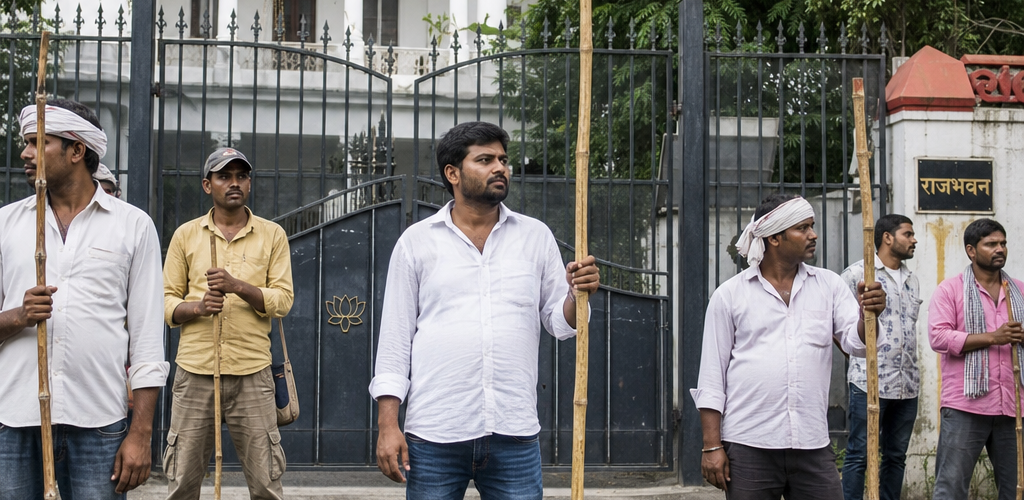
A dramatic political confrontation unfolded in Patna on Saturday after former Chief Ministers Lalu Prasad Yadav and Rabri Devi sent away all security personnel positioned outside their official residence at 10 Circular Road, a day after the Samrat Choudhary-led Bihar government downgraded their top-tier Z-plus security cover. Within hours, Rashtriya Janata Dal workers armed with bamboo sticks took position outside the bungalow, assuming responsibility for guarding the premises.
What Led to the Standoff
The Bihar government earlier this week withdrew the Z-plus security cover provided to Lalu Prasad and Rabri Devi following a review of VIP protection in the state. The Z-plus category — the highest domestic security tier — typically involves a large team of armed commandos, escort vehicles, and advance security arrangements.
In its place, the government deployed a reduced detail comprising two to eight house guards from the Bihar Special Armed Police, two bodyguards from the Patna District Force, and a pilot car with a bulletproof vehicle. For a former Chief Minister who has faced assassination threats and remains one of India’s most polarising political figures, the downgrade was seen by the RJD as a deliberate political provocation.
Rather than accept the reduced cover, the Yadav family chose a more dramatic response — returning the entire replacement detail. Rabri Devi’s political secretary, Mera Kumar Yadav, wrote on X: “Given that there is no point in retaining a mere facade of security after such a reduction, Rabri Devi ji has decided to send the security personnel back from her official residence.”
Tejashwi Follows Suit
Their son Tejashwi Yadav, who serves as Leader of the Opposition in the Bihar Assembly, followed his parents’ lead by returning his Y-category security cover. The Y-category of his elder brother Tej Pratap had already been withdrawn by the state government. RJD spokesperson Shakti Yadav indicated that more party leaders are expected to return their security covers in solidarity.
The visual of RJD workers — men and women carrying bamboo sticks and standing vigil outside the former Chief Minister’s residence — was broadcast widely across news channels. One party worker told reporters: “It is our duty to provide security to Rabri Devi ji. Lalu ji has gone to Singapore and Tejashwi ji is also not available right now. We ourselves will take full care of her.”
The Political Calculus
Security reviews for VIP protectees are a legitimate administrative exercise. Governments routinely reassess threat levels and adjust security accordingly. However, the timing and political context make it difficult to separate security assessment from political messaging.
The Samrat Choudhary government, which leads the NDA coalition in Bihar, has been locked in an intensifying confrontation with the RJD-led opposition. Withdrawing VIP security from opposition leaders is a well-worn tactic in Indian politics — it simultaneously projects authority, creates a spectacle that garners media attention, and forces the opposition into a reactive position.
The RJD’s response, however, has turned the tactic on its head. By rejecting even the reduced security and substituting party workers with sticks, Lalu’s camp has reframed the narrative from “government reviews VIP security” to “government endangers former CM’s safety.” The imagery of ordinary workers guarding a leader’s home is powerful electoral symbolism — it reinforces the RJD’s core messaging around identity, loyalty, and the ruling party’s alleged vindictiveness.
Security Implications
Beyond the political theatre, there are genuine security concerns. Lalu Prasad Yadav, 78, has significant health issues and a long political career that has generated real enemies. The absence of professional security at the residence of a former Chief Minister, regardless of political affiliation, creates a vulnerability that would be scrutinised severely if any incident were to occur.
Convention and precedent across Indian states generally provide senior security cover to former Chief Ministers on a continuing basis. The Bihar government will face pressure to clarify whether the security downgrade applies uniformly to all former CMs or has been selectively applied — a distinction that could have legal implications if challenged.
For now, the standoff continues, with the bamboo-wielding RJD workers becoming an unlikely symbol of Bihar’s latest political crisis.
Historical Precedent
The withdrawal of VIP security from political opponents is a recurring feature of Indian politics, though the practice varies significantly by state. In Uttar Pradesh, security downgrades for opposition leaders have been a regular feature of successive governments. In West Bengal, the TMC government and central agencies have clashed over security jurisdiction for political figures. In Bihar, the practice has particular resonance given the state’s history of political violence and the intensely personal nature of its political rivalries.
Legal precedent on the matter is limited. Courts have generally held that security assessment is an executive function, but have also intervened in cases where security withdrawal appears politically motivated rather than threat-based. If the RJD challenges the Bihar government’s decision legally, the court would likely examine whether a formal threat assessment was conducted and whether the decision applied uniformly to all former Chief Ministers or was selectively targeted.
The Optics and the Ground Reality
Beyond the courtrooms and political stages, the situation carries real risks for the individuals involved. RJD workers standing guard with bamboo sticks may project loyalty and defiance for television cameras, but they are not trained security personnel. They cannot screen visitors, identify threats, coordinate with police, or respond to a genuine security emergency with professional effectiveness.
The responsibility for any incident that occurs during this standoff would fall squarely on the state government. A former Chief Minister’s security is a state obligation, not a political favour that can be withdrawn at will. The Bihar government’s decision to proceed with the downgrade despite the predictable political fallout suggests either a calculated risk assessment that no credible threat exists, or a political calculation that the optics of confrontation serve the ruling coalition’s interests.
As the standoff enters its second day, the central question is whether either side blinks — does the Bihar government restore security to defuse the situation, or does the RJD sustain the dramatic protest long enough to extract maximum political benefit before pragmatism compels a resolution? With state elections still some years away, the incentives for both sides favour prolonging the confrontation, at least until the news cycle moves on.