US Supreme Court Bars Asylum Claims From Migrants Still Standing on Mexican Soil

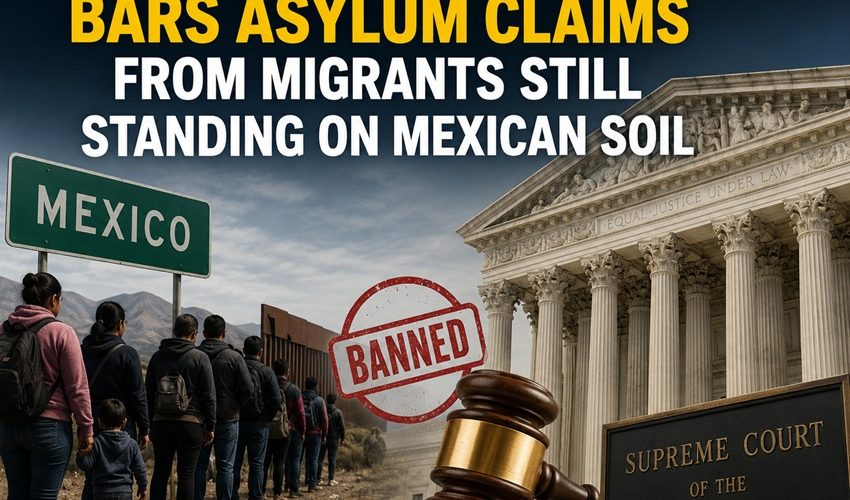
The US Supreme Court handed the Trump administration two sweeping immigration victories on Thursday, ruling that migrants presenting themselves at the US-Mexico border while physically still on Mexican soil have no legal right to apply for asylum — and separately allowing the administration to strip Temporary Protected Status from hundreds of thousands of Haitian and Syrian nationals.
The 6-3 decision in Mullin v. Al Otro Lado, authored by Justice Samuel Alito and joined by all five other conservative justices, resolved a long-running dispute over “metering” — the practice of limiting how many asylum seekers can be processed at border crossings on any given day. The court ruled that only a migrant who has physically crossed into the United States has “arrived” for purposes of asylum eligibility under the Immigration and Nationality Act.
“A guest does not arrive in a house when he knocks on the front door,” Alito wrote in the majority opinion. “An alien ‘arrives in the United States’ only when he crosses the border.”
Background: What Metering Is and Why It Matters
The metering policy was first introduced by the Obama administration in 2016 as a mechanism to manage overflow at border crossings, then expanded significantly during Donald Trump’s first term. Under the practice, CBP officers block migrants from entering a designated port of entry if the facility is deemed to be at capacity. Advocates documented thousands of people waiting for weeks or months in unsafe conditions in makeshift camps on the Mexican side of the Rio Grande.
A California federal judge struck down the practice in 2019, finding it violated the rights of asylum seekers under federal immigration law. A divided panel of the Ninth Circuit Court of Appeals upheld that ruling in 2024, setting the stage for the Trump administration’s appeal to the Supreme Court. Thursday’s ruling overturns the lower courts and removes the legal barrier to reviving the policy.
Justice Sonia Sotomayor delivered a bench dissent — an unusually public rebuke — arguing that the majority’s interpretation would allow border officials to render the asylum provisions of the INA “wholly inoperable at ports of entry” simply by preventing migrants from stepping onto US soil. She said the ruling “regrettably and tragically extinguishes the light of the torch of the Statue of Liberty.” In an exchange that drew attention in the courtroom, Alito responded to her remarks directly after she finished speaking.
TPS Decision Affects Haitians and Syrians
In a separate ruling issued the same morning, the court cleared the way for the administration to end Temporary Protected Status for nationals from Haiti and Syria. TPS is a humanitarian designation that shields migrants from deportation when their home countries are facing war, natural disasters or other dangerous conditions. Advocates representing Haitian TPS holders warned after the ruling that the decision would “directly result in thousands of innocent people dying violent, needless deaths.”
The White House described both decisions as a “tremendous win.” Spokeswoman Abigail Jackson said the TPS ruling “affirmed what President Trump has always maintained: temporary protected status is, by definition, temporary.”
The TPS ruling came on the same day that at least 188 people were killed in major earthquakes in Venezuela — a country that, in prior administrations, would have been assessed for a potential TPS designation given the scale of the disaster. Haiti’s own TPS status was first granted following a 7.0-magnitude earthquake in 2010.
Immigration attorneys said the practical impact of the asylum ruling may take time to materialise, since the metering policy itself has not been formally reinstated. However, they noted the decision removes any remaining legal obstacle to its immediate revival.

- Indian Army Gets New Chief as General Dwivedi Hands Over Command Amid Push for Indigenous Defence Tech - July 1, 2026
- Ayodhya Ram Temple Donation Scandal Deepens as Trustees Resign and SIT Arrests Eight - June 29, 2026
- Bengal Seven Weeks On: Modi’s Historic Win and the Questions That Won’t Go Away - June 28, 2026