Ayodhya Ram Temple Donation Scandal Deepens as Trustees Resign and SIT Arrests Eight

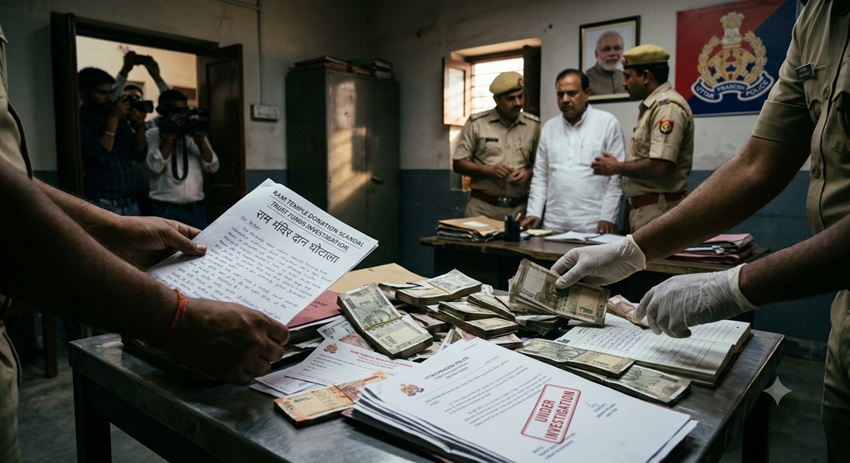
A preliminary investigation has uncovered at least 70 theft incidents since the temple’s inauguration, setting off a political storm ahead of crucial Uttar Pradesh elections
The Shri Ram Janmabhoomi Mandir — consecrated amid national fanfare in January 2024 and a symbol of decades of faith-driven aspiration for hundreds of millions of Hindus — is today at the centre of the most damaging institutional scandal in its short history. A Special Investigation Team (SIT) probe has revealed a brazen and systematic scheme to steal cash and valuables from the donations of ordinary devotees, leading to eight arrests, the resignations of senior trustees, and a political firestorm that threatens to reshape the contest for Uttar Pradesh’s assembly elections, now only months away.
The scale of alleged wrongdoing, as it has gradually emerged over the past four weeks, has left both devotees and political observers stunned. The SIT’s preliminary report, submitted to the Uttar Pradesh government on 23 June 2026, identified significant procedural failures and flagged at least 70 documented theft incidents stretching back to the very day the temple opened its doors in early 2024.
How the Theft Allegedly Worked
Suspicion first arose when temple trust officials noticed discrepancies between cash collected and amounts deposited into bank accounts. Bundles of Rs 500 notes pulled from donation boxes — which typically held between Rs 6 lakh and Rs 7 lakh — were repeatedly falling short. Hidden cameras were subsequently installed inside the counting room, and what they captured was methodical and damning.
The footage revealed two distinct methods. In one approach, a staff member would deliberately obstruct the CCTV camera while a colleague concealed currency in their clothing. In another, additional notes were slipped into counting bundles and then quietly removed before the cash reached the bank, ensuring the final tally matched the voucher while cash quietly disappeared. Stolen money was allegedly stashed inside temple washrooms before being smuggled out in batches. Investigators recovered Rs 2.5 lakh from a washroom near the counting room alone — found there after the controversy broke and just before the SIT was formally constituted.
Eight individuals linked to the cash and valuables counting operations have since been arrested and remanded to judicial custody. Among those named in the FIR are Avinash Shukla, Anukalp Mishra, Lavkush Mishra, Manish Kumar Yadav, Karunesh Pandey, Ramashankar Mishra, and two others. The police allege that one of the accused, Manish Kumar Yadav, was placed in the cash-counting unit through the influence of a relative already working at the trust — pointing to systemic lapses in vetting and oversight.
Resignations at the Top
The political fallout accelerated on 27 June when Champat Rai, the trust’s longstanding general secretary and one of the most publicly prominent figures in the Ram Temple movement, stepped down along with other senior trustees. Rai’s resignation has been widely seen as an attempt to contain the damage, but for many devotees the exit of a figure so central to the temple’s founding has only deepened their sense of betrayal.
Devotees who had travelled from across India to make offerings — some donating silver bricks, gold jewellery, and family heirlooms — have come forward demanding accountability. “We have been betrayed by the management, who have looted our faith, nothing less,” one devotee told Al Jazeera this week.
The Political Dimension
The timing could hardly be worse for the Bharatiya Janata Party. Uttar Pradesh, India’s most populous state, is heading into an election cycle, and the Ram Temple was arguably the party’s single most resonant political achievement since 2014. The Congress party has demanded a Supreme Court-monitored probe and called for the dissolution of the temple trust, while Shiv Sena (UBT) MP Sanjay Raut went further, alleging without evidence that stolen funds were used to engineer political splits in opposition parties — a claim the ruling party has not publicly addressed.
Samajwadi Party chief Akhilesh Yadav weighed in with pointed commentary on social media, implying that those who had promised moral guardianship of Hindu faith had instead enabled systematic looting.
Chief Minister Yogi Adityanath has publicly crossed swords with the opposition on the matter, framing the SIT action as evidence that his government acted swiftly and transparently. His critics, however, point out that the racket appears to have run for over two years before any official action was taken. The Congress general secretary K C Venugopal put it bluntly: after using Ayodhya for political purposes, the BJP-RSS had “made a complete mockery” of the sentiments of ordinary devotees.
What Comes Next
The SIT probe is still ongoing, and investigators acknowledge that the full scale of embezzlement remains unknown. All eight accused are currently in judicial custody, and the report has already triggered demands for a more fundamental overhaul of how India’s most prominent religious institutions manage their finances and oversee those placed in positions of trust.
For the millions of Indians who donated to the Ram Temple with sincerity of faith, the events of the past month have raised a harder question that courts and investigations alone may struggle to answer: who watches the watchmen?

- Indian Army Gets New Chief as General Dwivedi Hands Over Command Amid Push for Indigenous Defence Tech - July 1, 2026
- Ayodhya Ram Temple Donation Scandal Deepens as Trustees Resign and SIT Arrests Eight - June 29, 2026
- Bengal Seven Weeks On: Modi’s Historic Win and the Questions That Won’t Go Away - June 28, 2026