Quick Commerce vs Own Channels: Inside India’s D2C Distribution War and the Battle for Consumer Loyalty

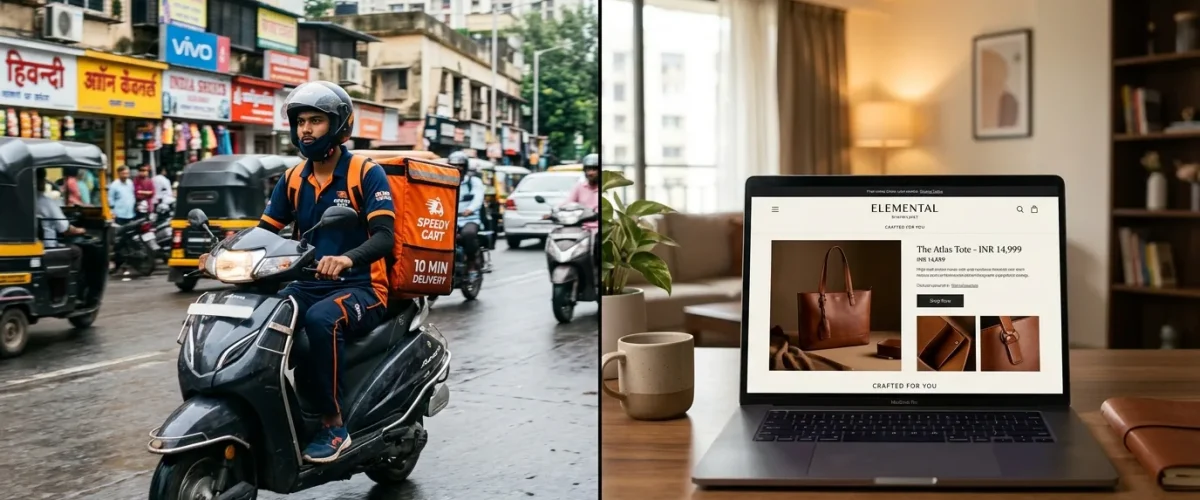
India’s direct-to-consumer landscape is being reshaped by a distribution tug-of-war that will define the sector’s winners and losers for the next decade. On one side, quick commerce platforms—Blinkit, Zepto, Swiggy Instamart, and Flipkart Minutes—promise instant gratification and massive reach, delivering products to urban consumers in under 30 minutes. On the other, D2C brands are investing heavily in owned channels—their own websites, apps, and flagship stores—to build direct customer relationships and protect margins. The strategic choices brands make in navigating this tension will determine not just profitability, but long-term brand equity and survival.
The Quick Commerce Explosion: A Channel That Demands Attention
Quick commerce has grown from a pandemic-era experiment to a $5 billion-plus market in India, with penetration deepening across metro and Tier 1 cities. Blinkit, the Zomato-owned platform, has expanded to over 1,000 dark stores across 40+ cities. Zepto, backed by fresh funding, operates a rapidly growing network focused on efficiency and assortment breadth. Swiggy Instamart leverages Swiggy’s existing delivery fleet and customer base for cross-platform synergies.
For D2C brands, quick commerce represents both an irresistible opportunity and a strategic minefield. The platforms offer access to millions of high-intent urban consumers who are willing to pay premium prices for convenience. Conversion rates on quick commerce are significantly higher than traditional e-commerce—consumers browsing Blinkit at 10 PM are ready to buy, not just browse. This immediacy-driven consumption pattern favours impulse purchases, pantry refills, and need-based buying.
Several D2C brands have reported explosive growth on quick commerce channels. Brands in snacking, beverages, personal care, and household products have seen quick commerce contribution rise from negligible levels in 2023 to 15-25 per cent of total online revenue in early 2026. Some niche brands, particularly in premium snacking and craft beverages, report even higher shares.
The Hidden Costs of Quick Commerce Dependence
Behind the impressive topline numbers, quick commerce presents D2C brands with structural challenges that can undermine long-term business health. Platform commissions of 20-35 per cent—including listing fees, promotional charges, and delivery commissions—eat into margins that are already thin for many consumer brands.
More critically, quick commerce platforms control the customer relationship. Brands cannot directly communicate with consumers who purchase through Blinkit or Zepto—no email addresses, no purchase history analytics, no retargeting capability. In a business model where customer lifetime value is the key to profitability, this data blindspot represents a strategic vulnerability.
Algorithmic visibility on quick commerce platforms creates winner-take-all dynamics within categories. Products that achieve high sales velocity receive prominent placement, while slower-moving SKUs are relegated to deep search results or removed entirely. This creates pressure on brands to discount aggressively to maintain velocity—a strategy that can train consumers to buy only on promotion and erode brand pricing power over time.
The Owned Channel Counterattack: Building Direct Relationships
In response to these dynamics, sophisticated D2C brands are making significant investments in owned channels. Brand websites, particularly those optimised for mobile, are being redesigned as lifestyle destinations rather than mere transaction points. Content marketing, community building, and loyalty programmes are being deployed to create engagement that transcends the transactional nature of marketplace interactions.
Subscription models represent a particularly effective owned-channel strategy. Brands like Sleepy Owl (coffee), The Whole Truth Foods (snacks), and mCaffeine (personal care) have built subscription programmes that lock in recurring revenue, reduce customer acquisition costs for subsequent purchases, and provide predictable demand forecasting that improves inventory management.
Physical retail—whether through standalone stores, shop-in-shop formats, or premium retail partnerships—serves as both a brand-building engine and a margin-enhancing channel. Without marketplace commissions, physical retail margins can be 15-20 percentage points higher than online marketplace sales. The growing retail real estate opportunity in India, as detailed in our analysis of India’s 2026 real estate outlook and the retail sector revival, is creating new possibilities for D2C brands to establish physical presences in high-footfall locations.
The Marketplace Middle Ground: Amazon and Flipkart’s Role
Between quick commerce and owned channels, traditional e-commerce marketplaces—Amazon India and Flipkart—occupy an important middle ground for D2C brands. These platforms offer broader geographic reach (beyond the metro focus of quick commerce), larger assortment capacity, and more sophisticated advertising tools that allow brands to build visibility and awareness.
Amazon’s Brand Registry and Flipkart’s brand partnerships provide D2C companies with enhanced storefronts, A+ content capabilities, and brand analytics that partially address the data limitation inherent in marketplace selling. The 30-minute delivery capabilities being built by both platforms—Flipkart Minutes and Amazon’s expanded quick commerce play—are further blurring the lines between traditional e-commerce and quick commerce.
The Data Wars: Understanding the Consumer
At the heart of the distribution debate is a data question: who owns the customer relationship, and who has the insights needed to build lasting consumer loyalty? Quick commerce platforms collect transaction data, delivery preferences, and browsing patterns that they use to optimise their own algorithms—not to benefit individual brands. Marketplaces share some analytics but guard granular customer data closely.
Owned channels give brands complete data ownership—email addresses, purchase history, browsing behaviour, and response to marketing communications. This data is the foundation for personalised marketing, product development insights, and predictive analytics that can drive significant competitive advantage.
The brands that are winning the distribution war are those that use quick commerce and marketplaces strategically for acquisition and discovery, while building owned-channel capabilities to deepen relationships with acquired customers. The goal is to convert marketplace buyers into owned-channel loyalists—a funnel that requires excellent product experience, strategic CRM, and genuine brand differentiation.
Case Studies: Brands Getting It Right
Mamaearth has executed a textbook omnichannel strategy, maintaining strong marketplace presence while building a robust owned website with a loyalty programme, content platform, and subscription options. The brand’s IPO in 2023 and subsequent market performance have validated the model, despite ongoing debates about sustainable profitability.
boAt, the audio electronics brand, has combined aggressive marketplace pricing with a strong direct website and growing retail presence through exclusive store formats. The brand’s ability to maintain premium positioning while competing on price-sensitive platforms demonstrates the nuanced execution required for omnichannel success.
Licious, the fresh meat delivery platform, has prioritised owned-channel development from inception, building a subscription-first model that commands premium pricing and generates predictable recurring revenue. The company’s investment in cold chain infrastructure and quality control has created barriers to entry that protect its market position regardless of platform competition.
The Road Ahead: Coexistence, Not Confrontation
The future of D2C distribution in India is not about choosing between quick commerce and owned channels—it is about orchestrating a coherent multi-channel strategy that leverages the strengths of each. Quick commerce drives discovery and impulse purchases, marketplaces provide scale and geographic reach, owned channels build loyalty and protect margins, and physical retail creates brand experiences and trust.
Brands that can master this orchestration—managing channel-specific pricing, assortment, and marketing while maintaining a consistent brand identity—will build defensible positions in India’s increasingly competitive consumer landscape. Those that default to platform dependence, whether out of convenience or resource constraints, risk becoming commodity suppliers to algorithms rather than brands with genuine consumer relationships. The Indian D2C evolution is closely tied to the broader consumer economy transformation powered by digital innovation, including developments in how ultra-low inflation is reshaping Indian household purchasing power and consumption patterns.