India’s Gaming Market Hits USD 5.9 Billion: Inside the Growth Engine Driving Asia’s Fastest-Rising Gaming Economy

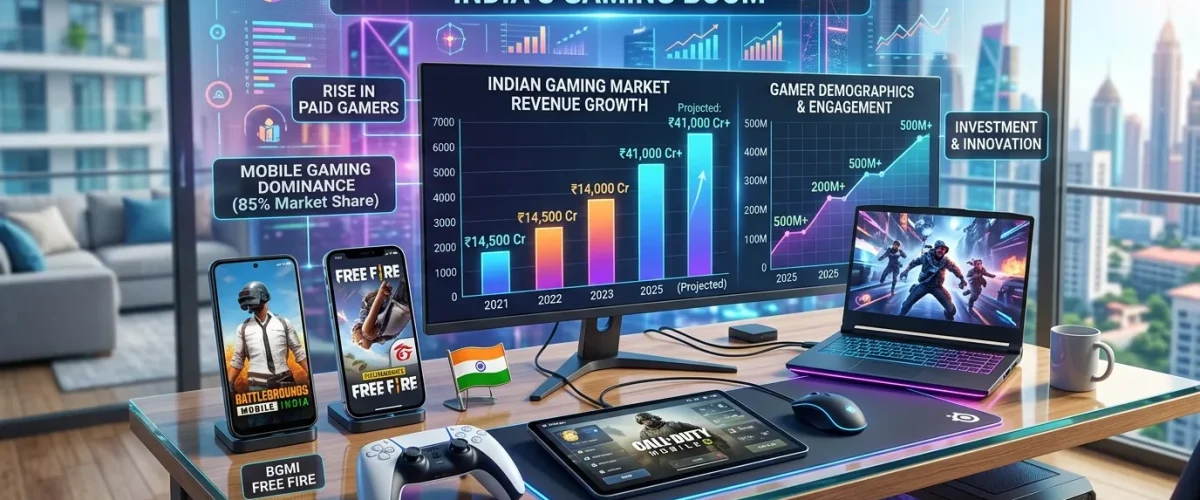
India’s gaming industry has crossed a historic milestone. Valued at USD 5.91 billion in 2025 and projected to surge to USD 16.72 billion by 2034, the Indian gaming market is now among the fastest-growing in the world. This growth, driven by unprecedented smartphone adoption, affordable data connectivity, and the aspirations of a young demographic, is reshaping India’s digital economy and establishing the country as a global gaming frontier that publishers, investors, and developers cannot afford to ignore.
The Numbers Behind the Boom
The headline figures are striking. India’s gaming market is projected to grow at a compound annual growth rate of 14.6 per cent from 2026 to 2034 — a rate that outpaces the global gaming industry’s average growth and positions India alongside China and the United States as a tier-one gaming market. The user base, already exceeding 500 million, continues to expand as smartphone penetration reaches deeper into semi-urban and rural India.
Revenue growth has been driven primarily by mobile gaming, which accounts for the lion’s share of the market. However, the contribution of PC gaming, console gaming, and esports is growing, indicating a maturing market where consumers are diversifying their gaming habits and willing to spend more on premium experiences.
Smartphone Penetration: The Foundation
India’s smartphone installed base has crossed 800 million devices, with 5G adoption accelerating rapidly. The availability of capable gaming smartphones at price points below Rs 15,000 has been a critical enabler, allowing budget-conscious consumers to access graphically rich, multiplayer gaming experiences. Manufacturers like Xiaomi, Samsung, Realme, and domestic brands have recognised the gaming use case, incorporating features like enhanced processors, high refresh rate displays, and gaming modes into mid-range devices.
The 5G rollout, while still uneven in coverage, is beginning to reduce latency issues that have historically hampered the mobile gaming experience in India. As 5G coverage expands and network quality improves, the potential for cloud gaming and more demanding multiplayer experiences on mobile devices will unlock new market segments.
Affordable Data: Jio’s Lasting Legacy
The affordability of mobile data in India — among the cheapest in the world — remains a foundational driver of gaming growth. Monthly data plans that offer generous allowances for under Rs 300 make it economically feasible for millions of Indians to engage in data-intensive gaming activities. This structural advantage, the legacy of the telecom price war initiated by Reliance Jio, gives India a unique position in the global gaming market.
Revenue Models: From Free-to-Play to Premium
India’s gaming revenue model has historically been dominated by free-to-play games monetised through in-app purchases and advertising. While this model remains dominant, there are signs of evolution. The willingness of Indian gamers to spend on in-game items, battle passes, and cosmetic upgrades has increased, driven by rising disposable incomes and the normalisation of digital payments through UPI.
The premium gaming segment — encompassing paid game purchases, subscription services, and hardware sales — is also growing, albeit from a smaller base. The launch of cloud gaming services and game subscription platforms in India suggests that international publishers are confident in the market’s premium potential. This evolution from a purely free-to-play market to one with premium segments is a hallmark of a maturing gaming economy.
Indian Game Developers: A Nascent but Growing Force
India’s game development industry, while still in its relative infancy compared to established centres in the US, Japan, and Europe, is growing rapidly. Indian studios are producing titles that resonate with domestic audiences, drawing on Indian mythology, culture, and aesthetics to create distinctive gaming experiences. The growth of India’s technology sector and AI capabilities is also beginning to influence game development, with Indian studios experimenting with AI-driven game design and procedural content generation.
The availability of game development tools like Unity and Unreal Engine, combined with online learning resources and a growing community of Indian game developers, has lowered the barriers to entry. University-level game development programmes are expanding, and game jams and developer conferences provide platforms for emerging talent to showcase their work.
Investment and Corporate Interest
Venture capital and corporate investment in Indian gaming has increased significantly. Major international publishers and investors have either established Indian operations or invested in Indian gaming companies, recognising the market’s long-term potential. Indian conglomerates, including those in the media, entertainment, and technology sectors, have made strategic investments in gaming, viewing the sector as a natural extension of their digital entertainment portfolios.
The investment landscape has matured, with investors increasingly willing to back Indian game developers, esports organisations, and gaming infrastructure companies. This capital inflow is essential for the industry’s growth, enabling companies to invest in talent, technology, and marketing at a scale necessary to compete in the global gaming market.
Challenges: Regulation, Monetisation, and Retention
Despite the optimistic trajectory, India’s gaming industry faces significant challenges. Regulatory uncertainty, particularly around real-money gaming and gambling, has created headwinds for certain segments of the market. State-level variations in gaming regulation add complexity for developers and operators seeking national scale.
Monetisation remains challenging in a price-sensitive market where free-to-play expectations are deeply entrenched. User retention is another concern, as the low cost of switching between games creates a churn-prone environment. Addressing these challenges will require a combination of industry self-regulation, constructive engagement with government, and continued innovation in game design and monetisation.
A Market on the Verge of Greatness
India’s gaming market at USD 5.91 billion is substantial, but the projected growth to USD 16.72 billion by 2034 suggests that the industry is still in its early chapters. The confluence of demographic advantage, technological infrastructure, and cultural receptivity to gaming creates conditions for sustained growth that few other markets can match. For investors, developers, and the broader technology ecosystem, India’s gaming market is no longer a future promise — it is a present reality with extraordinary potential. The game, as they say, is on.

- India’s Startup Funding Crosses $7.2 Billion in H1 2026 - July 1, 2026
- After Ireland Shock, India’s T20I Side Faces Bigger Test - July 1, 2026
- Ireland Stun World Champions India 2-0 in Belfast, Sooryavanshi Debate Rages On - June 29, 2026