BSNL’s 4G Revival and Vodafone Idea’s 5G Gamble: India’s Telecom Underdogs Fight Back

The Other Side of India’s Telecom Story
While Reliance Jio and Bharti Airtel dominate India’s telecommunications narrative with their 5G sprint, a quieter but equally significant drama is unfolding at the margins of the industry. Bharat Sanchar Nigam Limited (BSNL), India’s state-owned telecom operator, is staging what may be the most improbable comeback in Indian corporate history. Simultaneously, Vodafone Idea (Vi) — the debt-laden product of India’s most troubled telecom merger — is making a late-stage bet on 5G that will either validate its survival or hasten its decline.
Together, these two operators represent the complexity that lies beneath India’s telecom success story. Their fortunes will determine whether India’s digital connectivity remains a two-player monopoly or whether genuine competition survives to benefit the country’s 1.2 billion mobile subscribers.
BSNL’s Indigenous 4G: A Technology Sovereignty Play
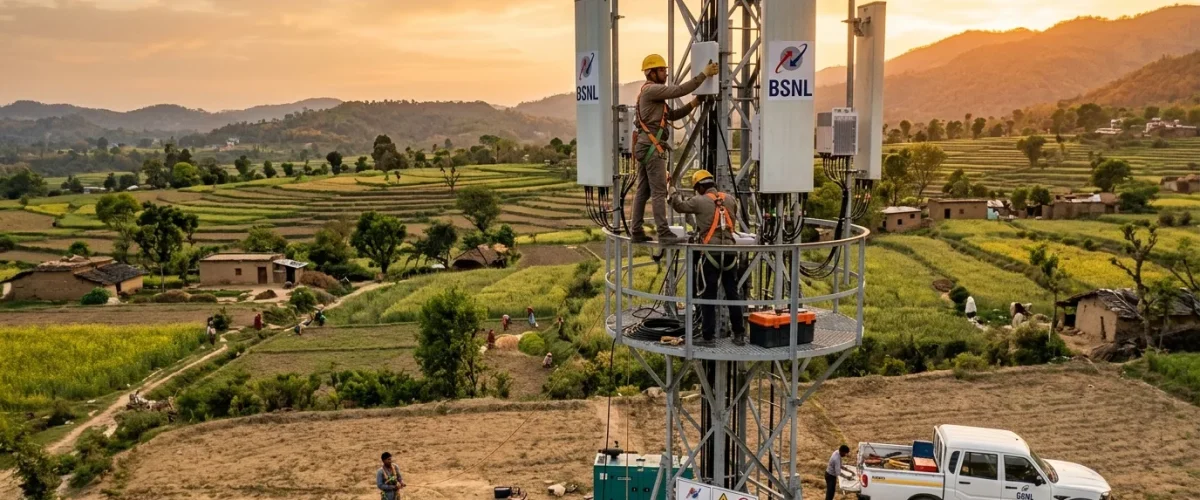
BSNL’s 4G network, powered entirely by indigenous technology developed by the Centre for Development of Telematics (C-DOT) and Tata Consultancy Services, represents India’s most ambitious attempt at telecommunications technology sovereignty. The decision to bypass global equipment vendors — Ericsson, Nokia, Huawei, and Samsung — in favour of a domestically developed 4G stack was initially met with scepticism from industry analysts who questioned whether Indian technology could match the performance and reliability of established global platforms.
As of March 2026, BSNL has deployed approximately 80,000 4G base transceiver stations across the country, with a target of reaching 100,000 by December 2026. Early performance data suggests that the indigenous equipment is meeting baseline quality standards, though network speed and consistency still trail behind the mature 4G networks of Jio and Airtel. BSNL’s average 4G download speeds hover around 15 to 20 Mbps — acceptable for basic data consumption but noticeably slower than the 30 to 40 Mbps that subscribers on competing networks routinely experience.
The strategic significance of BSNL’s indigenous 4G extends well beyond telecom. It demonstrates India’s ability to develop and deploy complex technology infrastructure without foreign dependency — a principle that also underpins the IndiaAI Mission’s push for sovereign AI infrastructure. If BSNL’s network proves commercially viable, it could serve as a template for indigenous technology deployment in other strategic sectors.
The Rural Connectivity Mandate
BSNL’s most compelling value proposition lies in rural India. As a government-owned operator, BSNL has a mandate to provide connectivity in areas where private operators find deployment economically unviable. India’s estimated 350,000 uncovered villages represent a digital divide that has significant implications for financial inclusion, education, healthcare, and governance.
The government has allocated ₹1.64 lakh crore in revival packages for BSNL since 2019, with a substantial portion earmarked for network expansion in underserved areas. BSNL’s 4G deployment prioritises locations where no other operator provides data services, effectively serving as the connectivity provider of last resort.
This rural focus has important downstream effects. The spectacular growth of India’s UPI digital payments ecosystem has been concentrated in urban and semi-urban areas partly because of connectivity limitations in rural regions. BSNL’s 4G expansion could extend the digital payments revolution to the approximately 65 per cent of India’s population that lives in villages — an enormous market that remains largely cash-dependent.
Vodafone Idea’s High-Stakes 5G Rollout
Vodafone Idea’s commercial 5G launch in late 2025 marked a turning point for a company that many industry observers had written off. The operator signed multi-year equipment contracts worth $3.6 billion with Ericsson, Nokia, and Samsung — a significant financial commitment for a company carrying net debt exceeding ₹2 lakh crore.
Vi’s 5G strategy focuses on select urban markets where subscriber density justifies the investment. The operator has initially deployed 5G in Mumbai, Delhi NCR, Bengaluru, Kolkata, and Pune, with plans to expand to 25 additional cities by March 2027. This targeted approach contrasts with the pan-India rollouts undertaken by Jio and Airtel, who have raced to achieve nationwide 5G coverage.
Vi’s introductory 5G plan at ₹299 was designed to undercut competitors, but the company has been gradually aligning its pricing with market rates. The operator’s challenge is not merely attracting new subscribers but stemming the outflow of existing customers who have been migrating to Jio and Airtel at a rate of approximately 2 to 3 million per month.
The Debt Dilemma
Vi’s financial position remains its most critical vulnerability. The company’s adjusted gross revenue (AGR) dues to the government, combined with spectrum payment obligations and vendor financing, create a debt servicing burden that consumes a disproportionate share of operating cash flows. In its latest quarterly results, Vi reported a net loss of approximately ₹6,400 crore, continuing a streak of consecutive quarterly losses that stretches back to the 2018 merger.
The government’s decision to convert a portion of Vi’s AGR dues into equity — effectively making the Indian government a significant shareholder — has provided temporary relief but has not resolved the fundamental problem: Vi generates insufficient revenue to simultaneously service debt, invest in network expansion, and maintain service quality.
Fresh capital is needed, and Vi has been in discussions with potential investors including international private equity firms and strategic partners. However, the challenging competitive environment and uncertain regulatory landscape have made potential investors cautious. The window for a successful capital raise is narrowing as subscriber losses continue.
What Competition Means for Consumers
The survival of both BSNL and Vi matters beyond corporate finance. A telecom market dominated by just two private operators would reduce competitive pressure on pricing, potentially ending the era of affordable mobile data that has powered India’s digital transformation. The Telecom Regulatory Authority of India (TRAI) has repeatedly emphasised the importance of maintaining at least three viable private operators to ensure healthy competition.
India’s mobile data prices — currently among the lowest in the world at approximately $0.17 per gigabyte — are a direct result of competitive intensity. If that competition diminishes, consumers will inevitably bear the cost through higher tariffs and reduced service quality.
A Market in Transition
India’s telecom market in 2026 is a study in contrasts. At the top, Jio and Airtel are building next-generation networks that rival the best in the world. At the bottom, BSNL is striving to bring basic connectivity to India’s forgotten villages using homegrown technology. In between, Vodafone Idea is fighting for survival in a market that has little patience for the weak.
The outcome of these parallel stories will shape not just the telecom sector but the broader digital economy. Connectivity is the foundation on which everything else — payments, commerce, education, healthcare, governance — is built. How India manages its telecom transition will determine whether the promise of Digital India reaches every citizen, or only those fortunate enough to live in the right postcode.