DRDO and Indian Air Force Successfully Test TARA Indigenous Glide Weapon System Off Odisha Coast in Major Defence Milestone

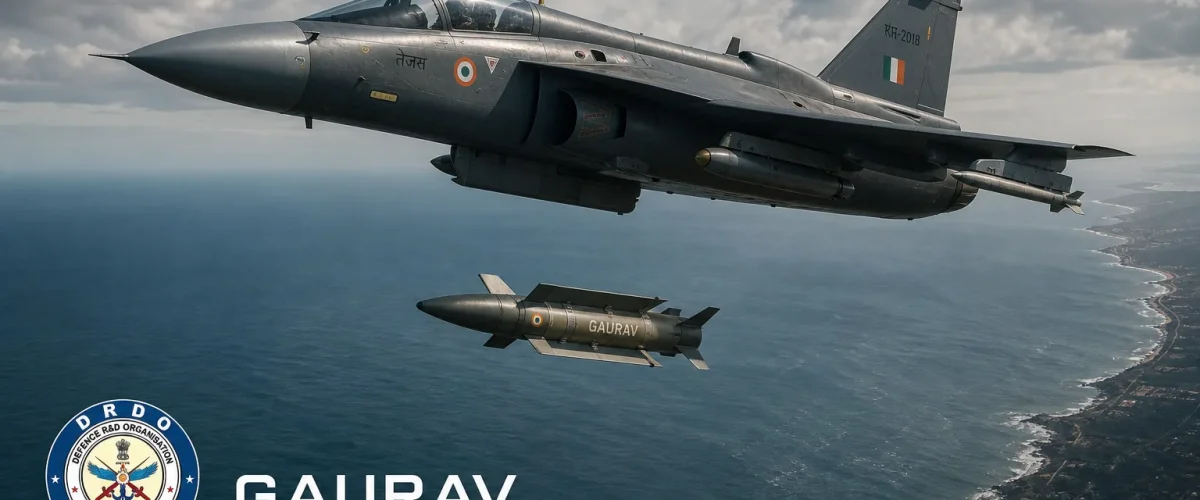
In a significant boost to India’s indigenous defence capabilities, the Defence Research and Development Organisation (DRDO) and the Indian Air Force (IAF) successfully conducted the maiden flight trial of the Tactical Advanced Range Augmentation (TARA) weapon system off the coast of Odisha on Friday, 08 May 2026. The successful test marks a major milestone in India’s quest for self-reliance in advanced military technology and positions the country among a select group of nations that possess precision glide weapon systems.
According to the Defence Ministry, TARA is India’s first indigenous glide weapon system capable of converting standard unguided warheads into precision-guided munitions using a modular range extension kit. The system was designed and developed by the Research Centre Imarat (RCI) in Hyderabad, in collaboration with other DRDO laboratories and Indian industry partners. Defence Minister Rajnath Singh congratulated DRDO scientists, IAF personnel, and industry partners, calling the successful trial “a significant achievement in strengthening India’s self-reliant defence ecosystem.”
What Is TARA and How Does It Work?
TARA stands for Tactical Advanced Range Augmentation — a glide weapon system that essentially adds wings, guidance systems, and a GPS/INS navigation unit to existing unguided bombs, transforming them into precision-guided weapons with significantly extended range. The concept is similar to the US Joint Direct Attack Munition (JDAM) and the Israeli SPICE system, but TARA is entirely designed and manufactured in India.
The system works by attaching a bolt-on kit to standard general-purpose bombs already in the IAF’s inventory. Once released from an aircraft at altitude, TARA’s wings deploy, allowing the munition to glide toward its target over distances significantly greater than an unguided bomb could travel. The onboard guidance system — which combines GPS satellite navigation with inertial navigation — steers the weapon to its target with precision accuracy, even in adverse weather conditions.
The key advantage of TARA is its cost-effectiveness. Rather than developing entirely new precision-guided munitions from scratch, the system allows the IAF to upgrade its existing stockpile of unguided bombs into smart weapons at a fraction of the cost. This approach maximises the combat utility of existing research and development investments while dramatically improving the air force’s precision strike capability.
Details of the Maiden Flight Trial
The flight trial was conducted from the Integrated Test Range at Chandipur, Odisha — one of India’s primary weapons testing facilities. An IAF combat aircraft released the TARA-equipped munition at a predetermined altitude and speed, after which the weapon system autonomously navigated to its designated target. All test parameters, including range, accuracy, guidance performance, and aerodynamic stability, were reported to have been met successfully.
DRDO Chairman Samir V Kamat praised the teams involved in the project, noting that TARA represents the culmination of years of research into guidance systems, aerodynamics, and precision navigation. “This system gives our armed forces a significant capability enhancement at low operational cost,” Kamat said. “The production activities have already begun with support from Indian industry partners, and we expect the system to be available for operational deployment in the near future.”
Strategic Significance for India
The successful TARA test comes at a time when India is actively pursuing indigenous alternatives to imported defence systems as part of the government’s Atmanirbhar Bharat (Self-Reliant India) initiative in defence. The country currently imports a significant portion of its precision-guided munitions, primarily from Israel and Russia. TARA could reduce this dependency and save substantial foreign exchange over the long term.
The system is also strategically significant in the context of India’s evolving security environment. Following India’s plans for a 55-satellite military constellation for round-the-clock defence surveillance, the combination of space-based targeting data and precision glide weapons like TARA represents a quantum leap in the country’s ability to conduct surgical strikes against ground-based targets with minimal collateral damage.
Military analysts note that precision-guided munitions played a decisive role in recent conflicts worldwide, including the US-Iran confrontation in the Strait of Hormuz and the Russia-Ukraine war. Countries that possess these capabilities have a decisive advantage in modern warfare, where the ability to strike high-value targets with pinpoint accuracy can determine the outcome of conflicts.
India’s Growing Defence Technology Portfolio
The TARA test adds to an impressive series of defence technology achievements by DRDO and the Indian military in recent months. ISRO has announced 27 space missions for 2026-27, many with dual civilian-military applications, while India’s missile development programme continues to advance with systems like BrahMos, Agni-V, and the hypersonic missile programme.
The integration of TARA into the IAF’s operational inventory will likely begin within the current financial year, with initial deliveries expected to equip frontline fighter squadrons. The system is designed to be compatible with multiple aircraft platforms in the IAF’s fleet, including the Sukhoi Su-30MKI, Dassault Rafale, and the indigenous HAL Tejas Mk1A.
Global Context: The Precision Munitions Race
The global market for precision-guided munitions is projected to exceed $35 billion by 2028, driven by the lessons of recent conflicts and the growing emphasis on minimising collateral damage. The United States, Israel, France, and now India are among the leading developers of indigenous precision strike systems.
India’s entry into this space with TARA is particularly significant because it could eventually lead to export opportunities. Several countries in South and Southeast Asia, the Middle East, and Africa have expressed interest in acquiring affordable precision strike capabilities, and an Indian-made system would offer a competitive alternative to Western products at a lower price point.
As India’s space economy crosses $13 billion and its defence technology portfolio expands, the country is steadily transitioning from being one of the world’s largest arms importers to becoming a significant developer and potential exporter of advanced military systems. The successful TARA test is another step on that journey — one that enhances both India’s national security and its industrial capabilities.