Indian Literature 2026: Gulzar’s Mumbai, Arundhati Roy’s Memoir, and the Books Defining the Year


The Indian literary landscape of 2026 arrives on the momentum of what many consider the strongest period for Indian writing on the global stage. The year 2025 saw Banu Mushtaq’s short story collection Heart Lamp (translated by Deepa Bhasthi) win the International Booker Prize — the first Kannada-language title and the first short story collection to receive the honour. Kiran Desai returned with The Loneliness of Sonia and Sunny, Megha Majumdar delivered A Guardian and a Thief, and Arundhati Roy’s searing memoir Mother Mary Comes to Me stirred more conversation than perhaps any Indian book in recent memory. Against this backdrop, 2026 promises to be equally consequential.
Gulzar’s Aamchi Mumbai: A City in Stories and Poems
Among the most anticipated releases of the year is Gulzar’s Aamchi Mumbai: My City in Stories and Poems (HarperCollins India), a tribute to the city he has called home for seven decades. Featuring 30 short stories and 70 poems, translated by Rakhshanda Jalil, the collection represents one of India’s most beloved literary voices at his most personal and reflective. Gulzar’s Mumbai is not the familiar Bollywood backdrop of glamour and ambition but a layered, contradictory metropolis — at once tender and brutal, intimate and overwhelming.
The collection’s significance extends beyond its literary merit. At a time when Mumbai literature has become a recognised genre in Indian publishing — with novels, memoirs, and anthologies exploring the city from every conceivable angle — Gulzar’s contribution arrives with the authority of a lifetime’s observation. His ability to capture the rhythm of Mumbai’s speech, the texture of its streets, and the emotional geography of its neighbourhoods in both prose and verse makes this collection an essential addition to the city’s literary portrait.
Longevity, Love, and Reform: The Non-Fiction Slate
India’s non-fiction publishing in 2026 reflects the country’s preoccupations with characteristic breadth. Pullela Gopichand and physician Sophia Pathai’s The Longevity Code: The Science and Strategy of Resilience, Performance (Penguin Random House) arrives as the longevity debate continues to dominate public discourse. Drawing on cutting-edge research and Gopichand’s lived expertise as India’s national badminton coach, the book offers a practical roadmap to sustaining vitality — a subject of intense interest in a country whose demographic profile is simultaneously young and rapidly ageing.
Shashi Tharoor returns with The Sage Who Reimagined Hinduism (Aleph), a biography of Sree Narayana Guru. Born into the Ezhava caste in Kerala, Guru challenged entrenched hierarchies by advocating social equality, founding inclusive temples and educational institutions, and pushing for reform within Hinduism. Tharoor’s engagement with this subject is both historically rigorous and personally resonant, offering a fresh lens on faith through one of its most influential reformists. In a year when questions of caste, religion, and social justice continue to animate Indian public discourse, the book’s timing is impeccable.
Fiction: New Voices and Returning Masters
The fiction slate for 2026 is characteristically diverse. Deepa Anappara’s The Last of the Earth (Penguin Random House), set in 19th-century Tibet, follows Balram on a perilous mission to rescue a missing friend alongside Katherine, a defiant explorer in disguise. The novel’s ambition — historical fiction set outside India by an Indian writer — represents the expanding geographical and temporal imagination of contemporary Indian fiction.
Graphic novel readers can anticipate Sarnath Banerjee’s Absolute Jafar (HarperCollins India), a long-gestating novel of ideas exploring exile, displacement, and belonging through a father-son relationship. Banerjee, widely regarded as the father of the Indian graphic novel, brings a philosophical depth and visual sophistication that challenges the boundaries of the form. Meanwhile, Paromita Vohra’s Love, Sex and India: The Agents of Ishq Anthology (Westland) gathers sex-positive stories moving beyond binaries, capturing the messy, joyful, heartbreaking reality of intimate life in contemporary India.
Translated Literature: Breaking the English Barrier
The success of Heart Lamp at the International Booker has had a catalysing effect on India’s literary translation ecosystem. Publishers are investing more heavily in translations from India’s rich tapestry of regional languages — Tamil, Kannada, Malayalam, Bengali, Marathi, Hindi, Urdu — recognising that some of the most exciting writing in the country is happening outside the English-language mainstream. The Booker recognition has also opened international doors for Indian-language authors, with foreign publishers showing unprecedented interest in acquiring translation rights.
This trend aligns with broader cultural currents. As South Indian cinema finds national and international audiences and Indian music crosses linguistic barriers, the literary world is experiencing a parallel dissolution of the language hierarchy that has historically privileged English-language Indian writing. The most consequential Indian literature of 2026 may well be written in a language other than English — and that represents a healthy democratisation of the literary conversation.
The Publishing Ecosystem
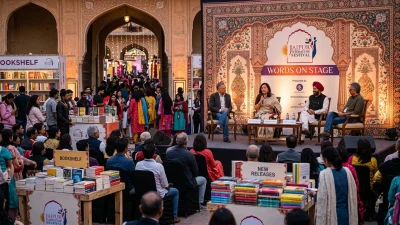
India’s publishing industry continues to evolve structurally. The major international houses — Penguin Random House, HarperCollins, Pan Macmillan — maintain strong Indian operations, while independent publishers like Aleph, Westland, Juggernaut, and Speaking Tiger have carved distinctive niches that prioritise editorial vision over commercial formula. The emergence of subscription-based reading platforms and audiobook services has created new revenue streams for authors and publishers, while literary festivals from Jaipur to Kerala continue to serve as vital spaces for public literary discourse.
For Indian readers, 2026 offers an embarrassment of riches. Whether drawn to Gulzar’s lyrical Mumbai, Tharoor’s intellectual rigour, Anappara’s historical imagination, or Vohra’s intimate truths, the year’s publishing slate testifies to a literary culture that is diverse, ambitious, and deeply connected to the questions that define contemporary Indian life. The page, like the screen, has never been more alive.