Ladakh Opens 100 Restricted Peaks to Mountaineers as India Positions Itself as a Global Trekking Destination

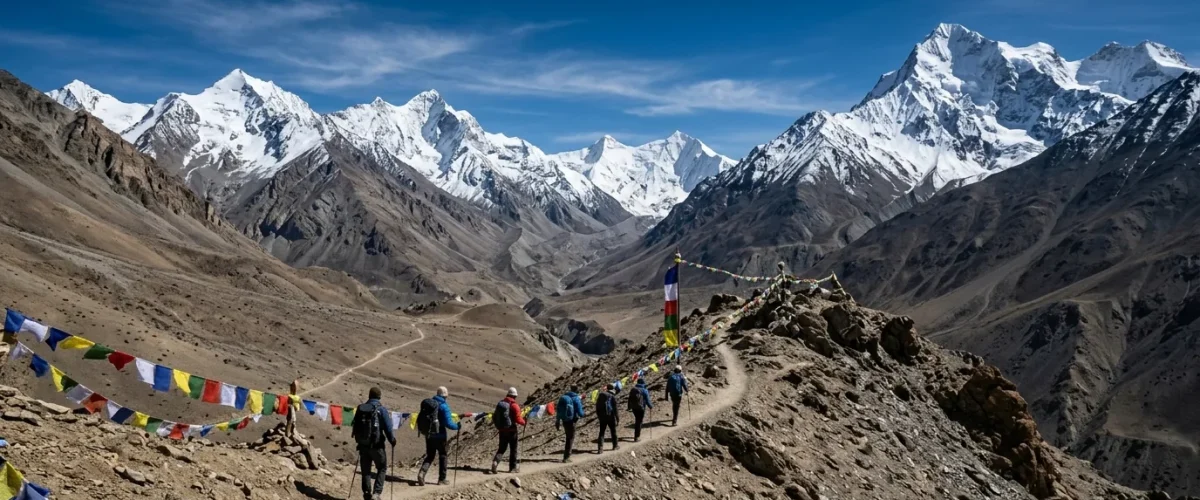
In a move that could reshape India’s adventure tourism landscape, the Ministry of Defence has approved the opening of over 100 previously restricted mountain peaks in Ladakh for civilian mountaineering and trekking expeditions. The decision, which follows years of advocacy by the mountaineering community and the Ladakh administration, opens access to some of the most spectacular and technically challenging terrain in the Himalayan-Karakoram system — territory that has been off-limits to civilians for decades due to its proximity to India’s borders with China and Pakistan.
A Historic Decision for Indian Mountaineering
The approval represents the most significant expansion of mountaineering access in India since the liberalisation of permit regulations in the 1990s. The 100-plus peaks, spanning altitudes from 5,000 metres to over 7,000 metres, are distributed across Ladakh’s Zanskar, Changthang, Nubra, and Kargil regions — areas of extraordinary natural beauty that have been largely inaccessible to anyone other than military personnel and approved research teams.
Ladakh’s Lieutenant Governor, Brigadier (Retd.) B.D. Mishra, described the decision as “a watershed moment for Ladakh’s development.” He stated that the opening of the peaks would “position Ladakh alongside Nepal, Pakistan’s Gilgit-Baltistan, and Kyrgyzstan as a world-class mountaineering destination, while creating livelihood opportunities for communities in some of India’s most remote and economically disadvantaged regions.”
The Indian Mountaineering Foundation (IMF) has welcomed the decision enthusiastically, noting that India’s mountaineering community has long been constrained by the limited number of accessible peaks relative to the country’s vast Himalayan geography. The IMF estimates that the newly opened peaks will attract between 5,000 and 10,000 expedition members annually within the first five years, generating significant economic activity in local communities.
The Peaks: A Mountaineer’s Dream
The newly accessible peaks include a remarkable diversity of mountaineering challenges. At the entry level, several peaks in the 5,000-5,500 metre range — including Kang Yatse I and II near Markha Valley, and Dzo Jongo near the Rupshu Plateau — offer achievable objectives for well-prepared trekkers with basic mountaineering training, potentially attracting the growing global community of recreational high-altitude enthusiasts.
At the more technical end, peaks such as Nun (7,135 metres) and Kun (7,077 metres) in Zanskar, and Saser Kangri II (7,518 metres) in the Karakoram, present serious challenges that will attract experienced expedition mountaineers from around the world. These peaks have been climbed only a handful of times, and their geological and meteorological characteristics offer mountaineering experiences distinct from the more frequently attempted peaks of Nepal and Pakistan.
The diversity of available objectives — from trekking peaks to technical mountaineering challenges — gives Ladakh a breadth of offering that few individual regions worldwide can match. This positions the territory as a comprehensive mountaineering destination rather than one defined by a single iconic peak.
Environmental and Safety Frameworks
The opening of the restricted peaks is accompanied by environmental and safety frameworks designed to prevent the ecological degradation and safety failures that have plagued mountaineering destinations elsewhere. The Ladakh Autonomous Hill Development Council, in consultation with the Wildlife Institute of India and the IMF, has developed regulations covering expedition group sizes, waste management protocols, route-specific seasonal restrictions, and mandatory insurance and rescue provisions.
The waste management provisions are particularly significant. The litter crisis on popular Himalayan trekking routes — most notoriously on Everest and its approach trails in Nepal — has become a global environmental concern. Ladakh’s regulations require expeditions to deposit waste bonds before departure, carry out all non-biodegradable waste, and submit photographic evidence of campsite cleanup. Repeat offenders face permit bans.
These conservation measures echo the thoughtful environmental approach visible across India’s tourism and environmental policy, from the strengthening of plastic waste management frameworks to the sustainable trail design principles being applied to the new mountain trail networks in Himachal Pradesh and Uttarakhand.
Economic Opportunity for Ladakh
The economic implications for Ladakh are potentially transformative. Mountaineering tourism generates significantly higher per-visitor revenue than standard tourism, as expeditions require extended stays, specialised services including guides, porters, cooks, and transport, and procurement of locally sourced food and supplies. The Nepal model — where mountaineering and trekking tourism contribute over $500 million annually to the economy — offers an aspirational benchmark for Ladakh.
Local communities in the affected regions are already preparing for the anticipated influx. Homestay programmes are being expanded, guide training initiatives are underway, and several communities are investing in basic mountaineering infrastructure such as base camp shelters and emergency communication systems. The Ladakh administration has established a dedicated Mountaineering Tourism Cell to coordinate logistics, safety oversight, and economic distribution.
Strategic Considerations
The decision to open the restricted peaks necessarily involves strategic considerations, given the areas’ proximity to contested borders. The Ministry of Defence’s approval includes conditions designed to ensure that civilian mountaineering activity does not compromise national security — including real-time expedition tracking, restricted zones within the broader permitted areas, and coordination with military authorities regarding expedition timing and routes.
Analysts note that the decision also carries geopolitical signalling value. By opening civilian access to border regions, India projects confidence in its territorial control and normalises activity in areas where China has sought to assert influence. The move is consistent with India’s broader strategy of developing infrastructure and civilian presence in border regions as a complement to military deployments.
Global Mountaineering Community Responds
The international mountaineering community has responded to the announcement with significant interest. Expedition operators in Europe, North America, and Japan — regions that supply the majority of commercial expedition clients — have reported increased inquiries about Ladakh programmes. The Alpine Club (UK) and the American Alpine Club have both issued statements welcoming the development and expressing interest in collaborative programmes with the IMF.
The timing is fortuitous. Growing concerns about overcrowding on popular peaks in Nepal — particularly Everest, K2, and the Annapurna Circuit — have created demand for alternative high-altitude destinations that offer comparable scenery and challenge without the queue factor. Ladakh, with its vast and virtually unexplored mountain terrain, is well-positioned to absorb some of this redirected demand.
India’s opening of mountain peaks adds another dimension to the country’s already diverse tourism portfolio, complementing the premium island eco-tourism offerings in the Andaman and Lakshadweep and the growing coastal tourism development in South India.