Plant-Based India 2026: How Flexitarian Diets Are Quietly Transforming Indian Households

A Quiet Revolution at the Indian Table
India, a country where vegetarianism has deep cultural and religious roots, is experiencing a new dietary transformation that goes beyond traditional categories. In 2026, the most significant shift in Indian eating habits is not the growth of strict veganism or the decline of meat consumption — it is the rapid rise of flexitarianism, a pragmatic approach where households eat predominantly plant-based meals while occasionally including animal products. This middle path, which aligns naturally with India’s existing food culture, is reshaping everything from kitchen routines to restaurant menus to the country’s $850 billion food industry.
The numbers are compelling. A survey conducted by the Indian Council of Medical Research (ICMR) in late 2025 found that 42 per cent of urban Indian households now describe their diet as “mostly vegetarian with occasional non-vegetarian meals” — up from 31 per cent in 2020. Among adults aged 25 to 40 — the demographic that drives household food purchases — the proportion is even higher at 48 per cent. India’s flexitarian moment has arrived, and it is transforming the food landscape in profound and largely positive ways.
Why Flexitarian Fits India
India’s embrace of flexitarianism makes cultural sense in ways that strict veganism does not. The country’s dairy tradition — encompassing ghee, curd, paneer, buttermilk, and lassi — is deeply embedded in culinary practice, religious observance, and nutritional habit. A diet that eliminates dairy entirely faces significant cultural resistance, regardless of health or ethical arguments. Flexitarianism, by contrast, accommodates India’s dairy heritage while encouraging a shift away from frequent meat consumption toward plant-centric meals.
The economic logic is equally straightforward. Plant-based proteins — lentils, chickpeas, kidney beans, black-eyed peas, and sprouted legumes — are significantly cheaper than meat in Indian markets. A kilogram of toor dal costs approximately ₹120; a kilogram of chicken costs ₹200 to ₹300; a kilogram of mutton costs ₹600 to ₹800. For households managing food budgets, increasing the proportion of dal-based meals is not a sacrifice but a financially rational choice that also happens to be nutritionally sound.
The health motivation is powerful. India faces a dual burden of malnutrition and lifestyle disease, with rising rates of diabetes, cardiovascular disease, and obesity — particularly in urban areas. ICMR’s dietary guidelines, updated in 2024, explicitly recommend that Indians increase their consumption of lentils, vegetables, and whole grains while limiting red meat and processed foods. The millet cooking revolution sweeping Indian kitchens is both a cause and a consequence of this dietary shift.
The Plant-Protein Boom
India’s plant-based protein market has grown from ₹1,200 crore in 2023 to an estimated ₹3,500 crore in 2026, driven by both traditional products and new-generation alternatives. Traditional categories — tofu, soya chunks, and paneer (which, while dairy-based, is increasingly positioned as a meat alternative) — continue to dominate. But newer products are gaining traction rapidly.
GoodDot, an Indian plant-based meat company, has expanded from a niche brand sold in health food stores to a mainstream product available across over 10,000 retail outlets and quick commerce platforms. Its “Proteiz” range — which includes plant-based keema, tikka, and biryani chunks — has found particular success in households that want to reduce meat consumption without abandoning familiar flavours and textures.
Blue Tribe Foods, another Indian startup, has developed plant-based chicken nuggets and sausages that have gained followers among urban consumers. The company’s products, priced at a 20 to 30 per cent premium over conventional meat, target the growing segment of health-conscious consumers who are willing to pay more for products they perceive as healthier and more sustainable.
The Traditional Protein Powerhouses
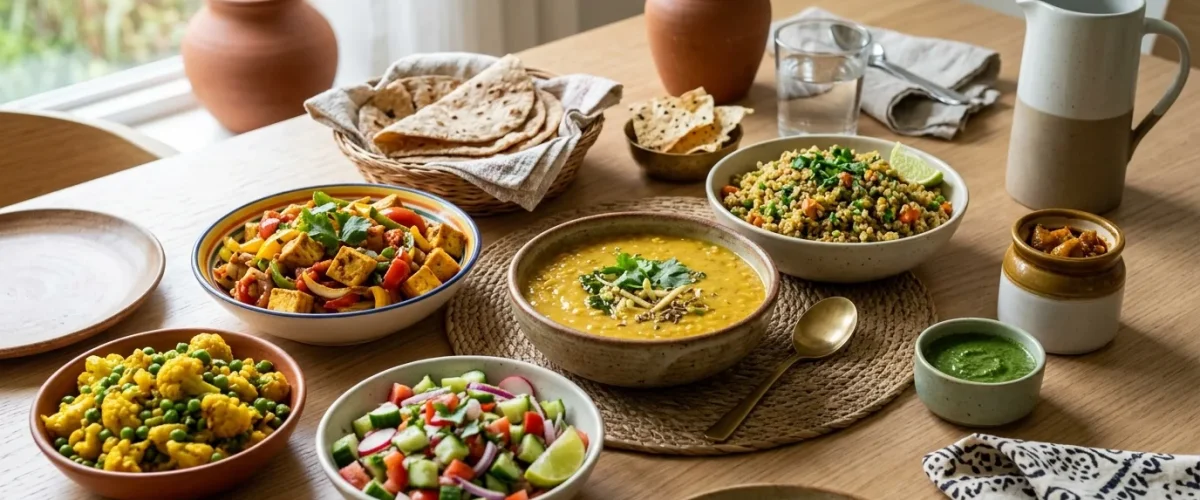
India’s most impactful plant-based proteins are not new-generation alternatives but traditional preparations that have sustained the subcontinent for millennia. Dal — the generic term for cooked lentil dishes — provides the protein backbone of hundreds of millions of Indian diets. The diversity of dal preparations across India is staggering: from the thin, tangy rasam of Tamil Nadu to the rich, butter-laden dal makhani of Punjab, from Bengal’s cholar dal with coconut to Rajasthan’s panchmel dal that combines five lentil varieties.
Sattu — roasted gram flour — has emerged as one of the trendiest traditional proteins of 2026, despite being a centuries-old staple in Bihar and eastern Uttar Pradesh. Sattu drinks (mixed with water, lemon, salt, and spices) have been embraced by India’s fitness community as a natural, affordable alternative to commercial protein shakes. At approximately ₹80 per kilogram, sattu provides over 20 grams of protein per 100 grams at a fraction of the cost of whey protein supplements.
Sprouted legumes — moong, chana, and masoor — are another traditional protein source experiencing renewed popularity. Sprouting increases protein bioavailability, reduces cooking time, and creates a crunchy, fresh texture that works in salads, chaats, and standalone snacks. The premiumisation of India’s street food market has introduced sprouted legume-based chaat and snacks to urban consumers who might not otherwise incorporate these nutritious foods into their diets.
Restaurants Lead the Way
India’s restaurant sector has responded to the flexitarian trend with remarkable agility. Vegetarian and plant-forward menus, which were once considered commercially risky in cities with large non-vegetarian populations, are now among the most popular dining options. The exciting wave of new restaurant openings across India in March 2026 includes multiple plant-forward concepts that showcase plant-based cuisine without the apologetic tone that once characterised vegetarian restaurants.
Fine dining establishments are also embracing plant-based tasting menus. Delhi’s Indian Accent, consistently ranked among Asia’s best restaurants, offers a vegetarian tasting menu that has become more popular than its non-vegetarian counterpart. The menu demonstrates that plant-based fine dining need not be an exercise in imitation — it can be a celebration of ingredients and techniques that stand on their own merit.
Challenges and Nutritional Considerations
The flexitarian shift is not without nutritional challenges. India already has among the highest rates of protein deficiency in the world, with ICMR estimating that 70 per cent of Indians consume less than the recommended daily protein intake. If the shift toward plant-based eating reduces overall protein consumption rather than substituting animal protein with adequate plant protein, the health outcomes could be negative rather than positive.
Vitamin B12 deficiency is another concern. This essential nutrient, naturally found primarily in animal products, is already deficient in a large proportion of the Indian population. Increasing reliance on plant-based diets without adequate supplementation or fortification could worsen this problem, particularly among pregnant women and young children.
Nutrition experts emphasise that a well-planned flexitarian diet — rich in diverse lentils, millets, vegetables, nuts, and seeds, with moderate dairy consumption — can meet all nutritional requirements. The key is dietary diversity, which India’s traditional regional cuisines naturally provide. The problem arises when flexitarianism becomes, in practice, a diet of refined carbohydrates and processed snacks with insufficient attention to protein and micronutrient adequacy.
A Natural Evolution
India’s flexitarian movement is not an imported trend but a natural evolution of the country’s food culture. India has always been a nation where the proportion of vegetarian meals in a household’s weekly rotation far exceeds the global average. What is changing in 2026 is the intentionality — households are making conscious decisions about the balance of plant-based and animal-based meals, informed by health awareness, environmental concern, and economic calculation.
This conscious approach to eating — neither dogmatically vegetarian nor reflexively omnivorous — may represent the most sustainable dietary model for a country of 1.4 billion people. It honours India’s culinary heritage while adapting to contemporary health challenges. And it does so in the most characteristically Indian way possible: not through rigid ideology but through pragmatic, flexible, and delicious compromise.

- Fentanyl Vaccine Breakthrough: Scripps Research Develops Shot That Blocks Deadly Overdoses Before They Reach the Brain - June 13, 2026
- Nipah Virus Returns to Kerala — First Case of 2026 Confirmed, State Declares High Alert - June 12, 2026
- Jill Biden Reveals She Wanted to Keep PM Modi’s 7.5-Carat Diamond Gift but Returned It After State Department Valued It at $20,000 - June 8, 2026