Delhi High Court Allows Vinesh Phogat to Compete in Asian Games 2026 Wrestling Trials — Overrules WFI Controversial Eligibility Rules

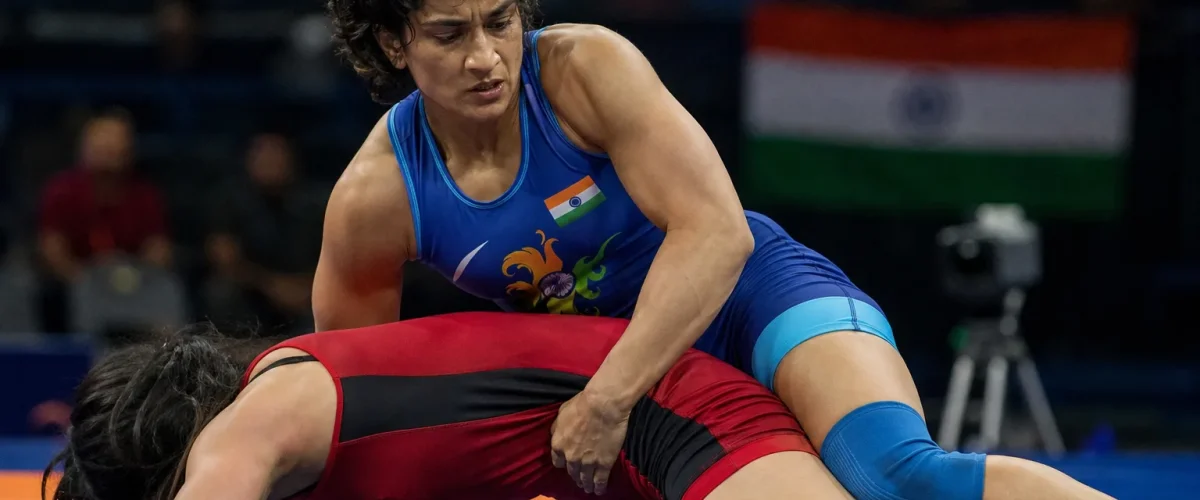
The Delhi High Court has permitted wrestler Vinesh Phogat to compete in the Asian Games 2026 wrestling selection trials scheduled for 30 and 31 May. A division bench led by Chief Justice DK Upadhyaya and Justice Tejas Karia overruled the Wrestling Federation of India’s eligibility criteria that had effectively barred the two-time world medallist from participating.
The court’s 15-page order, delivered on 23 May, found that WFI’s selection criteria were “exclusionary” and left “no discretion for the federation to consider accomplished athletes like Phogat, who is making a comeback after childbirth.” The ruling marks a significant deviation from past practice, where India’s top wrestlers were routinely given opportunities to prove fitness through trials regardless of recent tournament participation.
The women’s wrestling trials are being held at Indira Gandhi Stadium in New Delhi, while freestyle and Greco-Roman trials take place at the SAI Regional Centre in Lucknow. Vinesh will compete in the 57kg category, the same weight class where she reached the Olympic final in Paris 2024 before being disqualified for being 100 grams overweight.
WFI’s Controversial New Rules
The controversy began in early May when the WFI announced eligibility criteria for Asian Games trials that departed sharply from established norms. Under the new rules, only medal winners from three specific events — the 2025 Senior National Wrestling Championship, the 2026 Senior Federation Cup, and the Under-20 National Wrestling Championship — could participate in the selection trials.
The federation explicitly stated that “past performance will not be considered.” For Vinesh, who has been on a competitive sabbatical since the Paris Olympics, this meant her career achievements — including two World Championship medals, a Commonwealth Games gold, and an Asian Games gold — counted for nothing under the new framework.
Critics of the WFI’s decision pointed out that the timing appeared targeted. Vinesh had been preparing for a comeback and was set to compete in the National Open Ranking Tournament in the 57kg category. However, that tournament was not among the three qualifying events listed by the WFI.
The WFI’s restructuring efforts under new leadership have been contentious, with a stated focus on promoting younger talent sometimes coming at the expense of established athletes.
The Court’s Reasoning
Chief Justice Upadhyaya’s bench examined whether the WFI’s eligibility criteria met the test of reasonableness. The court found that while federations have the authority to set selection standards, those standards must not be arbitrary or designed to exclude specific athletes without justification.
The bench noted that WFI’s own National Coaching Camp guidelines, issued in April 2025, explicitly granted the federation discretion to select “iconic athletes” for trials. The rigid criteria announced for the Asian Games trials contradicted this earlier policy, suggesting an inconsistency that the court found troubling.
The court also observed that Phogat’s sabbatical was linked to childbirth — a factor that deserved consideration under principles of gender equity in sport. The ruling stopped short of declaring the WFI’s criteria unconstitutional but made clear that their application to Phogat was unjust given her circumstances.
Vinesh’s Path Back to Competition
Vinesh Phogat’s journey back to the wrestling mat has been anything but straightforward. After the devastating disqualification in Paris — where she was found 100 grams over the 50kg limit after reaching the Olympic final — she took an extended break that included the birth of her first child.
Her return to competition has been closely watched by Indian sports fans who viewed the Paris disqualification as one of the most heartbreaking moments in Indian Olympic history. The Court of Arbitration for Sport upheld the disqualification but acknowledged the emotional toll.
At 32, Vinesh is competing against a generation of younger wrestlers, but her technical skill and international experience remain assets that few in the Indian squad can match. Her performance at the trials will determine whether she represents India at the Asian Games in Aichi-Nagoya, Japan, scheduled for September 2026.
The Indian sporting landscape has been reshaped by the Tokyo and Paris Olympic cycles, and the 2026 Asian Games represent a critical stepping stone toward the 2028 Los Angeles Olympics for Indian wrestling.
WFI’s Track Record of Controversy
The Phogat eligibility dispute is the latest in a series of controversies involving India’s wrestling administration. The WFI was suspended by United World Wrestling in 2023 following protests by top wrestlers — including Vinesh — against then-president Brij Bhushan Sharan Singh over allegations of sexual harassment.
The federation has since been reconstituted under new leadership, but tensions between the administration and senior athletes have persisted. The squad selection process for the 2026 Asian Championships also drew criticism for perceived inconsistencies in how athletes were evaluated.
For Indian wrestling, the stakes extend beyond individual athletes. The sport has been one of India’s most consistent medal producers at major international events, and internal dysfunction risks undermining the pipeline of talent that has delivered results at the Olympics, World Championships and Asian Games.
What to Watch at the Trials
The 57kg category at the women’s trials is expected to be fiercely competitive. Vinesh will face wrestlers who have been competing actively on the national circuit, giving them a rhythm and match fitness advantage. However, Vinesh’s experience in high-pressure situations — including Olympic and World Championship finals — is a factor that no amount of domestic circuit competition can replicate.
Indian sports fans and the broader wrestling community will be following the trials closely. A strong performance by Vinesh would validate the High Court’s intervention and put pressure on the WFI to adopt more inclusive selection policies. A defeat would raise questions about whether the long sabbatical has taken an irreversible toll.
The trials represent more than a selection event — they are a test of whether India’s sports governance structures can accommodate both institutional authority and individual athlete rights. The court has made its position clear. Now the wrestling mat will have the final word.

- Fentanyl Vaccine Breakthrough: Scripps Research Develops Shot That Blocks Deadly Overdoses Before They Reach the Brain - June 13, 2026
- Nipah Virus Returns to Kerala — First Case of 2026 Confirmed, State Declares High Alert - June 12, 2026
- Jill Biden Reveals She Wanted to Keep PM Modi’s 7.5-Carat Diamond Gift but Returned It After State Department Valued It at $20,000 - June 8, 2026