India’s Clean Air Budget Slashed Even as AQI Crisis Chokes Major Cities in 2026

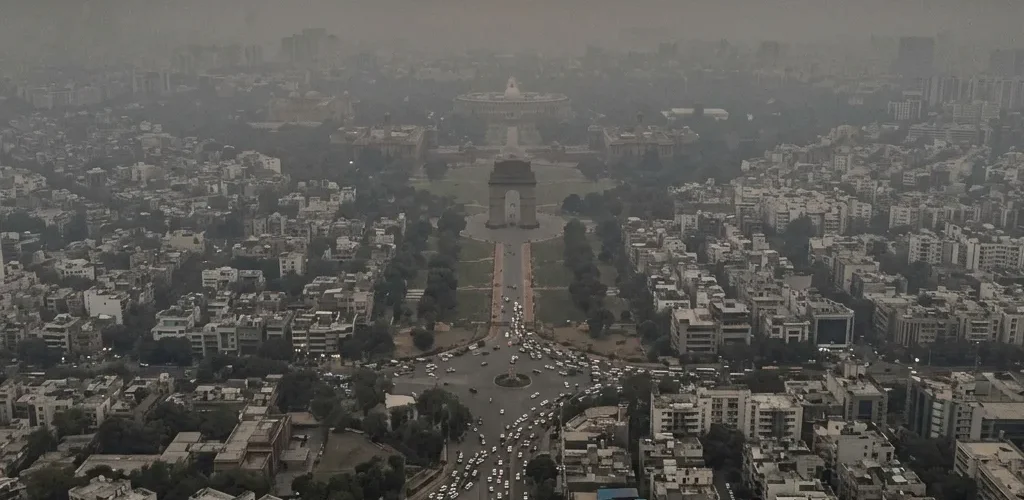
As India’s major cities gasped through another winter of toxic air, the Union Budget for 2026-27 delivered a development that left environmental activists and public health experts reeling: drastic cuts to the funding allocated for pollution control bodies, the Commission for Air Quality Management (CAQM), and the National Clean Air Programme (NCAP). The decision, coming at a time when air quality indices across northern India routinely breach hazardous thresholds, raises fundamental questions about the government’s commitment to what the Supreme Court has called the fundamental right to breathe clean air.
The Numbers That Tell the Story
The 2026-27 Budget estimates reveal a pattern of declining investment in air quality management. The Central Pollution Control Board (CPCB) saw its allocation reduced by an estimated 18 per cent compared to the previous fiscal year. The Commission for Air Quality Management in the National Capital Region, established in 2021 with considerable fanfare as a statutory body to tackle Delhi’s chronic air pollution, received a similarly diminished allocation. Most critically, the National Clean Air Programme — launched in 2019 with the ambitious target of reducing particulate matter concentrations by 40 per cent by 2026 — found its budget trimmed at the very moment it needed the most resources to meet its deadline.
These cuts come against the backdrop of a public health emergency that shows no signs of abating. Data from the Central Pollution Control Board’s real-time monitoring network shows that in the winter of 2025-26, over 60 per cent of India’s monitored cities recorded average PM2.5 concentrations exceeding the national ambient air quality standard of 60 micrograms per cubic metre. Delhi, which has become the global symbol of India’s air pollution crisis, recorded an average AQI of over 350 on multiple days in November and December 2025 — levels categorised as “severe” and associated with serious respiratory and cardiovascular health impacts.
What NCAP Has Achieved — and Where It Falls Short
The National Clean Air Programme, when launched, was regarded as India’s most comprehensive attempt to address air pollution systematically. Covering 131 non-attainment cities — those that consistently fail to meet air quality standards — NCAP provided a framework for city-level action plans, enhanced monitoring infrastructure, and source apportionment studies to identify the primary contributors to local pollution.
There have been genuine successes. The number of continuous ambient air quality monitoring stations (CAAQMS) has more than doubled since 2019, providing far more granular data on pollution levels across the country. Several cities, including Varanasi and Agra, have reported modest improvements in annual average PM2.5 levels, attributed to measures such as improved road dust management, construction site regulations, and the closure of brick kilns. Varanasi’s transformation extends beyond environmental metrics — the city has also experienced a remarkable tourism boom, with over 72 million visitors in 2025, indicating that cleaner urban environments can drive economic growth.
However, these improvements are unevenly distributed and insufficient relative to the programme’s own targets. A 2025 assessment by the Centre for Science and Environment found that while some cities had achieved PM2.5 reductions of 10-15 per cent, others had seen air quality deteriorate. The Indo-Gangetic Plain — home to over 600 million people and some of the world’s worst air quality — remains stubbornly resistant to improvement, a consequence of its geography, agricultural practices, industrial emissions, and vehicular pollution combining in a toxic cocktail.
The Agricultural Burning Conundrum
Perhaps the most politically sensitive contributor to north India’s winter air crisis remains crop residue burning in Punjab, Haryana, and western Uttar Pradesh. Despite billions of rupees spent on subsidies for Happy Seeder machines and alternative crop residue management technologies, satellite data from NASA’s FIRMS (Fire Information for Resource Management System) continues to show thousands of fire events each October and November. The fundamental economics of farming in these states — tight turnaround times between the kharif and rabi seasons, the high cost of mechanical alternatives, and inadequate enforcement of burning bans — mean that this contributor to Delhi’s winter smog remains largely unaddressed.
The budget cuts compound this challenge. State Pollution Control Boards, which are responsible for enforcing environmental regulations on the ground, have long been understaffed and under-resourced. A 2024 report by the National Green Tribunal found that several state boards operated with less than 40 per cent of their sanctioned staff strength, making effective monitoring and enforcement practically impossible. Reducing their budgets further threatens to hollow out whatever enforcement capacity remains.
Health and Economic Costs
The human cost of India’s air pollution crisis is staggering and well-documented. A 2024 Lancet study estimated that air pollution contributed to over 1.6 million premature deaths in India annually, making it the single largest environmental health risk in the country. The economic burden, encompassing healthcare costs, lost productivity, and premature mortality, has been estimated at 3-4 per cent of GDP — a figure that dwarfs the amounts being allocated to pollution control.
Children, the elderly, and outdoor workers bear a disproportionate burden. Studies by the All India Institute of Medical Sciences (AIIMS) have documented alarming rates of childhood asthma and stunted lung development in Delhi, while research from IIT Delhi has linked chronic PM2.5 exposure to accelerated cognitive decline in older adults. These findings add a dimension of intergenerational inequity to the pollution crisis — today’s children are paying with their health for decisions made by today’s policymakers.
The Electric Vehicle Promise
Amid the budget cuts, the government has pointed to its investments in electric vehicle adoption and clean energy transitions as evidence of its environmental commitment. The FAME (Faster Adoption and Manufacturing of Electric Vehicles) scheme and its successor programmes have indeed accelerated EV adoption, with electric two-wheeler sales crossing 1.5 million units in 2025. Delhi’s shift to an all-electric bus fleet, while proceeding slower than planned, has removed thousands of diesel buses from the capital’s roads.
However, experts caution that the benefits of electrification will take years to materialise at scale, and that they address only the vehicular component of a multi-source pollution problem. Industrial emissions, construction dust, waste burning, and the secondary formation of particulates from ammonia and other precursors require targeted interventions that the budget cuts directly undermine.
What Needs to Change
Environmental policy analysts have outlined several priorities that the budget should have addressed. First, a substantial increase in NCAP funding to enable city-level action plans to be implemented in full — many currently exist only on paper. Second, strengthening state pollution control boards with adequate staffing and technological resources, including AI-powered monitoring systems that can identify pollution hotspots in real time. The intersection of India’s growing AI capabilities and environmental monitoring represents a significant untapped opportunity.
Third, a fundamental rethink of the agricultural burning problem that moves beyond subsidies for equipment to structural reforms in the cropping calendar, minimum support prices, and biomass-based industries that create economic value from crop residue. Fourth, stricter emission standards for industries, with genuine enforcement backed by penalties that exceed the cost of compliance.
A Test of Priorities
India stands at a critical juncture. Its economic growth trajectory, its ambitions in technology and space, and its demographic dividend are all genuine strengths. But these achievements ring hollow when a significant portion of the population cannot breathe safely for months each year. The 2026-27 budget cuts to pollution control represent not just a policy failure but a moral one — a signal that the right to clean air remains, for many Indians, an aspiration rather than a guarantee. The coming months will determine whether this trend is reversed or whether India’s cities must endure yet another season of toxic skies.