Hampi Utsava 2026: Celebrating the Living Heritage of the Vijayanagara Empire

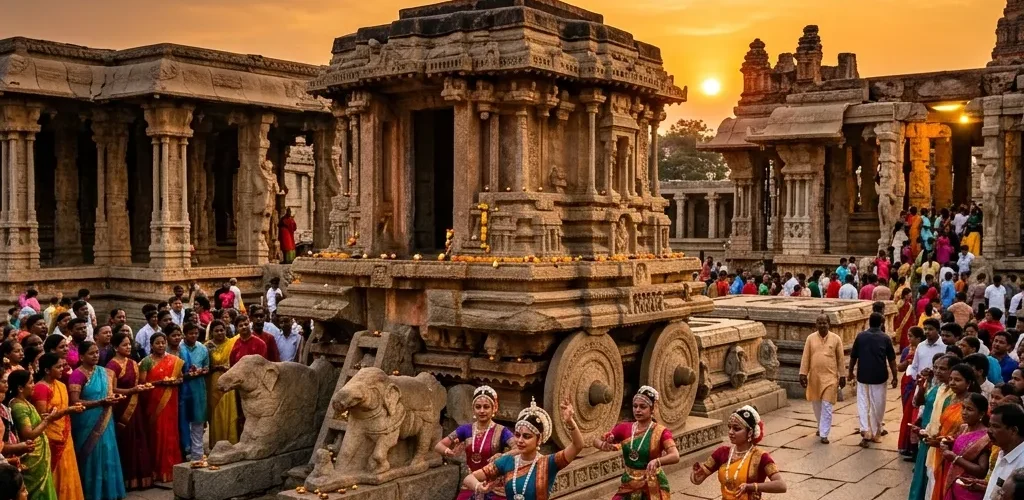
Every year, as the winter sun begins its retreat over the boulder-strewn landscape of northern Karnataka, the ancient ruins of Hampi come alive with a celebration that bridges six centuries of history. Hampi Utsava 2026, held in February, transformed the UNESCO World Heritage Site into a vibrant stage for folk dance, classical music, light shows, heritage walks, and cultural performances that honour the legacy of the Vijayanagara Empire — one of the greatest kingdoms in Indian history. For travellers and history enthusiasts, the festival offers an unparalleled opportunity to experience South India’s rich heritage in its most spectacular setting.
A Kingdom Preserved in Stone
Hampi was the capital of the Vijayanagara Empire, which at its peak in the 15th and 16th centuries was one of the largest and wealthiest cities in the world, with a population estimated at 500,000 — comparable to Rome at the height of the Roman Empire. The kingdom, founded in 1336, was a bulwark of Hindu culture in the Deccan, renowned for its patronage of art, architecture, music, and learning. Its fall in 1565 at the Battle of Talikota led to the systematic destruction of the city, but the sheer scale and quality of its stone architecture ensured that enough survived to create one of the world’s most extraordinary archaeological sites.
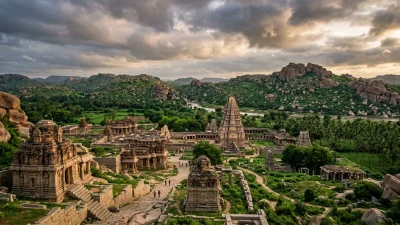
Today, Hampi’s ruins spread across 26 square kilometres of a surreal landscape dominated by massive granite boulders. The Virupaksha Temple, the Vittala Temple with its iconic Stone Chariot and musical pillars, the Royal Enclosure, the Lotus Mahal, the Elephant Stables, and dozens of other structures constitute a UNESCO World Heritage Site that ranks among Asia’s most important archaeological complexes. The Karnataka state tourism department has invested significantly in conservation, visitor facilities, and interpretation, making the site more accessible while maintaining its archaeological integrity.
Hampi Utsava 2026: The Programme
The 2026 edition of Hampi Utsava, held from February 13 to 15, featured a programme designed to appeal to diverse audiences — from serious students of Indian history and architecture to casual travellers seeking a culturally immersive experience. The festival’s signature events included illuminated evening performances against the backdrop of the Virupaksha Temple, classical dance recitals at the Royal Enclosure, and folk art demonstrations that showcased the traditional crafts of the Bellary and Hospet regions.
The light and sound show at the Vittala Temple complex was the festival’s centrepiece. Using projection mapping technology on the ancient stone surfaces, the show narrated the rise and fall of the Vijayanagara Empire in a multimedia presentation that combined historical accuracy with visual spectacle. The stone chariot — arguably India’s most photographed monument after the Taj Mahal — served as the focal point of the projection, its carved surfaces animated with scenes of courtly life, battle, and worship.
Heritage walks led by archaeological experts offered deeper engagement with the site. These guided tours, covering themes including “Temple Architecture of the Vijayanagara Period,” “Water Management in an Ancient City,” and “The Market Streets of Hampi,” provided context that transforms the experience from monument-viewing to genuine historical understanding. The walks were available in English, Hindi, and Kannada, with some offered in Japanese and Korean in recognition of growing tourist arrivals from East Asia.
Getting to Hampi in 2026
Hampi’s relative remoteness has historically been both its charm and its limitation. The nearest major city is Hospet (now officially Hosapete), approximately 13 kilometres away, which serves as the gateway for most visitors. The nearest airport is Hubli, about 160 kilometres distant, with flights connecting to Bengaluru, Mumbai, and Hyderabad. The recently improved road from Hubli to Hospet has reduced travel time to approximately two and a half hours.
For those incorporating Hampi into a broader South Indian itinerary, the site connects naturally with Badami, Aihole, and Pattadakal — the “Cradle of Indian Architecture” in northern Karnataka — and with Goa, approximately 350 kilometres to the west. The overnight train from Bengaluru to Hospet remains a popular and scenic option. A combined Karnataka-Kerala circuit that includes Hampi, the Western Ghats, and the Kerala coast represents one of South India’s finest multi-destination itineraries.
Accommodation in and around Hampi has improved dramatically. While budget guesthouses and homestays on the hippie-trail village of Virupapur Gadde (across the river from the main ruins) remain popular with backpackers, several heritage hotels and resorts have opened in Hospet and in the countryside surrounding Hampi, offering comfortable bases from which to explore the site.
The Vijayanagara Legacy in Contemporary India
Hampi Utsava serves not just as a tourist attraction but as a cultural reclamation project — an assertion that the Vijayanagara Empire’s achievements in art, architecture, governance, and intercultural exchange deserve recognition alongside those of the more widely known Mughal and British colonial periods of Indian history. The empire’s sophisticated urban planning, its hydraulic engineering (the ruins include an elaborate system of aqueducts and reservoirs), and its patronage of multilingual scholarship offer lessons that resonate in contemporary India’s development discourse.
The archaeological survey and conservation work at Hampi continues to reveal new findings. Recent excavations have uncovered market structures, residential quarters, and religious sites that expand understanding of the city’s daily life beyond its monumental architecture. Digital documentation projects, using LIDAR scanning and 3D modelling, are creating comprehensive records that will aid both conservation and public education.
Karnataka Tourism’s investment in Hampi reflects a broader strategy to position the state as a heritage tourism destination of international calibre. The state’s other UNESCO sites — the monuments at Pattadakal and the sacred ensembles at Halebid and Belur — are being developed in parallel, creating a “Heritage Trail of Karnataka” that could rival Rajasthan’s Golden Triangle as a cultural tourism circuit.
Planning Your Visit
The best time to visit Hampi is between October and March, when temperatures are manageable (20-30°C) and the landscape, though dry, has a dramatic beauty enhanced by the golden light that the granite boulders seem to absorb and re-emit. Two to three full days are recommended to explore the main site comprehensively. Guided tours are essential for understanding the historical significance of what you are seeing — without context, Hampi is a stunning landscape; with it, it is one of history’s most poignant stories.
Hampi Utsava 2026 has demonstrated that India’s heritage sites can serve as both conservation showcases and vibrant cultural venues. As India’s entertainment and cultural industries continue to draw global attention, festivals like Hampi Utsava play a vital role in connecting contemporary audiences with the deep roots of Indian civilisation. For any traveller seeking to understand not just where India is going but where it has been, Hampi is an essential destination — and the Utsava is the most spectacular time to experience it.