South Korea Crosses $4 Trillion Market Cap as Kospi Storms Past Record 6,600: Samsung, SK Hynix and the AI Chip Boom Driving Asia’s Newest Bull Market

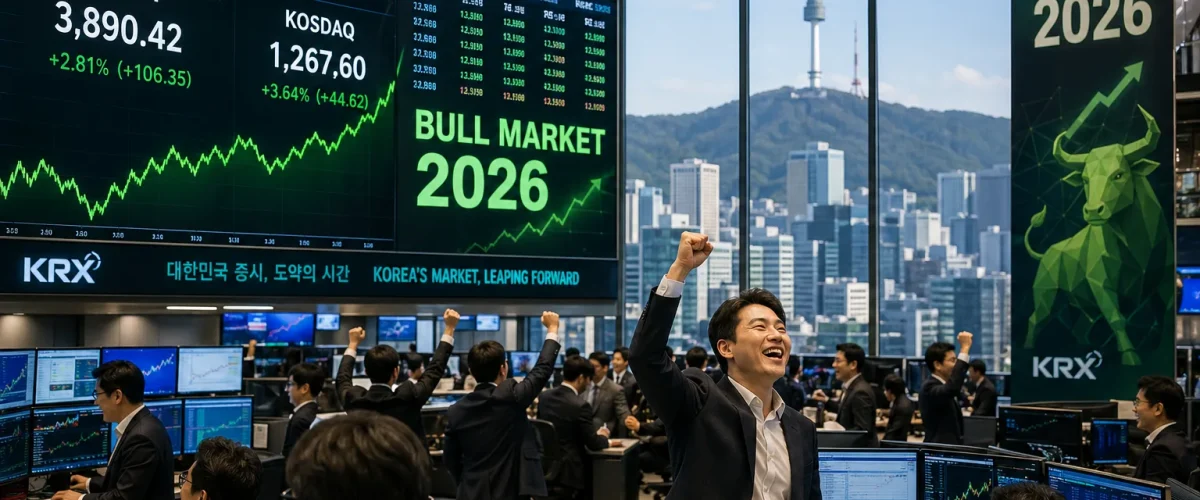
South Korea’s stock markets scaled a historic peak on Monday, 27 April 2026, as the total valuation of listed companies surpassed the 6,000 trillion won ($4.1 trillion) mark for the first time during trading hours. The benchmark Kospi index climbed to an intraday record of 6,603.01, breaking through the 6,600 barrier for the first time in the exchange’s history. The rally, driven primarily by semiconductor giants Samsung Electronics and SK Hynix, marks the culmination of a remarkable bull run that has been fuelled by the global artificial intelligence boom and South Korea’s dominant position in the memory chip supply chain.
According to data from the Korea Exchange cited by The Korea Herald, the combined market capitalisation of domestic bourses reached 6,031.97 trillion won in early trading. Of this, the Kospi made up the largest share at 5,354.36 trillion won, followed by the Kosdaq — the exchange for smaller and tech-focused companies — at 673.97 trillion won, and the Konex at 3.64 trillion won. The milestone places South Korea among an elite group of nations with stock markets valued at over $4 trillion, alongside the United States, China, Japan, and the United Kingdom.
Samsung and SK Hynix: The Twin Engines of the Rally
The rally has been overwhelmingly driven by South Korea’s semiconductor sector, which accounts for a disproportionate share of the Kospi’s total market capitalisation. Samsung Electronics, the world’s largest memory chip maker and South Korea’s most valuable company, has seen its share price surge by over 60 per cent in the past year as demand for high-bandwidth memory (HBM) chips used in AI data centres has exploded. SK Hynix, the world’s second-largest memory chip manufacturer, has performed even more spectacularly, with its stock price more than doubling over the same period. For more details, read about meta plans biggest layoff in history as zuckerberg restructures around ai.
The AI revolution has been transformative for the semiconductor industry. Global spending on AI infrastructure — including data centres, GPUs, and the high-bandwidth memory that supports them — is projected to exceed $300 billion in 2026, according to estimates from Gartner. South Korean companies are uniquely positioned to benefit from this spending boom, as they control approximately 70 per cent of the global HBM market and over 60 per cent of the broader DRAM memory market.
Samsung’s decision to accelerate investment in its HBM3E chip — the latest generation of high-bandwidth memory, which is used in Nvidia’s H200 and Blackwell GPU platforms — has been a key driver of investor enthusiasm. The company announced in its latest earnings call that HBM revenue had tripled year-on-year, and it projected continued growth as AI model sizes increase and data centres expand globally. SK Hynix has reported similar trends, with its HBM products selling out quarters in advance.
Broader Market Strength Beyond Semiconductors
While semiconductors have been the headline story, the Korean bull market has been supported by strength across multiple sectors. The automotive sector — led by Hyundai Motor and Kia — has benefited from strong global demand for electric vehicles and the expansion of Korean automakers into markets previously dominated by Japanese and European competitors. Hyundai’s share price is at a record high, driven by the success of the Ioniq range and robust sales in India, where it is the second-largest automaker.
Korea’s entertainment and cultural sector has also contributed to market optimism. The global dominance of K-pop, Korean dramas, and Korean cinema continues to drive revenues for entertainment conglomerates and their listed subsidiaries. Meanwhile, Korean shipbuilding companies have seen a surge in orders as the global shipping industry invests in new LNG carriers and container ships, partly in response to supply chain disruptions caused by the ongoing Strait of Hormuz crisis.
The Korean won has also strengthened against the US dollar in recent weeks, reflecting capital inflows from foreign investors attracted by the market’s growth prospects. Net foreign buying on the Kospi has totalled over $8 billion in 2026, reversing the outflows that characterised much of the previous two years when high US interest rates had drawn capital away from emerging and developed Asian markets alike.
The ‘Korea Discount’ and Government Reforms
The market’s record-breaking performance comes against the backdrop of the Korean government’s “Corporate Value-Up” programme, which was launched in 2024 with the aim of addressing the so-called “Korea discount” — the persistent undervaluation of Korean equities relative to peers in Japan, the US, and Europe. The programme has encouraged listed companies to improve shareholder returns through higher dividends, share buybacks, and better corporate governance.
The results have been encouraging. Dividend payout ratios among Kospi-listed companies have increased from an average of 22 per cent in 2023 to over 30 per cent in 2025, while the number of companies conducting share buybacks has risen significantly. Samsung Electronics alone has committed to returning 50 trillion won to shareholders through dividends and buybacks over a three-year period, a commitment that has been well received by both domestic and international investors.
Financial regulators have also eased rules on short selling, which had been banned in late 2023 after a market manipulation scandal. The phased reintroduction of short selling in early 2026, accompanied by stricter oversight measures, has been viewed positively by institutional investors who consider a functioning short-selling mechanism essential for market health and price discovery.
Can the Rally Continue?
Market analysts are divided on whether the Kospi’s rally has further room to run. Bulls point to the secular growth of AI spending, which they argue is still in its early stages, and the relative undervaluation of Korean semiconductor stocks compared to their US peers. Even after the recent surge, Samsung trades at a price-to-earnings ratio of approximately 14 times forward earnings — a significant discount to Nvidia, which trades at over 30 times.
Bears, however, warn of potential risks. The ongoing Strait of Hormuz crisis could disrupt South Korea’s energy imports, driving up costs for manufacturers. Geopolitical tensions — including the ever-present North Korea risk and US-China technology competition — add uncertainty. There are also concerns that the AI investment cycle could moderate if the return on investment from massive data centre builds fails to materialise as quickly as expected.
Regardless of the near-term outlook, the crossing of the $4 trillion threshold marks a significant milestone for South Korea’s economy and its capital markets. It underscores the country’s transformation from a manufacturing-focused emerging market to a global technology powerhouse that sits at the heart of the AI revolution.

- Fentanyl Vaccine Breakthrough: Scripps Research Develops Shot That Blocks Deadly Overdoses Before They Reach the Brain - June 13, 2026
- Nipah Virus Returns to Kerala — First Case of 2026 Confirmed, State Declares High Alert - June 12, 2026
- Jill Biden Reveals She Wanted to Keep PM Modi’s 7.5-Carat Diamond Gift but Returned It After State Department Valued It at $20,000 - June 8, 2026