Mamata Banerjee Leads Massive Sit-In Protest in Kolkata Over Post-Poll Violence and Attacks on TMC Leaders

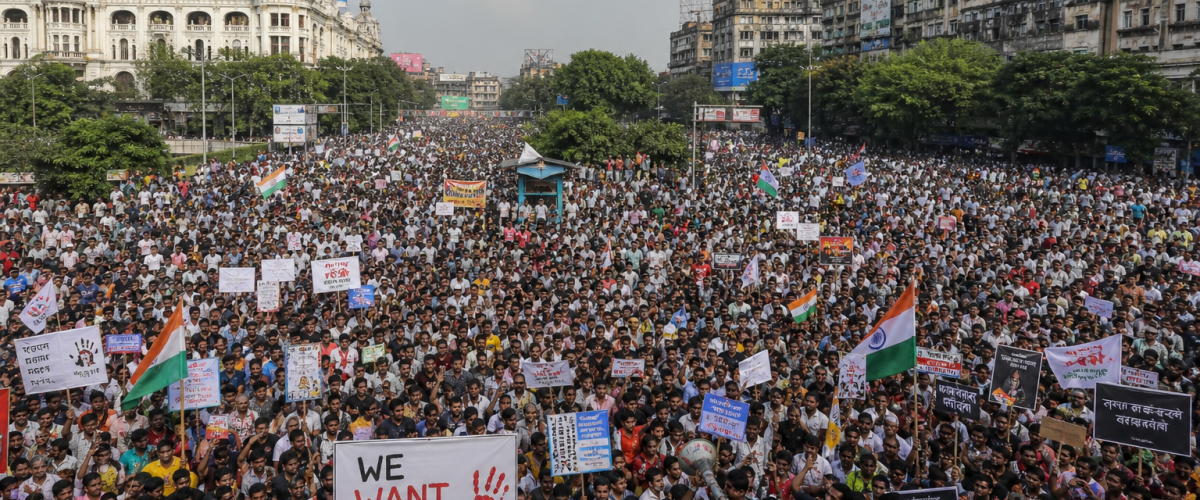
Mamata Takes to the Streets Despite Police Permit Denial
West Bengal Chief Minister and Trinamool Congress (TMC) supremo Mamata Banerjee led a massive sit-in protest on Monday at Rani Rashmoni Avenue in Esplanade, Kolkata, over what her party describes as an orchestrated campaign of post-poll violence and targeted attacks on TMC leaders by BJP-affiliated groups in the state.
The demonstration, which drew thousands of TMC supporters from across West Bengal, proceeded despite reports that police had not granted formal permission for the gathering. Banerjee arrived at the protest site around noon and vowed to continue the sit-in “until the central government acts against those responsible for political violence in Bengal.”
What Triggered the Protest
The immediate trigger was the alleged attack on TMC MP Abhishek Banerjee — the Chief Minister’s nephew and the party’s most prominent young leader — during his visit to Sonarpur on 30 May. Banerjee had gone to meet families affected by post-poll violence when he was allegedly attacked with stones and eggs by a group of locals. He sustained minor injuries in the incident.
Five persons have been arrested and two detained by police in connection with the Sonarpur attack. TMC alleges that the attackers were instigated by BJP operatives, a charge the BJP has denied, calling it “political drama” staged by TMC to divert attention from its own governance failures.
The Sonarpur incident was followed by a separate attack on TMC Lok Sabha MP Kalyan Banerjee, who was reportedly heckled and manhandled during a public event. TMC workers subsequently staged protests across parts of West Bengal over the weekend, setting the stage for Monday’s mega demonstration led by the Chief Minister herself.
Mamata’s Message and Demands
Speaking to supporters at Esplanade, Banerjee accused the BJP-led central government and the Governor of West Bengal of creating a “climate of violence” aimed at destabilising the elected state government. “They couldn’t defeat TMC at the ballot box, so now they’re trying to intimidate us through street violence,” she told the crowd.
Her specific demands include: an impartial investigation by a sitting High Court judge into the attacks on TMC leaders; action against what she called “BJP goon squads” operating with impunity in certain districts; and the recall of the current West Bengal Governor, whom TMC accuses of functioning as a “BJP agent” rather than a constitutional authority.
Banerjee also used the platform to address the internal challenges her party has been facing. Reports in recent weeks suggested that as many as 60 of TMC’s 80 MLAs skipped a critical party meeting, raising questions about dissent within the ranks. On Monday, the Chief Minister’s ability to mobilise a massive crowd appeared to be a pointed response to those narratives.
The Political Context
West Bengal has been a tinderbox of political tensions since the 2024 general elections, where BJP made significant inroads in the state. The party won 18 of 42 Lok Sabha seats in Bengal — its best-ever performance in the state — emboldening its cadre and creating friction with TMC’s traditional dominance.
Post-poll violence has been a recurring feature of West Bengal politics, with accusations flowing in both directions. Following the 2021 state assembly elections that Mamata won decisively, the BJP accused TMC of orchestrating violence against its supporters. The National Human Rights Commission (NHRC) sent a fact-finding team and produced a report detailing alleged atrocities. TMC dismissed the NHRC findings as politically motivated.
The current round of violence, however, has a different character. TMC claims that its leaders are being targeted specifically to create a narrative of lawlessness in West Bengal, which can then be used to justify central intervention or President’s Rule — a scenario that opposition parties in several states have warned about.
BJP’s Counter-Narrative
The BJP has dismissed Mamata’s protest as “political theatre” designed to distract from TMC’s internal problems and governance failures. Bengal BJP president Sukanta Majumdar told reporters: “Mamata Banerjee is protesting against violence that her own party cadre has perpetrated for decades. This is the height of hypocrisy.”
Governor CV Ananda Bose, who has had a consistently adversarial relationship with the TMC government, issued a statement calling on all parties to “maintain peace and respect democratic institutions.” TMC immediately rejected the statement, with party spokesperson Kunal Ghosh calling it “interference from an unelected office that has no business commenting on democratic protests.”
BJP’s central leadership, meanwhile, has used the Bengal situation to reinforce its national narrative about “lawless opposition-ruled states.” Union Home Minister Amit Shah said the central government was “monitoring the situation closely” and would “not hesitate to act if the constitutional machinery breaks down.”
Impact on Bengal Politics
The protest is likely to have significant implications for West Bengal’s political landscape. For Mamata, successfully mobilising a large crowd demonstrates that her hold over the party and its base remains strong despite the reported MLA dissent. It also allows her to frame the narrative as TMC versus BJP’s central machinery, rather than addressing internal party fissures.
For the BJP, the challenge is to maintain its momentum in Bengal without overplaying its hand. Heavy-handed central intervention could backfire by uniting Bengali sentiment behind Mamata, who has historically thrived in the role of a fighter taking on powerful forces.
Political analysts note that the 2026 municipal elections in West Bengal are approaching, and both parties are positioning themselves for what could be a crucial test of strength. The violence and protests are as much about controlling the narrative ahead of those elections as they are about the specific incidents themselves.
What Happens Next
The sit-in protest is expected to continue through Tuesday, with TMC announcing that party leaders from all 294 assembly constituencies will participate in rotation. The party has also called for a statewide “bandh” (general strike) if its demands are not met within a week — a move that could significantly escalate tensions.
Legal challenges are also likely. TMC has announced it will move the Calcutta High Court seeking a court-monitored investigation into the attacks on its leaders. The BJP is expected to counter-file, demanding investigation into TMC’s own alleged violence against opposition workers.
For ordinary citizens of West Bengal, the spiral of political violence and protest is a depressingly familiar pattern. As one Kolkata shopkeeper near the Esplanade protest site told news cameras: “Every few years, someone is protesting here. The party changes, the slogans change, but the common man’s problems remain the same.”

- Surya Chauhan Murder Case — Main Accused Killed in Police Encounter, House Gets Demolition Notice - June 2, 2026
- Surya Chauhan Murder Case — Main Accused Killed in Police Encounter, House Gets Demolition Notice - June 2, 2026
- Cockroach Janta Party Founder Abhijeet Dipke to Return to India on June 6 for Jantar Mantar Education Protest - June 2, 2026