Massive Midnight Anti-Encroachment Drive at Howrah Railway Station Sees Bulldozers Demolish Illegal Structures as New West Bengal Government Takes Action

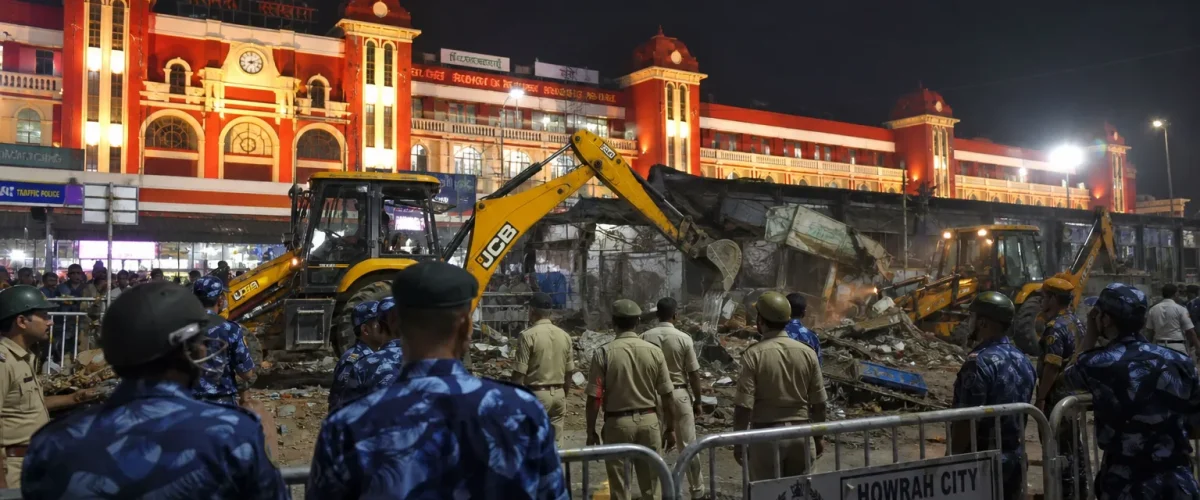
A massive anti-encroachment drive was conducted outside Howrah railway station in West Bengal past midnight on Saturday night, with bulldozers and earthmovers demolishing rows of makeshift shops and illegal structures that had occupied footpaths and public spaces in the area for years. The operation, conducted jointly by the Railway Protection Force (RPF), Government Railway Police (GRP), railway authorities, and Howrah City Police, marks one of the most significant enforcement actions and a major trending national story since the change of government in the state.
The Midnight Operation
The anti-encroachment drive began at approximately 12:30 AM on Sunday and continued until the early hours of the morning. Heavy deployment of security personnel was maintained across the area — from the Ganga ghat to the station premises — to prevent any untoward incident during the eviction drive. Police barricaded large sections of the area while bulldozers razed roadside shops selling food items, plastic goods, and other daily-use articles.
Multiple temporary stalls and structures occupying footpaths and public spaces near the bus stand and Ganga ghat area were removed using bulldozers and earthmovers as part of what railway officials described as a “railway land clearance initiative for passengers’ convenience.” The operation targeted structures that had been built on railway land without authorisation, many of which had been in place for years or even decades.
Visuals from the spot showed police barricading large sections of the area while heavy machinery moved in to demolish the illegal constructions. The operation was conducted at night to minimise disruption to the thousands of passengers who pass through Howrah station — one of India’s busiest railway terminals — during the day.
Scale of Encroachment at Howrah Station
Howrah railway station, located on the western bank of the Hooghly River and connected to central Kolkata by the iconic Howrah Bridge, handles over 600 trains and more than one million passengers daily. The area surrounding the station has long been plagued by illegal encroachments, with hundreds of unauthorised shops, food stalls, and temporary shelters occupying footpaths, access roads, and railway land.
The encroachments have been a source of persistent complaints from commuters, who have cited safety hazards, pedestrian congestion, hygiene concerns, and obstruction of emergency exits as major problems. Previous attempts to clear the area have met with limited success, as encroachers have typically returned within days or weeks of eviction drives.
“The area outside Howrah station was practically unusable for pedestrians. You had to walk on the road because the footpaths were completely blocked by shops. It was a safety disaster waiting to happen, especially during festivals when the crowd is massive,” said Subhrajit Sen, a daily commuter who travels from Howrah to Sealdah for work.
Political Context: New Government’s Enforcement Drive
The anti-encroachment drive comes in the wake of a change of government in West Bengal, with the BJP-led administration under Chief Minister Suvendu Adhikari taking a notably more aggressive approach to law enforcement and urban governance compared to the previous TMC government under Mamata Banerjee.
Adhikari, who took over as Chief Minister in late April 2026 after a closely contested state election, has made “restoring order and rule of law” a central theme of his administration’s early actions. Within his first 48 hours in office, Adhikari took several high-profile enforcement actions that signalled a departure from the previous government’s approach.
The use of bulldozers for anti-encroachment drives has become a politically charged symbol across India, with BJP-ruled states frequently deploying heavy machinery in what critics describe as “bulldozer politics.” While the BJP frames such actions as necessary enforcement against illegal construction, opposition parties and civil society groups have raised concerns about the lack of due process, the disproportionate impact on poor and marginalised communities, and the selective targeting of certain religious or ethnic groups.
Railway’s Official Position
The Indian Railways has not issued an official statement about the Howrah drive, but when asked, officials said it was “part of a regular cleanup operation” aimed at clearing railway land and improving passenger safety and convenience. The Railways has been conducting similar drives at major stations across the country as part of a broader “Clean Station” initiative launched by Railway Minister Ashwini Vaishnaw in 2024.
However, the scale and timing of the Howrah operation — conducted at midnight with heavy police presence and bulldozers — go well beyond the typical cleanup drives seen at other stations, suggesting a coordinated political will behind the action. Railway officials privately acknowledged that the drive was facilitated by the “full cooperation of the state government,” which had previously been less supportive of such enforcement actions under the TMC administration.
Reactions and Controversy
The anti-encroachment drive has drawn mixed reactions. Commuters and residents in the Howrah area have largely welcomed the action, with many expressing relief that the chronically congested station area is finally being cleared. “This should have been done years ago. The encroachments were not just an inconvenience — they were a fire hazard and a breeding ground for crime,” said Arindam Ghosh, a local businessman.
However, those whose livelihoods depended on the demolished structures have been left devastated. Many of the shopkeepers and street vendors who operated in the area were from low-income families and had been doing business at those locations for generations. “They came at midnight and destroyed everything. I have been selling tea here for 20 years. Where will I go now? This is not development — this is destruction of the poor,” said Mohammed Rafiq, a tea vendor who lost his stall in the drive.
The TMC, now in opposition, condemned the drive as “state-sponsored violence against the working poor.” Former Chief Minister Mamata Banerjee posted on social media: “Bulldozing the livelihoods of the poor at midnight is not governance — it is cruelty masquerading as development. These people needed rehabilitation, not demolition.”
What Happens Next
Railway officials have indicated that the anti-encroachment drive will continue in phases, with the goal of clearing all illegal structures from railway land in and around Howrah station within the next two weeks. The Indian Railways has also announced plans to develop the cleared land into a modern passenger amenity zone with designated areas for authorised vendors, clean public toilets, waiting areas, and improved pedestrian pathways.
The Howrah Municipal Corporation has been asked to prepare a rehabilitation plan for displaced vendors, though details of such a plan have not yet been announced. Social activists have demanded that the government provide alternative vending zones and financial assistance to those affected before proceeding with further demolitions.
The Howrah anti-encroachment drive is emblematic of the broader tensions in Indian society and governance between the imperative of public order and infrastructure improvement on one hand, and the rights and livelihoods of the urban poor on the other. As the debate continues, the empty stretches of footpath outside Howrah station stand as a stark reminder that progress and displacement often walk hand in hand.

- Indian Army Gets New Chief as General Dwivedi Hands Over Command Amid Push for Indigenous Defence Tech - July 1, 2026
- Ayodhya Ram Temple Donation Scandal Deepens as Trustees Resign and SIT Arrests Eight - June 29, 2026
- Bengal Seven Weeks On: Modi’s Historic Win and the Questions That Won’t Go Away - June 28, 2026