Actor Vijay Takes Oath as Tamil Nadu Chief Minister at Jawaharlal Nehru Stadium in Historic Ceremony

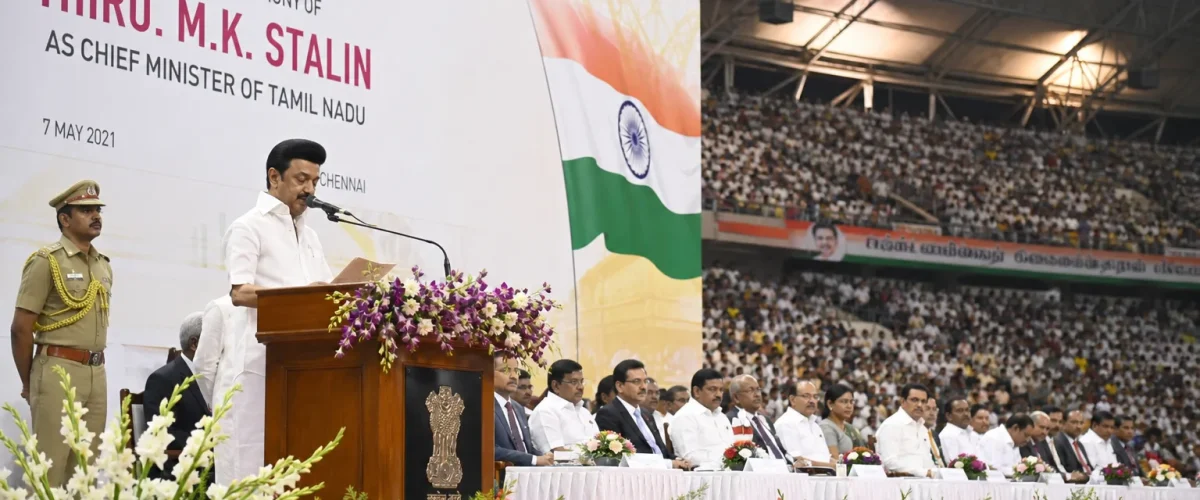
In a moment that will be remembered as a turning point in Tamil Nadu’s political history, actor-politician Vijay was sworn in as the Chief Minister of Tamil Nadu on 07 May 2026 at the Jawaharlal Nehru Indoor Stadium in Chennai. The ceremony marked the culmination of an extraordinary political journey that saw Vijay’s Tamilaga Vettri Kazhagam (TVK) emerge from its very first election as the single-largest party, shattering the state’s decades-old Dravidian duopoly.
Governor Rajendra Vishwanath Arlekar administered the oath of office to Vijay, known to millions of fans as “Thalapathy”, before an audience that included senior political leaders, film industry figures, and thousands of supporters who had gathered outside the stadium to celebrate the occasion. The swearing-in came after the TVK secured formal backing from the Indian National Congress and other smaller parties, pushing the coalition past the 118-seat majority mark needed to form a stable government.
How TVK Built Its Majority
The TVK won 108 seats in the Tamil Nadu Assembly election — a stunning debut by any measure — but fell 10 seats short of the simple majority of 118 in the 234-member house. In the days following the results, the party embarked on coalition talks with Congress and Left parties to secure the numbers needed to form government.
The coalition arithmetic, as confirmed by party sources ahead of the swearing-in, includes the following allies:
- Indian National Congress: 5 seats (confirmed, with cabinet berths offered)
- CPI(M) and CPI: 4 seats (2 each, after internal consultations)
- VCK (Viduthalai Chiruthaigal Katchi): 2 seats
- IUML (Indian Union Muslim League): 2 seats
- DMDK: 1 seat
With these allies, the TVK-led coalition controls approximately 122 seats — a working majority of four. Vijay won from two constituencies, Perambur and Tiruchirappalli East, and is expected to retain the Perambur seat while vacating Trichy East through a by-election. One TVK MLA is slated for the Speaker’s post, which would bring the effective coalition strength to a comfortable margin.
A Historic Power-Sharing Model
What sets this government formation apart from past Tamil Nadu administrations is the TVK’s willingness to share power with smaller allies in a way that neither the DMK nor the AIADMK had typically done during their long periods of dominance. Party sources indicated that cabinet berths have been promised to all coalition partners — a move that reflects both political pragmatism and Vijay’s stated commitment to inclusive governance.
Political analysts noted that this approach could reshape Tamil Nadu’s political landscape for years to come. “The Dravidian parties historically ran winner-takes-all governments with token representation for allies,” said Professor R Srinivasan of the University of Madras. “TVK’s coalition model is closer to what we see in states like Kerala or West Bengal, and it could force the DMK and AIADMK to rethink their approach to alliances.”
DMK and AIADMK’s Response
The TVK’s stunning election debut has left both the DMK and AIADMK in crisis. The DMK, which was defending its position as the ruling party, slumped to a distant third with just 38 seats — its worst performance in decades. The AIADMK won 62 seats, finishing second but still far short of a challenge to the TVK-led coalition.
Reports emerging on the day of the swearing-in suggest that the two Dravidian arch-rivals may be considering an unprecedented alliance against the TVK. Sources close to the NDTV newsroom indicated that the BJP, which has a small but growing presence in the state, may serve as a bridge between the DMK and AIADMK — a development that would have been unthinkable even a year ago.
However, both parties face internal divisions that make any such alliance complicated. The DMK’s leadership under M K Stalin is under pressure after the electoral debacle, while the AIADMK continues to grapple with factional disputes that have plagued the party since the death of J Jayalalithaa.
Vijay’s Priorities as Chief Minister
In his first address after taking the oath, Vijay outlined several priorities for his government. These include a comprehensive review of the state’s fiscal position, a focus on social welfare programmes for farmers and urban poor, an anti-corruption drive targeting state-level bureaucracy, and investment in Tamil Nadu’s technology and manufacturing sectors.
Vijay also pledged to establish a transparent system for government appointments and contract awards, a move that analysts see as a direct response to the corruption allegations that dogged the previous DMK administration. The new Chief Minister’s supporters hope his outsider status — he has no political dynasty or established party machinery — will enable him to pursue reforms that career politicians have been unable or unwilling to implement.
What Lies Ahead
The road ahead for Vijay’s government will not be easy. Governing Tamil Nadu with a thin majority will require careful coalition management, and the combined opposition of the DMK and AIADMK — two parties with deep institutional knowledge and extensive grassroots networks — will test the TVK’s staying power.
The immediate challenge is filling the cabinet. With multiple coalition partners expecting ministerial berths and the TVK’s own MLAs — many of them first-time legislators — vying for positions, the allocation of portfolios will be closely watched as an indicator of Vijay’s political judgement and leadership style.
For Tamil Nadu’s 8.2 crore residents, the swearing-in represents both a fresh start and an uncertain future. The state has been governed by either the DMK or the AIADMK for over five decades, and the arrival of a third force — led by a film star with no prior governing experience — is as much a leap of faith as it is a democratic mandate for change.
As celebrations continued across Chennai and other cities late into Wednesday evening, one thing was clear: Tamil Nadu’s politics will never be quite the same again. The entertainment industry’s most prominent crossover into politics since the days of MGR and Jayalalithaa has produced a result that few predicted and many are still struggling to fully comprehend.