DMK and AIADMK Explore Historic Alliance to Block Vijay’s TVK From Forming Government in Tamil Nadu

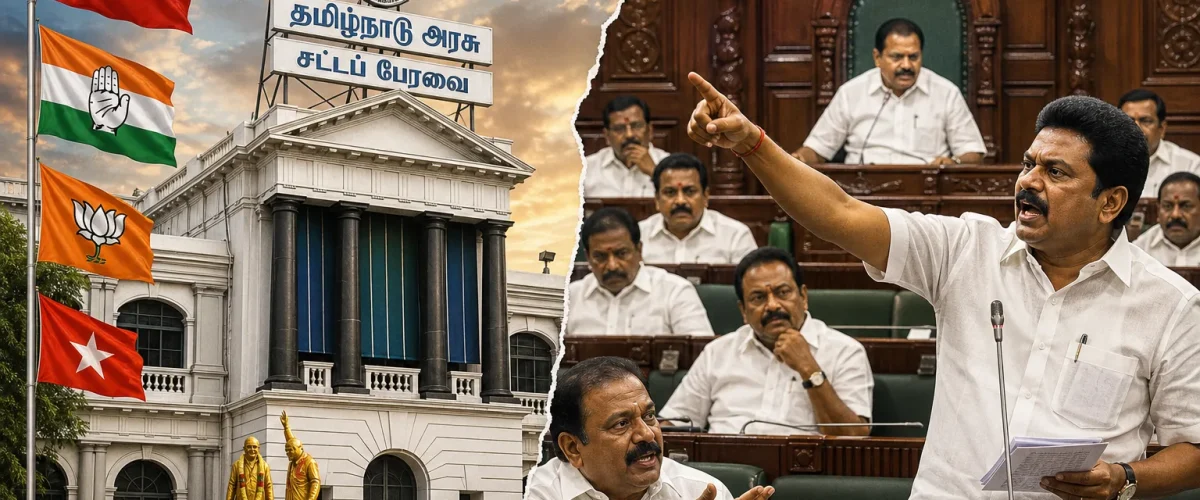
In what could become one of the most extraordinary political manoeuvres in Indian democratic history, the Dravida Munnetra Kazhagam and the All India Anna Dravida Munnetra Kazhagam are reportedly exploring a coalition to prevent actor-turned-politician Vijay’s Tamilaga Vettri Kazhagam from forming the government in Tamil Nadu. The two parties, which have been fierce ideological rivals for over 50 years, may now join hands in a bid to keep the political newcomer out of power.
TVK Emerges as Single-Largest Party With 108 Seats
The 2026 Tamil Nadu Assembly election delivered a verdict that shattered the state’s traditional political order. Vijay’s TVK, contesting its first-ever state election, won 108 seats in the 234-member assembly, making it the single-largest party and ending a 59-year streak of DMK-AIADMK dominance in Tamil Nadu politics. The majority mark stands at 118, meaning the TVK needs the support of at least 10 more legislators to form the government.
The result itself was historic. The TVK, founded just two years ago in 2024, positioned itself as an alternative to the oscillating duopoly of the DMK and AIADMK. The party contested alone in 233 constituencies, rejecting pre-election alliances, and its grassroots campaign resonated strongly with younger voters who had grown disillusioned with the established Dravidian parties.
Governor Remains Unconvinced on TVK’s Numbers
Three days after the results were declared, there is still no clarity on who will form the government. Tamil Nadu Governor Rajendra Vishwanath Arlekar, who has met Vijay twice in three days, is not yet convinced that the TVK has secured the numbers to prove a majority on the floor of the house.
It initially appeared that the TVK, with conditional support from the Indian National Congress, would stake its claim. Congress won 14 seats in the election and had indicated willingness to support a TVK-led government. However, even with Congress support, the TVK would reach only 122 seats, a razor-thin majority that could be vulnerable to defections or floor-crossing.
Vijay has also approached the Communist parties and the Viduthalai Chiruthaigal Katchi for support, but both have been stalling for time, with neither giving a definitive commitment. In a dramatic escalation, all 107 TVK MLAs (Vijay won two seats) threatened to resign if the DMK and AIADMK attempt to form a coalition government, calling it a betrayal of the people’s mandate.
The Unthinkable Alliance: DMK-AIADMK Talks
Amid the uncertainty, reports have emerged of behind-the-scenes negotiations between the DMK and AIADMK, brokered in part by the BJP’s national leadership. Sources familiar with the discussions say the DMK is prepared to extend outside support to an AIADMK-led government, without directly participating in the ministry. In return, the DMK has sought ministerial berths for its alliance partners, including the VCK.
The possibility of a DMK-AIADMK alliance, even an informal one, would be unprecedented. The two parties have defined Tamil Nadu politics since the late 1960s, and their rivalry has been the central axis of the state’s electoral landscape. Their ideological differences, rooted in competing visions of Dravidian identity and governance, have made any form of cooperation unthinkable for generations of political observers.
Yet the emergence of Vijay’s TVK as a viable third force has apparently done what decades of political evolution could not — push the two rivals towards each other. “This is not about ideology anymore. It is about survival,” said R. Narayanan, a political analyst at the Madras Institute of Development Studies.
Vijay’s Response: People’s Mandate Must Be Respected
After the earlier swearing-in as Tamil Nadu Chief Minister, Vijay has been vocal about his claim to form the government. Speaking to reporters outside Raj Bhavan after his second meeting with the Governor, Vijay said: “The people of Tamil Nadu have spoken. We are the single-largest party, and we have the moral and democratic right to form the government. Any attempt to cobble together an unnatural alliance to deny the people’s mandate will be resisted.”
The TVK has also pointed to constitutional conventions that typically require the Governor to first invite the single-largest party to prove its majority before exploring other options. Legal experts, however, note that the Governor has discretion in such matters, particularly when no party has a clear majority.
Congress and Left Parties Hold the Key
The final outcome hinges on the decisions of smaller parties. Congress, which won 14 seats, has been cautious in its public statements. Party leaders in Chennai have indicated support for a TVK government, but the national leadership in New Delhi is reportedly weighing whether to back Vijay or align with the DMK, a long-standing ally in the INDIA alliance.
The Communist Party of India and CPI(Marxist), which together won eight seats, are also in a difficult position. VCK leaders are said to be engaging with the Communists on behalf of the DMK, but the Left parties may ultimately choose to remain neutral rather than support either side. This was the position that the TVK had anticipated during its coalition talks with these parties.
What Does This Mean for Tamil Nadu Politics?
Regardless of the outcome, the 2026 election has fundamentally reshaped Tamil Nadu’s political map. The TVK’s historic debut has broken the Dravidian duopoly that has governed the state for nearly six decades. Whether Vijay ultimately forms the government or is kept out by an unlikely coalition, the message from voters is clear — they want change.
Constitutional experts say the situation could drag on for days or even weeks if neither side is able to demonstrate a clear majority. In the most extreme scenario, the Governor could recommend President’s Rule, though this would be politically explosive and legally contentious.
For now, Tamil Nadu remains in political limbo, with the fate of 80 million people hanging on backroom negotiations between parties that have spent half a century trying to destroy each other. The next 48 hours are expected to be decisive.
Follow the latest political developments on Social Trends and Culture & Lifestyle at Daily Tips.