Gujarat Local Body Elections 2026: Over 4 Crore Voters Decide 9,992 Seats Across Corporations, Municipalities, and Panchayats in State’s Biggest Grassroots Poll

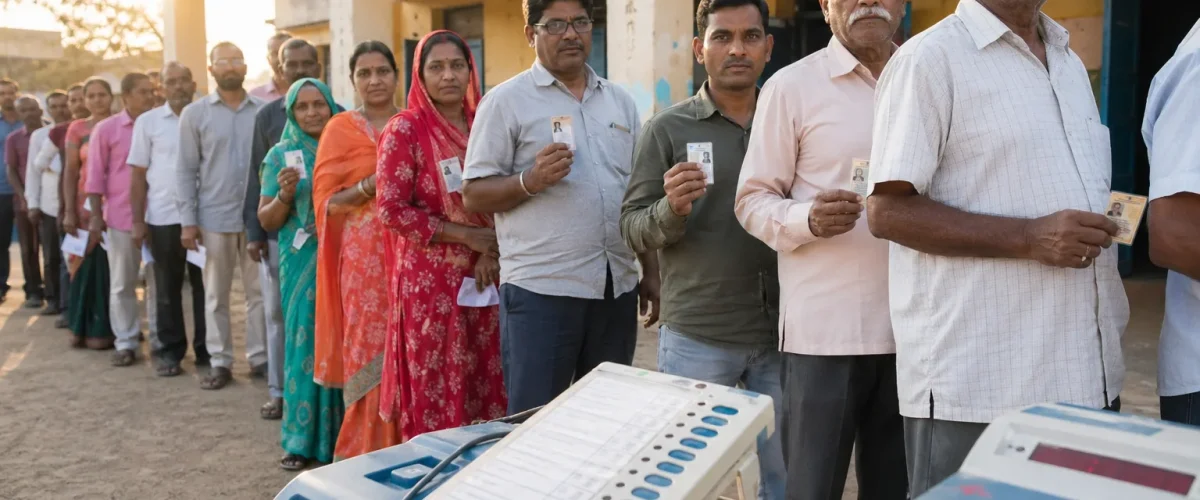
Voting began across Gujarat on Sunday, 26 April 2026, in what is the state’s largest grassroots democratic exercise, with approximately 4.19 crore eligible voters casting ballots to elect representatives to 15 municipal corporations, 84 municipalities, 34 district panchayats, and 260 taluka panchayats. The State Election Commission (SEC) has set up polling stations across 7,253 wards, and voting is being conducted using electronic voting machines (EVMs) from 7 AM to 6 PM.
Scale of the Elections
The elections encompass 9,992 seats across urban local bodies as well as district and taluka panchayats, making this the single largest local body election in Gujarat’s recent history. Out of the state’s total 4.4 crore registered voters, approximately 4.19 crore are eligible to participate. By-elections are also being held simultaneously for 13 seats in 11 municipalities.
For the first time, elections are being held in nine newly constituted municipal corporations. While the BJP currently controls the six existing corporations — Ahmedabad, Surat, Vadodara, Rajkot, Bhavnagar, and Jamnagar — the new corporations of Karamsad-Anand, Gandhidham, Nadiad, Navsari, Porbandar, Mehsana, Morbi, Vapi, and Surendranagar are virgin territory where all parties are fighting to establish dominance.
Multi-Cornered Contest Expected
A multi-cornered contest is expected among the BJP, Congress, Aam Aadmi Party (AAP), smaller regional outfits, and a large number of independent candidates. The BJP enters the elections as the dominant force in Gujarat, having won the state assembly elections convincingly and holding all six existing municipal corporations. However, local body polls in India often produce surprises, with hyper-local issues such as water supply, roads, sanitation, and waste management taking precedence over national political narratives.
The AAP, which made significant inroads in Gujarat during the 2022 assembly elections, faces an existential challenge after the dramatic exit of Raghav Chadha and six AAP MPs to the BJP earlier this week. The party’s organisational capacity in Gujarat has been tested by the national-level turmoil, and its performance in these local polls will be closely watched as a barometer of its grassroots relevance.
Key Battlegrounds
Ahmedabad, the state’s largest city and a BJP stronghold, is the marquee contest. The municipal corporation election here covers 64 wards and is seen as a prestige battle for the ruling party. Surat, India’s diamond capital, and Vadodara, with its mix of industrial and academic populations, are also closely contested. Union Home Minister Amit Shah, who cast his vote in Ahmedabad on Sunday morning, has personally overseen the party’s campaign in the city.
The results of the West Bengal assembly elections earlier this month have already demonstrated that high voter turnout can produce surprising outcomes. In Gujarat, where the BJP machinery is traditionally well-oiled at the grassroots level, the Congress is banking on anti-incumbency at the local level — pointing to unresolved issues of waterlogging, traffic congestion, and inadequate public transport in several cities.
Also Read: Social Trends
Infrastructure and Governance on the Ballot
Voters across Gujarat’s urban areas are weighing in on years of municipal governance, with issues varying significantly by city. In Ahmedabad, the Sabarmati riverfront development has been a point of pride for the BJP, but critics argue that peripheral areas have been neglected. In Surat, the city’s famed cleanliness rankings face scrutiny amid rapid population growth. In the newly formed corporations, residents are voting for structured governance for the first time, having previously been administered by smaller municipal bodies.
State Election Commissioner S. Murali Krishna confirmed that adequate security arrangements have been made, with police and paramilitary forces deployed at all sensitive and hyper-sensitive polling stations. The counting of votes is scheduled for 28 April 2026, and results are expected by the evening.
National Significance
Also Read: Economy & Governance
While local body elections are primarily about municipal governance, the Gujarat polls carry national significance as a test of political momentum. For the BJP, a dominant performance would reinforce its stranglehold on Prime Minister Modi’s home state. For the Congress, winning even a handful of municipal corporations would signal a revival. And for the AAP, anything less than a respectable showing could accelerate questions about the party’s future after the major political realignments of 2026.
The results on 28 April will provide the clearest picture yet of where Gujarat’s political winds are blowing as the country heads into an eventful second half of 2026.