NEET UG 2026 Re-Exam Scheduled for June 21 as Government Announces Shift to Computer-Based Testing From Next Year After Paper Leak Scandal

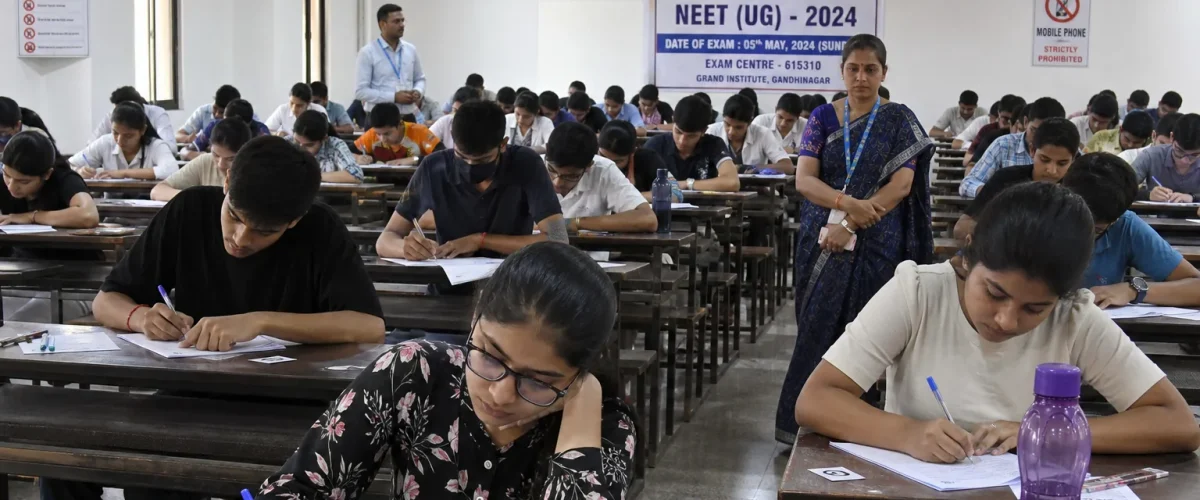
The National Testing Agency (NTA) will conduct the re-examination for NEET UG 2026 on Sunday, 21 June, Union Education Minister Dharmendra Pradhan announced on Friday, 15 May 2026, nearly two weeks after the medical entrance examination was cancelled over alleged paper leaks that led to CBI intervention and the arrest of five suspects across three states. The announcement brings partial relief to over 24 lakh students whose academic futures have been thrown into uncertainty since the original exam held on 3 May was scrapped.
In a significant reform announcement, Pradhan also confirmed that NEET will shift to Computer-Based Test (CBT) mode from the 2027 cycle onwards, moving away from the OMR (Optical Mark Recognition) pen-and-paper format that the minister himself acknowledged was the “root cause” of the security vulnerabilities that enabled the leak. “The command chain was breached,” Pradhan said during a press briefing. “We are taking this extremely seriously, and the first priority is to conduct the re-examination in a completely safe, transparent and credible manner.”
What Students Need to Know About the Re-Exam
The NTA, in a post on the social media platform X, confirmed the new date: “NEET (UG) 2026 — Examination Date Announced. The National Testing Agency, with the approval of the Government of India, has scheduled the re-examination of NEET (UG) 2026 on Sunday, 21 June 2026.” The agency said that students will be given a week to select their preferred exam city — a response to complaints that many students were assigned centres far from their home cities in the original exam.
The re-exam will follow the same pattern, syllabus, and duration as the original NEET UG 2026 exam. Students who had registered for the 3 May examination will not need to re-register or pay additional fees — their existing registrations remain valid. Admit cards for the June 21 exam will be released separately, and the NTA is expected to announce the download dates within the next two weeks.
However, the six-week gap between the cancellation and the re-exam has caused significant anxiety and disruption for students. Many had already begun preparing for counselling and college admissions, while others had moved on to prepare for alternative entrance exams. Coaching institute associations have criticised the delay, arguing that the re-exam should have been scheduled within 15 days of the cancellation to minimise disruption to the academic calendar.
The Paper Leak Scandal: How It Unfolded
The NEET UG 2026 exam, held on 3 May across thousands of centres nationwide, was cancelled by the NTA after evidence emerged that the question paper had been leaked and distributed to students before the exam. The leak was first reported from Maharashtra, where arrested suspects were found with copies of the paper that matched the version used in the actual examination.
The leaked paper subsequently spread to several states, including Haryana’s Gurugram, Rajasthan’s Jaipur and Sikar — a major coaching hub — as well as Jammu and Kashmir, Bihar, and Kerala. WhatsApp messages recovered from the phones of arrested suspects showed guarantees of “500, 600 marks” being offered to students in exchange for payments, according to investigators. The CBI, which took over the investigation from state police, has so far arrested five people across three states: three from Rajasthan, one from Haryana, and one from Maharashtra.
The investigation has also raised uncomfortable questions about the Biwal family of Jaipur, where five family members reportedly cleared NEET in 2025. Investigators are probing whether the family’s success was connected to the alleged paper leak network and whether the network had been operating for multiple years before being detected.
Education Minister Admits Security Failure
In his most candid acknowledgement of the security breach, Education Minister Pradhan accepted that the “root cause was OMR” — referring to the physical question paper format that requires printed papers to be transported to thousands of examination centres across the country, creating multiple points of vulnerability. “The command chain was breached at the distribution level,” he said, without providing specific details of where and how the leak occurred.
Pradhan’s announcement that NEET will shift to CBT mode from 2027 is designed to address these structural vulnerabilities. Computer-based tests eliminate the need for physical question paper distribution, as questions are delivered digitally to secure terminal devices at exam centres and can be randomised for each candidate, making coordinated cheating virtually impossible. The JEE (Main), CUET, and several other national-level exams already use the CBT format successfully.
However, the shift to CBT for NEET presents significant logistical challenges. NEET is India’s largest single-day examination, with over 24 lakh candidates appearing annually. Conducting the exam on computers would require either multiple testing sessions spread across several days — raising questions about question paper equivalence — or a massive expansion of secure computer-based testing infrastructure across the country.
Political Fallout: States Demand NEET Exemption
The NEET fiasco has also reignited the political debate over centralised versus decentralised medical admissions. Former Tamil Nadu Chief Minister and DMK chief MK Stalin on Friday wrote to PM Modi requesting that NEET UG be exempted for the 2026-27 cycle and that state governments be allowed to make medical admissions based on qualifying examination marks — a long-standing demand of the DMK and several other regional parties.
Kerala CM-designate VD Satheesan echoed this sentiment, saying his administration would “not conduct NEET” and would submit proposals to concerned authorities for an alternative admissions framework. The opposition Congress has demanded an independent judicial inquiry into the paper leak, arguing that the NTA — which is responsible for both conducting and securing the exam — cannot be trusted to investigate its own failures.
The NEET controversy also comes against the backdrop of a broader national conversation about examination integrity. Multiple high-stakes examinations have faced allegations of paper leaks, impersonation, and systematic cheating in recent years, undermining public confidence in the examination system and the meritocratic principles it is supposed to uphold.
What Happens to Medical Admissions?
The delay in conducting the re-exam will inevitably push back the medical admissions cycle for the 2026-27 academic year. Typically, NEET results are declared in June and counselling begins in July, with medical colleges starting classes by August or September. With the re-exam now scheduled for 21 June, results are unlikely before mid-July at the earliest, potentially delaying the start of the academic year by several weeks.
Medical education regulators are expected to adjust admission timelines accordingly, and the government has asked medical colleges to be prepared for a compressed academic calendar. For the lakhs of students who have invested years of preparation and significant financial resources into their NEET preparation, the wait continues — but at least the announcement of a definitive re-exam date provides a target to work towards.