Peter Magyar Sworn In as Hungary New Prime Minister Ending Viktor Orban 16 Year Rule and Pledging to Dismantle Illiberal Regime

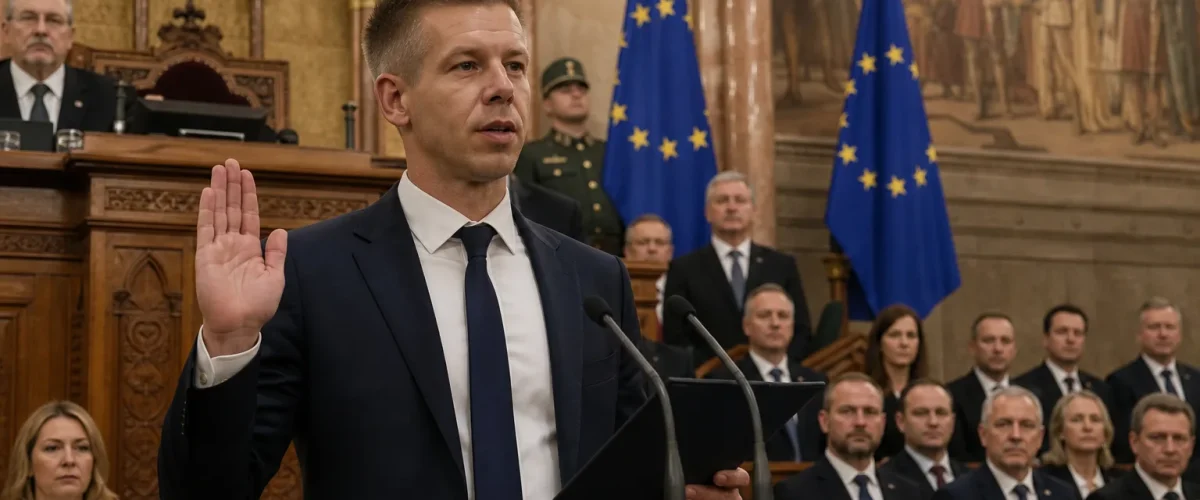
In a landmark moment for European politics, Péter Magyar, the 45-year-old leader of the Tisza Party, was sworn in as Hungary’s new Prime Minister on Saturday, May 9, 2026, formally ending the 16-year rule of nationalist strongman Viktor Orbán. The swearing-in ceremony, held in the Hungarian Parliament on Europe Day — a symbolically charged date — marked the beginning of what Magyar has described as a “new chapter” in Hungarian democracy.
Magyar was elected prime minister by the National Assembly with 140 votes in favour and 54 against in the 199-seat parliament. In his inaugural address, he struck a tone of reconciliation while delivering a clear repudiation of the Orbán era: “I ask everyone here, within these walls of parliament, to hear the message Hungarians have delivered: they want change, not only a change of government, but a change of system.”
From Orbán Insider to Opposition Leader
Magyar’s political trajectory is one of the most remarkable in recent European history. Born in 1981, he was once an insider in the Orbán system, having served as a diplomat and government official. His ex-wife, Judit Varga, was Orbán’s Justice Minister. However, Magyar broke publicly with the Fidesz party in early 2024, alleging systemic corruption within the government and accusing Orbán’s inner circle of personal enrichment at the expense of the Hungarian people.
The break was spectacular and irreversible. Magyar released recordings and documents that he said proved corruption at the highest levels of government. He then founded the Tisza Party (named after Hungary’s second-longest river) and began building a grassroots movement that rapidly attracted support from Hungarians disillusioned with Orbán’s increasingly authoritarian governance style.
The Tisza Party’s victory in the April 2026 parliamentary elections was decisive, winning a clear majority that allowed Magyar to form a government without the complex coalition-building that has characterised many recent European elections. Political scientists have attributed the victory to a combination of anti-incumbency sentiment, corruption fatigue, and Magyar’s ability to appeal to both urban liberals and rural conservatives who had previously been part of Orbán’s base.
Pledges to Dismantle the ‘Illiberal Regime’
Orbán famously declared in 2014 that he was building an “illiberal state” within the European Union, a project that involved undermining judicial independence, curtailing press freedom, concentrating economic power among loyalists, and weaponising migration fears for political advantage. Magyar has made dismantling this system the centrepiece of his governing agenda.
In his first speech as Prime Minister, Magyar outlined several immediate priorities:
- Restoring judicial independence by reversing changes made to the appointment process for judges and prosecutors
- Reforming media regulations to end what critics describe as a government-controlled media empire that gave Fidesz outsized influence over public discourse
- Reopening negotiations with the European Union on billions of euros in frozen EU funds that were withheld over rule-of-law concerns
- Launching anti-corruption investigations into government contracts and procurement during the Orbán years
- Re-engaging with NATO allies after years of Hungarian obstruction on Ukraine policy and defence spending
European Union Welcomes the Change
The reaction from Brussels was swift and overwhelmingly positive. European Commission President Ursula von der Leyen congratulated Magyar and expressed hope for a “renewed partnership” between Hungary and the EU. European Council President António Costa called the transition “a victory for European democracy.”
For the EU, the change in Budapest resolves one of its most persistent internal challenges. Orbán’s Hungary had been a thorn in the side of European unity for years, blocking sanctions against Russia, vetoing Ukraine-related aid packages, and challenging the EU’s core values on migration, LGBTQ rights, and media freedom. The European Parliament had voted in 2022 to declare Hungary “no longer a full democracy” — a designation that Magyar has pledged to reverse through tangible reforms.
The Hungarian transition also carries implications for the broader geopolitical landscape. Orbán was one of Russian President Vladimir Putin’s closest allies in Europe, maintaining warm relations with Moscow even as the Russia-Ukraine war — which Putin recently said was “coming to an end” — continued to reshape European security dynamics.
The Dancing Politician and the Inauguration’s Lighter Moment
The inauguration ceremony was not without its lighter moments. Zsolt Hegedüs, a Tisza Party MP, went viral after performing an exuberant dance at the parliamentary celebration following Magyar’s swearing-in. The video, which garnered millions of views within hours, earned Hegedüs the nickname “Hungary’s dancing politician” and provided a moment of levity in what was otherwise a solemn and historically significant event.
Challenges Ahead
Despite the optimism surrounding his inauguration, Magyar faces enormous challenges. The Orbán system was not built overnight and will not be dismantled quickly. Many of the structural changes — from the stacking of courts to the consolidation of media ownership — were designed to be difficult to reverse, with constitutional amendments and entrenched legal frameworks protecting key elements of the illiberal architecture.
Economically, Hungary faces headwinds including high inflation, a weak forint, and the need to unlock approximately €22 billion in frozen EU funds. Magyar has signalled that meeting EU rule-of-law benchmarks to release these funds will be among his top priorities, providing a significant fiscal boost if achieved.
The transition in Hungary carries relevance for democratic movements worldwide, including in countries where similar concerns about democratic backsliding and institutional erosion have been raised. For the people of Hungary, Saturday’s ceremony was not just a change of prime minister — it was, in Magyar’s own words, “the beginning of the restoration of a democratic Hungary that belongs to all its citizens, not to one party or one man.”
Whether Magyar can deliver on that promise will be the defining question of Hungarian politics in the years ahead, with implications that extend far beyond the country’s borders. As global geopolitical dynamics continue to shift, Hungary’s return to the European mainstream could play a crucial role in reshaping the continent’s political landscape.

- Indian Army Gets New Chief as General Dwivedi Hands Over Command Amid Push for Indigenous Defence Tech - July 1, 2026
- Ayodhya Ram Temple Donation Scandal Deepens as Trustees Resign and SIT Arrests Eight - June 29, 2026
- Bengal Seven Weeks On: Modi’s Historic Win and the Questions That Won’t Go Away - June 28, 2026