West Bengal BJP Cabinet Expansion — 35 MLAs Take Oath as Ministers in Suvendu Adhikari Government, Total Strength Rises to 41

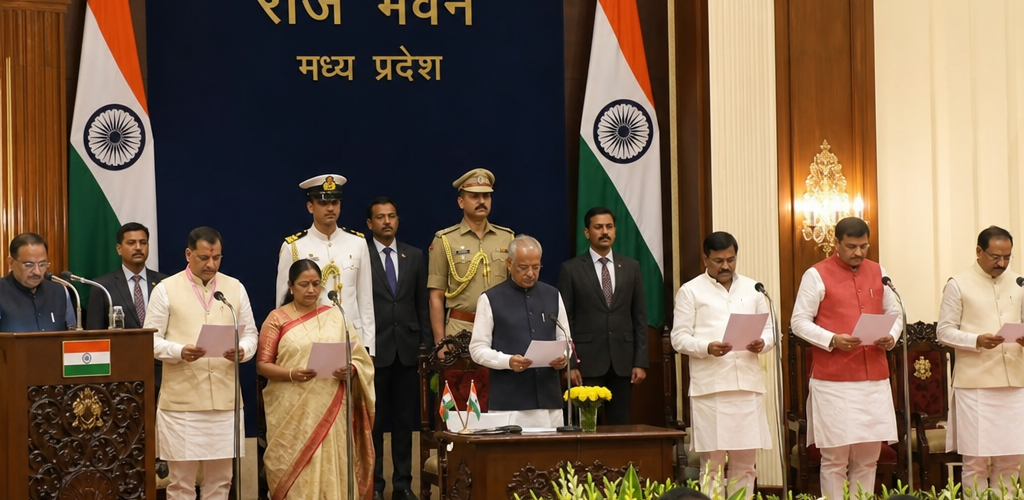
West Bengal’s first-ever BJP-led government completed a major milestone on June 1 as 35 MLAs were sworn in as ministers in Chief Minister Suvendu Adhikari’s expanded cabinet, bringing the total strength of the council of ministers to 41. Governor RN Ravi administered the oath of office and secrecy at Nabanna (Lok Bhavan) in a ceremony that marked the formal consolidation of the BJP’s power in a state that had been governed by Mamata Banerjee’s Trinamool Congress for over a decade.
Breakdown of the New Cabinet
Of the 35 newly sworn-in MLAs, 13 were inducted as cabinet ministers, three as ministers of state with independent charge, and 19 as ministers of state. This structure reflects a carefully calibrated balance of regional representation, caste dynamics, and factional interests within the Bengal BJP, which came to power in the state for the first time following its decisive victory in the 2026 assembly elections.
The expansion follows the initial swearing-in on May 9, when only six BJP leaders — including CM Suvendu Adhikari, Dilip Ghosh, Agnimitra Paul, and three others — took oath to form the core of the government. The limited initial cabinet was a tactical decision, allowing Adhikari and the BJP central leadership time to assess competing demands from various factions, regions, and community groups before making portfolio allocations.
Notable inclusions in the expanded cabinet reportedly include senior BJP leaders who had been instrumental in the party’s ground-level campaign in Bengal, legislators from key regions including North Bengal, the Jangalmahal belt, and the Matua-dominated areas of South Bengal, as well as representatives from scheduled caste, scheduled tribe, and minority communities.
Political Significance
The cabinet expansion is significant on multiple levels. For the BJP, it represents the transition from electoral victory to functional governance in a state where the party had been in opposition for years. A full council of ministers is essential for the day-to-day administration of a state with a population exceeding 100 million, and the delay in expansion had been cited by opposition parties as evidence that the BJP was struggling to manage its internal dynamics in Bengal.
The composition of the cabinet also sends important signals about the BJP’s governance priorities and its strategy for consolidating its position in Bengal’s complex political landscape. By including legislators from North Bengal — a region where the BJP has strong support among communities that have historically felt neglected by Kolkata-centric governments — the party is signalling that it intends to address regional imbalances that have long fuelled political discontent.
The inclusion of leaders from the Jangalmahal tribal belt (Bankura, Purulia, Jhargram, West Midnapore) is similarly significant. This region, which witnessed Maoist insurgency in the 2000s and has been a swing area between the TMC and BJP, will be closely watching whether the new ministers deliver on promises of development, road connectivity, and employment that the BJP made during the election campaign.
TMC’s Deepening Crisis
The cabinet expansion comes at a time when the opposition Trinamool Congress is facing one of its worst internal crises. In a stunning development, 60 of the TMC’s 80 MLAs reportedly skipped a meeting called by party supremo Mamata Banerjee, indicating a severe erosion of party discipline and loyalty following the party’s unexpected loss of power.
The TMC’s troubles have been compounded by allegations of attacks on its leaders, including party MP Abhishek Banerjee, who was allegedly assaulted during a visit to party workers affected by post-poll violence. Mamata Banerjee herself led a sit-in protest in Kolkata, accusing the BJP of targeting TMC workers and attempting to intimidate the opposition.
Political analysts note that the TMC’s difficulty in keeping its legislative party together is partly a consequence of the party’s historically centralised power structure, which revolved around Mamata Banerjee’s personal authority. With the party out of power for the first time since 2011, the incentive structures that kept the party together — access to government resources, patronage networks, and the promise of political advancement — have been disrupted, leading to fragmentation.
Governance Challenges Ahead
The Suvendu Adhikari government faces a formidable set of challenges as it settles into governance with a full cabinet. West Bengal’s economy, which grew at approximately 7 percent annually during the TMC’s tenure, is showing signs of strain in sectors including manufacturing, small business, and agriculture. The state’s fiscal position is constrained by high debt levels, limited own-tax revenue growth, and significant expenditure commitments on social welfare schemes that the previous government had introduced.
Law and order remains a pressing concern, with reports of post-poll violence, political intimidation, and communal tensions requiring firm but balanced handling by the new administration. The BJP’s central leadership has repeatedly emphasised that the Bengal government must demonstrate good governance and development delivery rather than engaging in political vendetta against the TMC, a message that will be tested as the new ministers take charge of their respective departments.
The industrial policy challenge is particularly acute. Bengal, which was once India’s industrial powerhouse, has seen a decline in manufacturing investment over decades. The BJP has promised to revive the state’s industrial sector by improving the ease of doing business, attracting investment, and resolving long-standing issues related to land acquisition, labour regulations, and infrastructure. Whether the expanded cabinet can translate these promises into concrete action will determine the government’s credibility.
Education, healthcare, and rural development are other priority areas where the new ministers will need to demonstrate quick wins while also laying the groundwork for longer-term structural improvements. The BJP’s performance in governance in Bengal will be closely watched nationally, as it will influence the party’s narrative ahead of future elections in other states and the 2029 general elections.