CERN Discovers Ξcc⁺ — A New Proton-Like Particle With Two Charm Quarks That Solves a 20-Year Physics Mystery

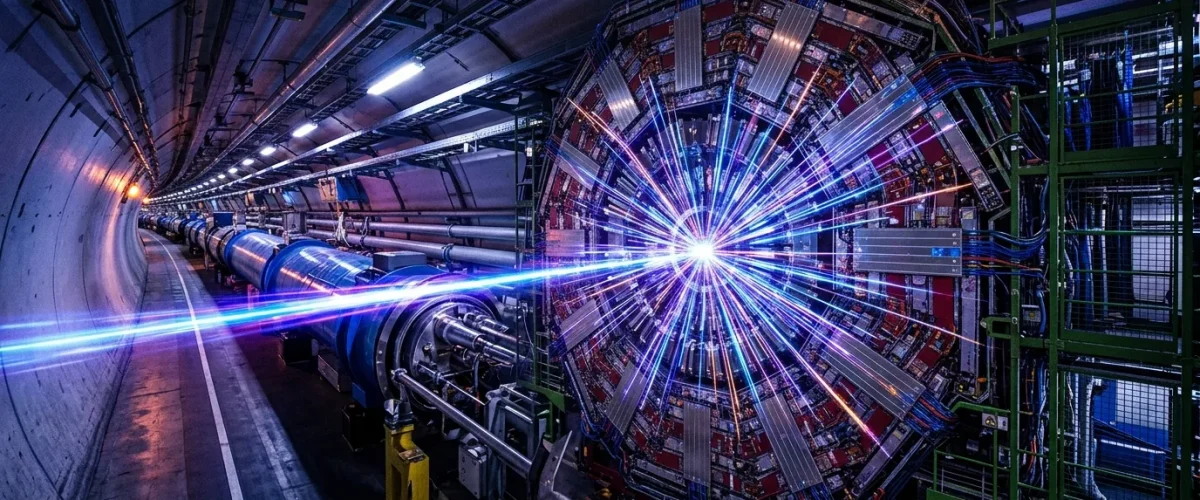
Scientists working on the LHCb experiment at CERN’s Large Hadron Collider (LHC) have announced the discovery of a new subatomic particle that has been dubbed a ‘heavy cousin of the proton.’ The particle, known as the Ξcc⁺ (Xi-cc-plus), consists of two charm quarks and one down quark — a configuration that had been predicted by theoretical physicists for over two decades but had never been observed experimentally until now.
The discovery, formally announced by CERN on 2 April 2026 and detailed in a paper published on the scientific preprint server, represents the first new particle found using the upgraded LHCb detector — a major milestone for the international collaboration of more than 1,000 scientists across 20 countries that operates the experiment. The finding completes what physicists call the ‘doubly charmed baryon doublet,’ confirming a key prediction of the Standard Model of particle physics.
What Is the Xi-cc-plus Particle?
To understand the significance of this discovery, a brief primer on particle physics is helpful. Ordinary matter — the atoms that make up everything from stars to human beings — is composed of particles called quarks and leptons. Protons and neutrons, which form the nuclei of atoms, are each made of three quarks: the proton contains two ‘up’ quarks and one ‘down’ quark, while the neutron has two ‘down’ quarks and one ‘up’ quark.
The Xi-cc-plus particle shares the proton’s three-quark structure but replaces the two light up quarks with two heavy ‘charm’ quarks. Charm quarks are significantly heavier than up and down quarks — approximately 500 times heavier — which means the Xi-cc-plus is considerably more massive than a proton. This mass difference is what gives the particle its ‘heavy cousin’ designation.
The existence of doubly charmed baryons (particles containing two charm quarks) was first predicted in the early 2000s by theoretical physicists working on Quantum Chromodynamics (QCD), the theory that describes how quarks interact via the strong nuclear force. However, producing and detecting these particles requires extraordinary experimental precision, as they decay almost instantaneously — surviving for just a trillionth of a second before breaking apart into lighter particles. The ongoing work by physicists at CERN, including Indian scientists who have contributed significantly to the LHCb programme, has been instrumental in pushing the boundaries of what can be detected.
The Upgraded LHCb Detector
The discovery was made possible by the comprehensive upgrade of the LHCb detector, which was installed during the LHC’s second long shutdown (LS2) between 2019 and 2022. The upgrade replaced almost every major component of the detector, improving its data collection rate by a factor of five to ten. This enhanced sensitivity allows the detector to record and analyse far more particle collisions per second, dramatically increasing the chances of spotting rare, short-lived particles like the Xi-cc-plus.
The United Kingdom made the largest national contribution to the LHCb upgrade, with scientists from the University of Manchester playing a leading role in both the hardware development and the data analysis that led to the Xi-cc-plus discovery. The Manchester team, led by Professor Mark Maybury, developed key components of the detector’s tracking system — the technology that traces the paths of particles after they are created in proton-proton collisions at nearly the speed of light.
Completing the Doubly Charmed Baryon Doublet
The Xi-cc-plus is the second member of the ‘doubly charmed baryon doublet’ to be observed. The first, the Ξcc⁺⁺ (Xi-cc-double-plus), was discovered by the LHCb collaboration in 2017 using the original detector. That particle contains two charm quarks and one up quark. The Xi-cc-plus, with its two charm quarks and one down quark, is the doublet’s partner — and its discovery was essential to confirm the theoretical framework that predicted both particles.
The confirmation of the complete doublet is significant because it validates predictions made by lattice QCD, a computational technique that uses supercomputers to simulate the behaviour of quarks and gluons. Lattice QCD calculations had predicted the mass and properties of both doubly charmed baryons with remarkable precision, and the experimental confirmation of these predictions strengthens confidence in the Standard Model — the theoretical framework that describes all known fundamental particles and forces (except gravity).
Why This Discovery Matters
The Standard Model of particle physics, while extraordinarily successful, is known to be incomplete. It does not account for dark matter, dark energy, gravity at the quantum level, or the observed matter-antimatter asymmetry in the universe. Every experimental test of the Standard Model — whether confirming or contradicting its predictions — provides valuable information about where the model succeeds and where it might need to be extended or replaced.
The Xi-cc-plus discovery is a confirmation of the Standard Model’s predictions, which might seem unremarkable at first glance. However, physicists emphasise that precise tests of QCD — the part of the Standard Model that governs the strong force — are essential for understanding the behaviour of matter at its most fundamental level. The strong force is responsible for binding quarks together inside protons and neutrons, and any deviation from QCD predictions could point towards new physics beyond the Standard Model.
India’s growing role in fundamental physics research, exemplified by the contributions of Indian scientists to CERN and the government’s ₹6,000 crore investment in advanced science and technology programmes, underscores the country’s commitment to participating in the most ambitious scientific endeavours of the 21st century.
What Comes Next at CERN
The LHCb experiment is expected to continue collecting data through Run 3 of the LHC, which is scheduled to run until 2025-2026, with Run 4 planned to begin after the next long shutdown. The upgraded detector’s enhanced capabilities mean that further discoveries of rare particles and decays are anticipated in the coming years. Physicists are particularly interested in studying the properties of the Xi-cc-plus in greater detail — measuring its mass, lifetime, and decay modes with increasing precision to compare against theoretical predictions.
Beyond doubly charmed baryons, the LHCb collaboration is also searching for evidence of phenomena that could point beyond the Standard Model, including rare B-meson decays, evidence of new force-carrying particles, and hints of supersymmetry. The upgraded detector’s ability to process data at unprecedented rates gives the collaboration a powerful tool for exploring these frontiers.
For the global physics community, the Xi-cc-plus discovery is both a celebration and a challenge — a celebration of the Standard Model’s predictive power, and a challenge to find the cracks in its armour that will lead to the next revolution in our understanding of the universe.

- Indian Army Gets New Chief as General Dwivedi Hands Over Command Amid Push for Indigenous Defence Tech - July 1, 2026
- Ayodhya Ram Temple Donation Scandal Deepens as Trustees Resign and SIT Arrests Eight - June 29, 2026
- Bengal Seven Weeks On: Modi’s Historic Win and the Questions That Won’t Go Away - June 28, 2026