World Inequality Lab Study Reveals Top 10 Per Cent of Rural Indian Households Control 44 Per Cent of Agricultural Land

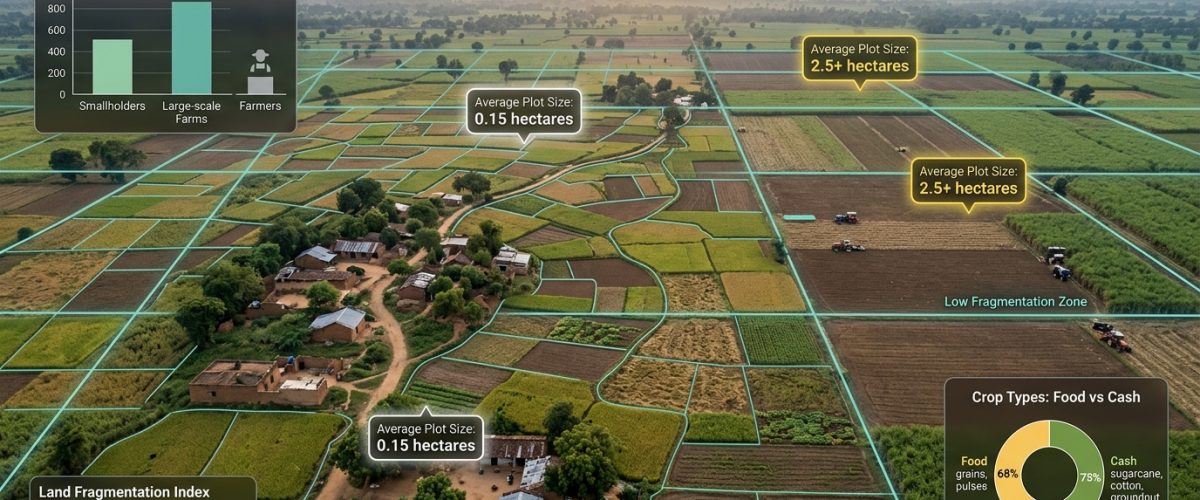
The top 10 per cent of rural Indian households control 44 per cent of all agricultural land, while 46 per cent of rural households remain entirely landless, according to a new study by the World Inequality Lab (WIL) published on 7 April 2026. The research paper, titled Land Inequality in India: Nature, History, and Markets, draws on one of the largest datasets ever assembled on Indian land ownership, covering approximately 650 million people across 270,000 villages.
Key Findings: Extreme Concentration at the Top
The study reveals a steeply concentrated pattern of land ownership in rural India. The top 5 per cent of landholding households own 32 per cent of all land, while the top 1 per cent alone controls 18 per cent. The average village-level land Gini coefficient — a standard measure of inequality where 0 represents perfect equality and 100 represents maximum concentration — reaches 71 when landless households are included in the calculation.
In some villages, a single landowner controls more than 50 per cent of the total agricultural land, highlighting the extreme disparities that persist decades after India’s post-independence land reform efforts.
Why Land Inequality Persists
The WIL paper, produced by researchers at the Paris School of Economics, examines the historical, institutional, and market-driven factors behind India’s rural land concentration. Colonial-era revenue systems, incomplete land reforms in the 1950s and 1960s, and fragmentation through inheritance laws have all shaped the current distribution.
More recently, the paper points to land markets themselves as a driver of concentration. Wealthier households can consolidate holdings through purchases, while smallholders facing crop failures or debt are often compelled to sell. The result is a market mechanism that reinforces, rather than corrects, historical imbalances.
Regional Variations
Land inequality is not uniform across India. States with stronger tenancy protections and more effective land reform implementation — such as Kerala and West Bengal — show lower Gini coefficients. Conversely, states like Bihar, Uttar Pradesh, and parts of central India exhibit higher concentration levels, aligning with broader patterns of economic disparity.
Implications for Policy and Development
The findings carry significant policy implications. Land ownership is closely linked to access to institutional credit, government subsidies, and social status in rural India. Landless households are disproportionately dependent on wage labour and are more vulnerable to economic shocks, including the rising cost of living driven by global energy prices.
The NITI Aayog’s separate report this year on women’s participation in India’s credit market found that women borrowers have grown at a CAGR of 22 per cent since 2019, with 60 per cent of borrowers from semi-urban and rural areas. However, without land as collateral, many rural women face structural barriers to accessing formal credit.
About the World Inequality Lab
The WIL is a research laboratory based primarily at the Paris School of Economics. It maintains the World Inequality Database, a comprehensive resource tracking wealth and income distribution across countries. The India land study is among the lab’s most data-intensive projects, leveraging administrative records and survey data to map landownership at a granular level.
As India debates economic inclusion and opportunity more broadly, the WIL’s research provides a stark empirical baseline against which progress can be measured.

- PV Sindhu Targets 2028 LA Olympics as India Badminton Stars Navigate Testing 2026 Season - April 9, 2026
- World Inequality Lab Study Reveals Top 10 Per Cent of Rural Indian Households Control 44 Per Cent of Agricultural Land - April 9, 2026
- India Hockey Faces FIH Pro League Crisis at Eighth in Standings With Zero Wins as Reforms Urged - April 8, 2026