Sarvam AI Closes $350 Million Round at $1.5 Billion Valuation, Becoming India’s Biggest AI Startup Fundraise of 2026

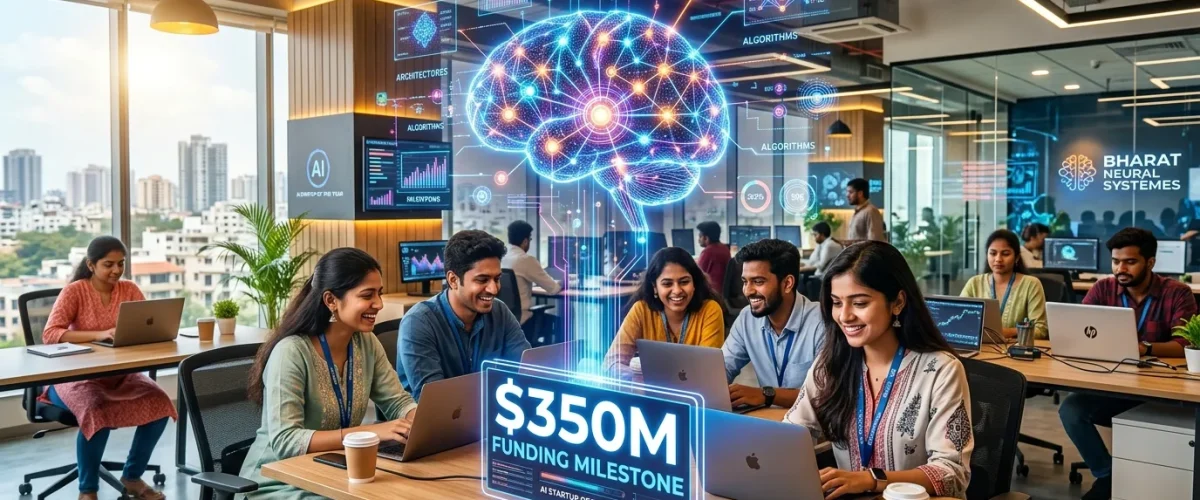
India’s artificial intelligence startup ecosystem just recorded its largest-ever single funding round. Sarvam AI, the Bengaluru-based company building India’s most advanced multilingual large language model, has closed a $350 million round at a $1.5 billion valuation — making it India’s newest unicorn and the most well-funded AI startup in the country’s history. The round, announced on April 17, 2026, was led by Lightspeed Venture Partners and Peak XV Partners (formerly Sequoia Capital India), with participation from Tiger Global, Khosla Ventures, and the India AI Mission Fund (a government-backed investment vehicle).
The funding represents a dramatic validation of India’s “sovereign AI” movement — the idea that India needs its own AI models trained on Indian languages and data, rather than relying on American-built models like ChatGPT and Gemini. For Funding, Sarvam AI’s mega-round is the clearest signal yet that deep-tech investing is back in India, and that AI is the sector commanding the biggest cheques.
What Sarvam AI Has Built
Founded in 2023 by Vivek Raghavan and Pratyush Kumar — both former AI researchers at Microsoft and Google — Sarvam AI has positioned itself at the intersection of advanced AI research and India-specific deployment. The company’s flagship product, Sarvam-1, is a large language model trained natively on 22 Indian languages (all languages listed in the Eighth Schedule of the Constitution), making it the most linguistically comprehensive AI model built for the Indian market.
Unlike OpenAI’s GPT or Google’s Gemini, which are trained primarily on English-language data and then adapted for other languages through translation layers, Sarvam-1 is trained from the ground up on Indian language corpora — including Hindi, Tamil, Telugu, Bengali, Marathi, Gujarati, Kannada, Malayalam, Odia, Punjabi, and Assamese. This approach results in significantly better performance on Indian language tasks, including regional news summarization, government document translation, and conversational AI in dialectal variations. Related: Unacademy-upGrad Merger Signals New Era of Edtech Consolidation i
Where the $350 Million Will Go
Sarvam AI has outlined an ambitious deployment plan for the funding. The largest allocation — approximately $150 million — will go toward GPU infrastructure. The company has signed a multi-year agreement with NVIDIA for H200 and Blackwell-generation GPUs, which will be housed in two new data centres in Hyderabad and Chennai. These facilities will also serve as shared infrastructure for India’s broader sovereign AI ecosystem, including government research projects under the India AI Mission.
Approximately $80 million will fund research and development, including training Sarvam-2 (an expected 10x improvement in parameter count and reasoning capability over Sarvam-1), development of multimodal AI capabilities (voice, image, and video understanding in Indian languages), and safety and alignment research specific to Indian cultural contexts.
The remaining $120 million will fund go-to-market expansion, including enterprise sales teams, government partnerships, and developer ecosystem building. Sarvam AI currently has 450 employees and plans to reach 800 by end of 2026. For the Startups ecosystem, this represents one of the most significant talent magnets in India’s startup history. From Side Hustles to Success: India’s Rising Founders of 2026 Red
Government Backing: The India AI Mission Fund
Perhaps the most notable aspect of Sarvam AI’s round is the participation of the India AI Mission Fund — a ₹2,500 crore ($300 million) government-backed investment vehicle established in the February 2026 Union Budget to support domestic AI companies. The fund’s investment in Sarvam AI (estimated at $25-30 million) marks its first deployment and signals the government’s willingness to put public money behind private AI companies that align with India’s sovereign AI objectives.
The India AI Mission, announced by IT Minister Ashwini Vaishnaw, has three strategic pillars: building Indian AI compute infrastructure (10,000 GPU target by 2027), funding Indian AI research and startups, and deploying AI in government services. Sarvam AI’s Sarvam-1 model is already being used by the government in two high-profile deployments: the DigiLocker platform (where it powers multilingual document assistance for 300 million users) and the Census 2026 digital portal (where it enables self-enumeration in 12 languages).
India’s AI Startup Funding Landscape: How Sarvam Compares
Sarvam AI’s $350 million round is not just the largest AI funding round in India — it’s one of the largest startup funding rounds in any sector in India in 2026. For context, the largest funding rounds of 2026 include Zepto ($500 million, quick commerce), Sarvam AI ($350 million, AI), PhonePe ($250 million, fintech), and Lenskart ($200 million, D2C eyewear).
India’s overall startup funding environment has shown signs of recovery in 2026, though it remains well below the 2021-22 peak. According to data from Tracxn, Indian startups raised approximately $4.2 billion in Q1 2026 — a 28 percent increase over Q1 2025 but still 60 percent below Q1 2022’s $10.5 billion. AI and deeptech startups are commanding an outsized share, accounting for approximately 22 percent of total funding despite representing less than 5 percent of funded startups. As covered in boAt Co-Founder Aman Gupta OFF/BEAT Raises Rs 100 Crore Seed Roun, the dynamics of India’s startup funding are shifting toward technology-intensive, defensible businesses.
What Sarvam AI’s Unicorn Status Means for India’s AI Ambitions
Sarvam AI’s ascent to unicorn status carries significance beyond the company itself. It demonstrates that India can produce globally competitive AI companies — not just AI services firms or system integrators, but companies building foundational AI models that rival Silicon Valley’s best. It validates the sovereign AI thesis — the idea that linguistically and culturally diverse nations need their own AI models, not just localized versions of American ones. It creates a talent magnet that could slow the “AI brain drain” from India to the US, with Sarvam AI offering salaries and equity packages competitive with (though not equal to) Silicon Valley AI labs. And it establishes a template for government-private sector collaboration in strategic technology — the India AI Mission Fund’s participation shows how public capital can de-risk and amplify private AI investment.
With $350 million in fresh capital, government backing, and a clear vision for India-first AI, Sarvam AI is positioned to become the defining technology company of India’s AI era. Whether it can deliver on that promise — building models that truly serve India’s 1.4 billion people across 22 languages — will be one of the most important technology stories of the next decade.

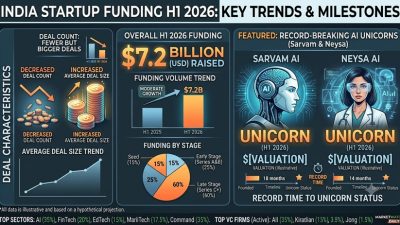
- India’s Startup Funding Crosses $7.2 Billion in H1 2026 - July 1, 2026
- After Ireland Shock, India’s T20I Side Faces Bigger Test - July 1, 2026
- Ireland Stun World Champions India 2-0 in Belfast, Sooryavanshi Debate Rages On - June 29, 2026