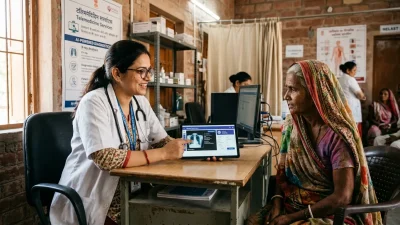
Ayushman Bharat Digital Mission Crosses 834 Million Users: How India Is Building the World’s Largest Health Information Network


India’s Ayushman Bharat Digital Mission is quietly building what may prove to be the most consequential piece of public digital infrastructure since the Aadhaar identity system. With over 834 million citizens now holding ABHA (Ayushman Bharat Health Account) digital health IDs, 438,000 registered health facilities, 738,000 healthcare professionals on the platform, and more than 787 million digital health records linked, ABDM has achieved a scale of health data integration that no other country has attempted, let alone accomplished. As India enters 2026, this infrastructure is transitioning from a registration platform to a transformative engine that is reshaping healthcare delivery, insurance, research, and public health management.
Understanding ABDM: The Architecture of a Digital Health Ecosystem
At its core, ABDM is an interoperability framework that connects every participant in India’s healthcare ecosystem—patients, doctors, hospitals, laboratories, pharmacies, and insurers—through a unified digital layer. The system operates on four pillars: ABHA (unique health ID for every citizen), Health Facility Registry (standardised database of all healthcare facilities), Health Professional Registry (verified credentials for healthcare workers), and Health Information Exchange (protocols for sharing health records with patient consent).
The genius of the system lies in its federated architecture. Unlike centralised health information systems where all data resides in a single government-controlled database, ABDM allows health records to remain with the healthcare facility that generated them. The patient holds the key to sharing their records—granting or revoking access through their ABHA account. This design addresses privacy concerns while ensuring that authorised healthcare providers can access a patient’s complete medical history when needed.
ABDM’s sandbox model has been particularly effective in encouraging private sector integration. Rather than requiring each healthtech company to build expensive, custom integrations with individual hospitals and laboratories, the sandbox provides standardised APIs that allow any digital health application to become ABDM-compatible through a single certification process. A custom integration that would typically cost a healthcare startup at least $2,500 per vendor is replaced by a one-time certification—a dramatic reduction in barriers to entry for health technology innovators.
The Impact on Healthcare Delivery: From Fragmented to Connected Care
For India’s patients, ABDM’s most immediate impact is the creation of longitudinal health records that follow them across healthcare encounters. In a country where patients routinely carry physical folders of medical reports, prescriptions, and test results—often losing critical documents between visits—the ability to access a complete digital health history through a smartphone is transformative.
Consider a practical scenario: a patient visiting a specialist in Mumbai can now share their complete health history—including primary care records from a clinic in Patna, diagnostic reports from a laboratory in Bengaluru, and hospital records from a previous admission in Chennai—with a single consent transaction. The specialist receives a comprehensive view of the patient’s health journey, enabling more informed clinical decisions and reducing the redundant testing that currently wastes an estimated 10-15 per cent of India’s healthcare expenditure.
For chronic disease management—diabetes, hypertension, cardiovascular conditions, and cancer follow-up—the continuity of digital records is particularly valuable. Healthcare providers can monitor treatment adherence, track biomarker trends over time, and adjust treatment protocols based on longitudinal data rather than point-in-time snapshots.
Insurance Transformation: Claims Automation and Fraud Reduction
ABDM is having a significant impact on India’s health insurance ecosystem. The integration of health records with insurance claims processing enables near-real-time claims verification, reducing the processing time from weeks to hours in many cases. For the Ayushman Bharat Pradhan Mantri Jan Arogya Yojana (PM-JAY) scheme—which provides hospitalisation coverage to over 50 crore beneficiaries—ABDM integration has streamlined the claims process and reduced fraudulent claims through automated cross-referencing of patient records, treatment protocols, and billing codes.
Private health insurers are also leveraging ABDM data for more accurate risk assessment and premium pricing, moving from the crude demographic-based pricing models of the past toward more sophisticated, health-data-informed underwriting. This transition has the potential to expand insurance coverage to populations previously considered too high-risk or too expensive to insure, supporting the broader financial inclusion goals reflected in developments like UPI’s transformation of India’s financial services landscape.
Public Health Intelligence: Disease Surveillance at Scale
Perhaps the most strategically significant application of ABDM is in public health surveillance and epidemic preparedness. The aggregated, anonymised health data flowing through the system provides unprecedented insight into disease patterns, emerging health threats, and the effectiveness of public health interventions across India’s diverse geographic and demographic landscape.
During seasonal disease outbreaks—dengue, malaria, respiratory infections—ABDM data can provide near-real-time situational awareness that enables targeted public health responses. The system’s ability to identify unusual clusters of symptoms or diagnoses in specific geographic areas could serve as an early warning system for emerging epidemics, a capability that India lacked during the initial phases of the COVID-19 pandemic.
Healthtech Innovation: The Platform Effect
ABDM has created a platform effect that is catalysing innovation across the healthtech startup ecosystem. With standardised APIs and a growing base of connected health facilities and patients, startups can build applications that leverage the digital health infrastructure without the prohibitive costs of building bilateral integrations from scratch.
Companies are building ABDM-integrated solutions for clinical decision support, pharmacy management, tele-radiology, home healthcare coordination, and wellness monitoring. The standardisation reduces technical barriers to entry, allowing startups to focus their resources on clinical innovation and user experience rather than infrastructure plumbing.
The venture capital community has taken note. According to Bain & Company, healthtech startups building on ABDM infrastructure are attracting premium valuations due to their lower customer acquisition costs and built-in interoperability advantages. This investment interest is part of the broader revival in Indian startup funding, as documented in our analysis of the resurgent funding environment in March 2026.
International Recognition and Export Potential
The World Economic Forum has identified India’s ABDM as a global model for digital health infrastructure, noting that its interoperable, consent-based design could be replicated by countries seeking to digitise their own healthcare systems. Several nations in Southeast Asia and Africa have expressed interest in studying ABDM’s architecture for their own digital health initiatives.
This international interest creates export opportunities for Indian healthtech companies that have built ABDM-compatible solutions. A telemedicine platform or diagnostic AI tool that works seamlessly with ABDM can be adapted for similar digital health ecosystems in other countries, creating a pathway for Indian healthtech to become a global industry in the same way that Indian IT services became globally competitive.
Challenges: Privacy, Adoption, and the Digital Divide
ABDM’s ambitions face significant challenges. Health data privacy remains a paramount concern—the sensitivity of medical records demands robust security frameworks, clear consent mechanisms, and strong penalties for data misuse. India’s Digital Personal Data Protection Act provides a legal foundation, but its enforcement mechanisms are still being developed.
Adoption among healthcare providers remains uneven. Urban multi-specialty hospitals and diagnostic chains have largely integrated with ABDM, but smaller clinics, single-doctor practices, and government primary health centres—which collectively serve the majority of India’s population—face barriers including limited internet connectivity, inadequate IT infrastructure, and staff training gaps.
The digital divide presents the most fundamental challenge. For ABDM to achieve its full potential, the 400+ million Indians who lack regular smartphone access need alternative pathways to participate in the digital health ecosystem. Solutions including feature phone-based access, assisted digital services at health facilities, and community health worker-mediated digital interactions are being developed but require significant scale-up to achieve universal coverage.
Despite these challenges, ABDM represents one of the most ambitious public health infrastructure projects in global history. Its success or failure will not only determine the future of healthcare in India but will also influence how other nations approach the digitisation of their own health systems in an increasingly connected world. The system’s development is emblematic of India’s broader digital infrastructure ambitions, which are powering transformation across sectors from economic growth to technology innovation.