India First AI Combat Aircraft Kaal Bhairava to Be Manufactured in Portugal in Historic International Defence Manufacturing Deal

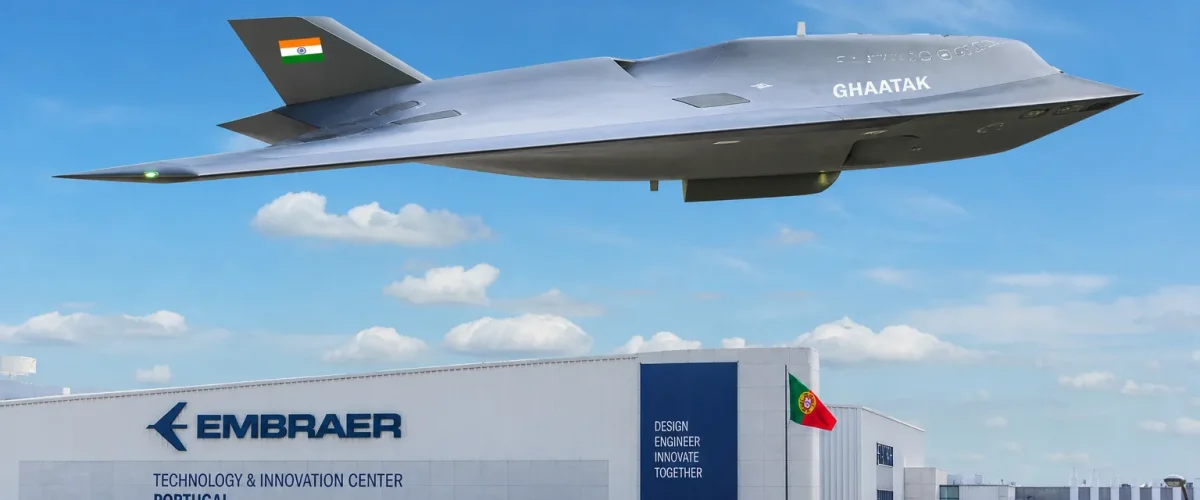
In a landmark moment for India’s defence industry, Indian AI warfare company Flying Wedge Defence & Aerospace (FWDA) has announced that its flagship autonomous combat aircraft, the Kaal Bhairava, will be manufactured in Portugal in partnership with European defence technology firm SKETCHPIXEL. The agreement marks the first time an Indian-designed and developed defence product will be manufactured on European soil — a powerful symbol of India’s growing capabilities in cutting-edge military technology and its emergence as a credible defence exporter.
What Is the Kaal Bhairava?
The Kaal Bhairava is a medium-altitude long-endurance (MALE) autonomous combat aircraft designed and developed entirely in India by FWDA. Named after the fierce manifestation of Lord Shiva in Hindu mythology, the unmanned aircraft boasts impressive specifications: a range of over 3,000 kilometres, endurance of more than 30 hours, and the ability to operate autonomously using advanced artificial intelligence systems for navigation, target identification, and mission planning.
Unlike traditional drones that require constant human control via satellite links, the Kaal Bhairava is designed to operate with a high degree of autonomy, making decisions in real-time based on AI algorithms. This makes it particularly valuable in contested electromagnetic environments where satellite communications may be jammed or disrupted — a scenario that has become increasingly relevant given modern electronic warfare capabilities.
The aircraft is designed for a range of missions including intelligence, surveillance, and reconnaissance (ISR), electronic warfare, strike operations, and maritime patrol. FWDA claims the Kaal Bhairava can carry a payload of up to 300 kilograms and is compatible with a variety of precision-guided munitions and electronic warfare pods.
The Portugal Manufacturing Partnership
Under the agreement announced on Thursday, SKETCHPIXEL — a Portuguese company known for building advanced fighter jet simulation systems for aircraft such as the F-16 — will contribute simulation technologies, AI integration, communications systems, and interoperability capabilities for the Kaal Bhairava platform. FWDA will retain full intellectual property rights to the core autonomous systems and airframe design.
The new communication systems, live-virtual-constructive (LVC) interoperability modules, and AI components will be developed jointly at SKETCHPIXEL’s laboratories in Portugal and FWDA’s facilities in India. The partnership involves a regular exchange of engineering teams and knowledge between the two countries.
“We will start with the FWDA Kaal Bhairava project for Portugal and NATO countries,” said a SKETCHPIXEL spokesperson, indicating that the Portuguese-manufactured variant will be marketed to NATO member states and allied nations. This is significant because it means Indian defence technology could potentially enter the arsenals of Western military alliances for the first time.
Significance for India’s Defence Industry
India has been aggressively pursuing its “Make in India” vision for the defence sector, with annual defence exports growing from approximately $600 million in 2019 to over $3 billion in 2025-26. However, the vast majority of Indian defence exports have been to developing countries in Asia, Africa, and the Middle East. The Kaal Bhairava deal with Portugal represents a qualitative leap — the entry of Indian defence technology into the European market.
“This is not just a manufacturing deal — it is a validation of India’s capabilities in advanced artificial intelligence and autonomous systems at the highest level,” said Air Marshal (Retd) Anil Chopra, Director General of the Centre for Air Power Studies in New Delhi. “For a NATO-aligned country to choose an Indian platform over established Western alternatives is a remarkable vote of confidence.”
The deal also aligns with India’s broader strategy of building defence technology partnerships with European nations. Prime Minister Modi’s recent visit to the Netherlands focused heavily on semiconductor and defence cooperation, and India has signed defence industrial cooperation agreements with France, Germany, Italy, and the UK in recent years.
The Global Race for Autonomous Combat Aircraft
The Kaal Bhairava enters a rapidly growing global market for autonomous combat aircraft, often referred to as “loyal wingman” drones. Several countries are developing similar platforms, including the US (the XQ-58A Valkyrie by Kratos), Australia (the MQ-28 Ghost Bat by Boeing Australia), the UK (the Mosquito by Spirit AeroSystems), and Turkey (the Bayraktar Kizilelma by Baykar Technologies).
What sets the Kaal Bhairava apart, according to FWDA, is its fully indigenous AI architecture, which has been designed from the ground up for autonomous operations rather than being adapted from existing manned aircraft systems. The AI system uses a combination of deep learning, reinforcement learning, and rule-based decision-making to handle complex combat scenarios without human intervention.
India’s own military is also a potential customer. The Indian Air Force has expressed interest in acquiring autonomous combat aircraft to complement its manned fighter fleet, and FWDA has been in discussions with the Defence Research and Development Organisation (DRDO) about integrating the Kaal Bhairava into India’s broader defence ecosystem. The Indian Navy is also reportedly evaluating the maritime patrol variant of the aircraft for operations in the Indian Ocean Region.
FWDA: The Company Behind Kaal Bhairava
Flying Wedge Defence & Aerospace is a Bengaluru-based defence startup founded in 2020 by a team of aerospace engineers and AI researchers. The company has raised over Rs 200 crore in venture capital funding and has been operating under the Indian government’s Innovation for Defence Excellence (iDEX) programme, which supports defence startups through grants, mentorship, and access to military testing facilities.
FWDA’s founding team includes veterans of India’s leading aerospace organisations including Hindustan Aeronautics Limited (HAL) and the National Aerospace Laboratories (NAL). The company’s rapid progress in developing a fully autonomous combat aircraft in just six years is a testament to the growing capabilities of India’s private defence startup ecosystem.
What This Means for India-NATO Relations
The manufacturing partnership in Portugal could open the door to deeper defence technology cooperation between India and NATO. While India is not a NATO member and has traditionally maintained a non-aligned foreign policy, the country has been gradually deepening its strategic partnerships with Western nations, particularly in the context of shared concerns about China’s military expansion in the Indo-Pacific region.
India’s defence cooperation with Russia, including the purchase of the S-400 missile system, has been a point of friction with the US and its allies. However, the Kaal Bhairava deal signals that India is capable of developing indigenous technologies that are attractive to Western partners, potentially reducing its dependence on Russian military hardware over time.
As autonomous combat aircraft become an increasingly critical component of modern military forces, the Kaal Bhairava’s entry into the European market through Portugal could mark the beginning of a new chapter in India’s journey from a major defence importer to a significant defence technology exporter on the global stage.