India Launches Cell Broadcast Emergency Alert System on May 2: Phones Beep Across the Country as DoT and NDMA Test Indigenous Disaster Warning Technology

Millions of Phones Buzz as India Tests Indigenous Cell Broadcast Alert System
Millions of mobile phones across India buzzed simultaneously on Saturday, 2 May 2026, as the Department of Telecommunications (DoT) and the National Disaster Management Authority (NDMA) conducted a nationwide test of the country’s indigenous Cell Broadcast emergency alert system. Union Home Minister Amit Shah, along with Union Minister of Communications Jyotiraditya Scindia, formally launched the mobile-based disaster communication system in New Delhi, marking a significant leap in India’s disaster preparedness infrastructure.
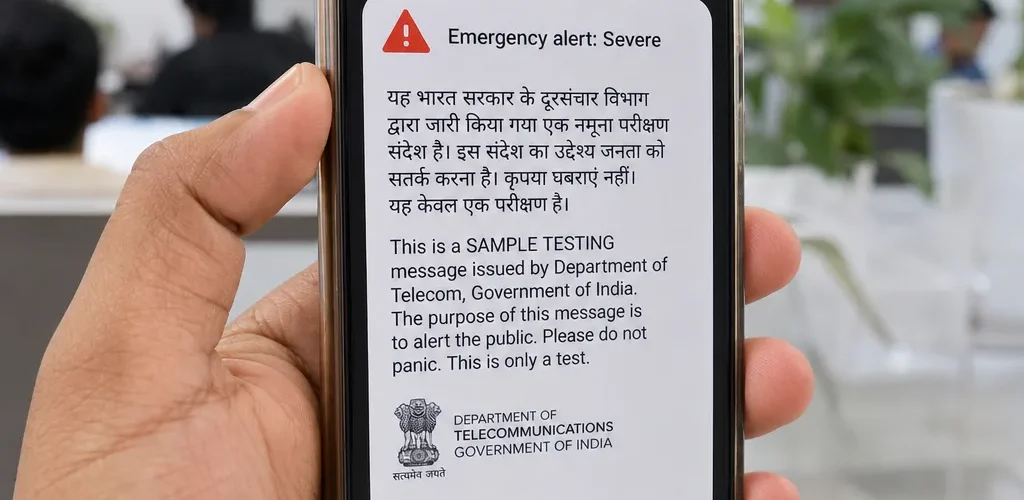
The test messages were received on mobile handsets in all capital cities of India, along with the Delhi and National Capital Region. Users reported pop-up notifications appearing on their screens with a distinctive alert tone, accompanied by a message in English, Hindi, and regional languages reading: “India launches Cell Broadcast using indigenous technology, for instant disaster alerting service for its citizens. Alert citizens, safe nation. No action is required by the public upon receipt of this message. This is a test message.”
What Is the Cell Broadcast System and How Does It Work
The Cell Broadcast system is a technology that transmits emergency alerts to all mobile devices within a defined geographic area simultaneously, ensuring near real-time delivery. Unlike traditional SMS-based alerts, which are sent individually to each phone number and can experience delays during network congestion, Cell Broadcast messages are pushed to every compatible device within a cell tower’s range at the same time. This makes the technology particularly effective during time-critical emergencies such as tsunamis, earthquakes, lightning strikes, and man-made disasters like gas leaks or chemical hazards.
The system has been developed indigenously by the Centre for Development of Telematics (C-DOT), the premier research and development centre of the Department of Telecommunications. It is based on the Common Alerting Protocol (CAP), as recommended by the International Telecommunication Union (ITU), a United Nations body that sets global standards for information and communication technologies.
As part of India’s broader push for technology-driven governance, the Cell Broadcast system represents a major upgrade over the existing SMS-based Integrated Alert System known as SACHET, which was already operational across all 36 states and union territories. SACHET has enabled the dissemination of over 134 billion SMS alerts in more than 19 Indian languages during natural disasters, weather warnings, and cyclonic events.
Why India Needed an Upgrade Beyond SMS Alerts
While SACHET proved effective in many scenarios, its reliance on SMS technology posed limitations during mass emergencies. During events like the Bargi Dam boat tragedy in Jabalpur on 30 April 2026, where a sudden storm capsized a cruise boat killing nine people, the ability to send instant geo-targeted warnings to all devices in a specific area could have provided critical advance notice to passengers and operators.
Cell Broadcast technology addresses these gaps. The key advantages include the ability to reach all devices simultaneously without network congestion, geo-targeting capabilities that allow alerts to be sent only to affected areas, delivery even when voice and data networks are overloaded, and compatibility with most modern smartphones without requiring any app installation or subscription.
The Indian Meteorological Department (IMD) issues thousands of weather warnings annually, and integrating these with Cell Broadcast allows for real-time, location-specific alerts. According to government officials, the system will be especially valuable in disaster-prone regions across India’s coastline, flood plains, and earthquake zones.
Scale of the Test and Technology Behind It
Saturday’s nationwide test was the largest deployment of Cell Broadcast technology in India to date. The DoT had issued an advisory on Wednesday, 29 April, informing citizens that they might receive test messages and advising them that no action was required. Despite the advance notice, social media platforms were flooded with screenshots and reactions from users who were surprised by the sudden alert on their phones.
The Cell Broadcast system operates independently of the subscriber’s data or messaging plan. When a disaster management authority triggers an alert, the message is broadcast by all cell towers within the designated area. Each tower sends the alert once, and every compatible device within range receives it within seconds. The system supports multi-language delivery, which is critical for India’s linguistically diverse population.
C-DOT engineers have been working on the system since 2024, drawing on lessons from similar systems deployed internationally, including the Wireless Emergency Alerts (WEA) system in the United States, the EU-Alert system in Europe, and Japan’s J-Alert system. India’s implementation, however, is entirely indigenous, with all software and integration developed domestically, making it one of the few countries to build such a system without relying on foreign technology providers.
How the System Will Be Used in Real Emergencies
Government officials outlined several use cases for the Cell Broadcast system going forward. Tsunami warnings from the Indian National Centre for Ocean Information Services (INCOIS) in Hyderabad can be transmitted to coastal populations within seconds of detection. Earthquake alerts, particularly for the seismically active zones in the Himalayan belt and northeast India, can provide critical seconds of warning. Cyclone landfall alerts can be geo-targeted to specific coastal districts.
The system will also support alerts for industrial accidents, chemical spills, and other man-made emergencies. In urban areas, it could be used to alert residents about flooding, gas leaks, or building collapses. The government is also exploring integration with the artificial intelligence-based prediction models that are being developed for weather and disaster forecasting.
Integration With Existing Disaster Infrastructure
The Cell Broadcast system will work alongside India’s existing disaster warning infrastructure, including the SACHET SMS platform, All India Radio broadcast warnings, television crawlers through Doordarshan, siren systems in coastal areas, and the Indian Ocean Tsunami Warning System. The National Disaster Management Authority plans to conduct regular drills and tests across different states to ensure the system functions reliably when needed. State disaster management authorities across all 36 states and union territories have been trained on using the system to issue alerts within their jurisdictions.
Public Reaction and What Comes Next
Reactions on social media ranged from appreciation for the government’s disaster preparedness efforts to humorous posts about the unexpected phone buzzing. Several technology experts praised the indigenous development, noting that India now joins a select group of nations with comprehensive cell broadcast emergency alerting capability. The launch also coincided with growing awareness about India’s push for self-reliance in critical technology sectors.
Looking ahead, the DoT plans to expand the system to cover rural areas more comprehensively and to integrate it with the upcoming 5G network infrastructure, which will allow for even more precise geo-targeting. The government has also announced that regular public awareness campaigns will be conducted to educate citizens about what Cell Broadcast alerts look like and how to respond to them during actual emergencies.
The May 2 test represents a foundational step in building a more resilient India, where technology serves as the first line of defence against natural and man-made disasters.

- India’s Startup Funding Crosses $7.2 Billion in H1 2026 - July 1, 2026
- After Ireland Shock, India’s T20I Side Faces Bigger Test - July 1, 2026
- Ireland Stun World Champions India 2-0 in Belfast, Sooryavanshi Debate Rages On - June 29, 2026